
| Download the amazing global Makindo app: ✅ Means NICE/National Guidelines 2026 compliant Android | Apple | |
|---|---|
| MEDICAL DISCLAIMER: Educational use only. Not for diagnosis or management. See below for full disclaimer. |
Drug induced Lupus Erythematosus
Related Subjects: |Systemic Lupus Erythematosus (SLE) |Drug induced Lupus Erythematosus |Discoid lupus erythematosus (DLE) |Neonatal Lupus Erythematosus |Raynaud's Phenomenon |Polymyositis |Dermatomyositis |Polyarteritis nodosa |Rheumatoid Arthritis |Systemic Sclerosis (Scleroderma) |Rheumatology Autoantibodies |Overlap Syndrome |Inclusion Body Myositis |Inflammatory Myopathies |Psoriatic Arthritis |Adult Onset Still's Disease |Alkaptonuria |Behcet's Syndrome
💊 Drug-induced lupus erythematosus (DILE) is an autoimmune condition caused by a reaction to certain medications. ⚠️ It tends to be more benign than idiopathic SLE, with rare renal, skin, or neurological involvement.
🧬 About
- Resembles systemic lupus erythematosus but usually milder.
- Key distinction: renal, neurological, and cutaneous involvement is uncommon.
- Improves after withdrawal of the offending drug.
⚖️ Risk Factors
- Older age group compared with classic lupus.
- Pharmacogenetics: slow acetylator status.
- Genetic predisposition: HLA DR4, DR2, DR3, DR0301, DQB1, B8, C4 null allele.
💊 Common Culprit Drugs
- High yield: Isoniazid, Procainamide, Hydralazine, Penicillamine, Phenytoin.
- Biologics: TNF-α inhibitors (etanercept, infliximab, adalimumab).
- Other causes: Minocycline, Quinidine, Methyldopa, Chlorpromazine, Sulfasalazine, Capoten (captopril).
- Levamisole-adulterated cocaine – increasingly recognised cause.
🩺 Clinical Features
- Onset: usually after 3–6 months of therapy (sometimes up to 10 years).
- Systemic: fever, malaise, weight loss.
- MSK: polyarthritis or migratory arthralgia (often symmetrical).
- Serositis: pleuritis or pericarditis.
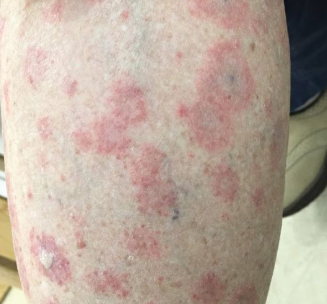
- Skin: annular or papulosquamous lesions on sun-exposed areas (less severe than idiopathic SLE).
🔬 Investigations
- FBC & U&E: usually normal.
- Complement (C3/C4): usually normal (contrast with SLE where low).
- ANA: positive in ~90% (homogeneous pattern).
- Anti-dsDNA: typically negative.
- Anti-histone antibodies: positive in >95% of DILE cases – hallmark test.
- ESR: may be raised.
🛠️ Management
- 🚫 Stop the causative drug – symptoms usually resolve within weeks to months.
- NSAIDs or low-dose steroids for symptomatic relief in persistent arthritis/serositis.
📊 Exam Tip – DILE vs SLE
| Feature | Drug-Induced Lupus | Systemic Lupus (SLE) |
|---|---|---|
| Age | Older | Younger (esp. women of childbearing age) |
| Time course | Months–years after exposure | Chronic/relapsing |
| Renal/CNS involvement | Rare | Common |
| ANA | Positive, homogeneous | Positive, mixed patterns |
| Anti-dsDNA | Negative | Positive (specific) |
| Anti-histone | Positive in >95% | Positive in 50–70% |
| Management | Stop drug → resolution | Immunosuppression needed |
📚 References
Cases - Drug-Induced Lupus Erythematosus (DILE)
- Case 1 - Hydralazine-related 💊: A 54-year-old man on long-term hydralazine for resistant hypertension develops fatigue, arthralgia, low-grade fever, and a photosensitive rash. Bloods: ANA positive, anti-histone antibody positive, normal complement levels. Diagnosis: drug-induced lupus from hydralazine. Symptoms improve on drug withdrawal.
- Case 2 - Procainamide-associated ❤️: A 61-year-old woman treated with procainamide for atrial fibrillation presents with pleuritic chest pain and arthralgia. Exam: small pleural effusion. Autoantibodies: anti-histone strongly positive, dsDNA negative. Diagnosis: drug-induced lupus from procainamide. Managed with discontinuation and NSAIDs.
- Case 3 - Anti-TNF induced 🌐: A 45-year-old man with rheumatoid arthritis on infliximab reports photosensitive rash, oral ulcers, and joint pains. ANA and anti-dsDNA are positive, but disease resolves after stopping the drug. Diagnosis: anti-TNF–induced lupus-like syndrome. Managed with drug cessation and short steroid course.
Teaching Point 🩺: DILE resembles SLE but usually spares the kidneys and CNS. Hallmarks are exposure to culprit drugs (hydralazine, procainamide, isoniazid, minocycline, anti-TNF agents), positive ANA/anti-histone antibodies, and resolution after withdrawal.
| The content on this website is provided for educational and informational purposes only to support exam preparation (e.g., MLA, MRCP, USMLE) and learning. This is NOT medical advice, diagnosis, treatment, or professional guidance. It does not replace consultation with a qualified healthcare professional, official guidelines (e.g., NICE, GMC, BNF), or supervised clinical practice. Always verify information with current, authoritative sources. Makindo and its contributors accept no liability for any reliance on this content, including errors, omissions, or any resulting harm, loss, or consequences. By using this site, you agree to these terms. |
|
|
Categories
- About
- Acute Medicine
- Anaesthetics and Critical Care
- Anatomy
- Anatomy and Physiology
- Biochemistry
- Book
- Cardiology
- Collections
- CompSci
- Crib Sheets
- Critical care
- Dental
- Dermatology
- Differentials
- Drugs
- ENT
- Electrocardiogram
- Embryology
- Emergency Medicine
- Endocrinology
- Ethics
- Foundation Doctors
- GCSE
- Gastroenterology
- General Practice
- Genetics
- Geriatric Medicine
- Geriatrics
- Guidelines
- Haematology
- Hepatology
- Immunology
- Infectious Diseases
- Infographic
- Investigations
- Lists
- MRCP
- Mandatory Training
- Medical Students
- Microbiology
- Nephrology
- Neurology
- Neurosurgery
- Nutrition
- OSCE
- Obstetrics Gynaecology
- Oncology
- Ophthalmology
- Oral Medicine and Dentistry
- Orthopaedics
- Paediatrics
- Palliative
- Palliative Care
- Pathology
- Pharmacology
- Physiology
- Procedures
- Psychiatry
- Public Health
- Radiology
- Respiratory
- Resuscitation
- Revision Topics
- Rheumatology
- Statistics and Research
- Stroke
- Surgery
- Toxicology
- Trauma and Orthopaedics
- USMLE
- Urology
- Vascular Surgery