
| Download the amazing global Makindo app: ✅ Means NICE/National Guidelines 2026 compliant Android | Apple | |
|---|---|
| MEDICAL DISCLAIMER: Educational use only. Not for diagnosis or management. See below for full disclaimer. |
Rehabilitation in a Nutshell of older patients
✅ Rehabilitation is not simply “more physiotherapy”. It is the structured attempt to regain lost function after a pathological process, using the patient’s own healing and repair mechanisms, supported by the whole multidisciplinary team.
🧠 Background
I have been doing rehabilitation selection since 1997, starting as a registrar. I still remember getting my first assessment wrong, and that experience made me determined to get better at judging who is likely to benefit from rehabilitation - and who is not.
Many years working in UK stroke and frailty rehabilitation have taught me that many of these decisions are not straightforward in frailty. In stroke we aim to rehab everyone who is not dying. It is different in the very old and frail🚶♂️👵👴
Rehabilitation decisions are best made within the MDT - doctors, nurses, physiotherapists, occupational therapists, speech and language therapists, discharge teams, patients and families. Even then, we can still get it wrong. ✅
The skill to learn is to do a little though experiment on imagining the best life the patient can have after hospital
🗣️ Useful Vocabulary
🔁 Transfers
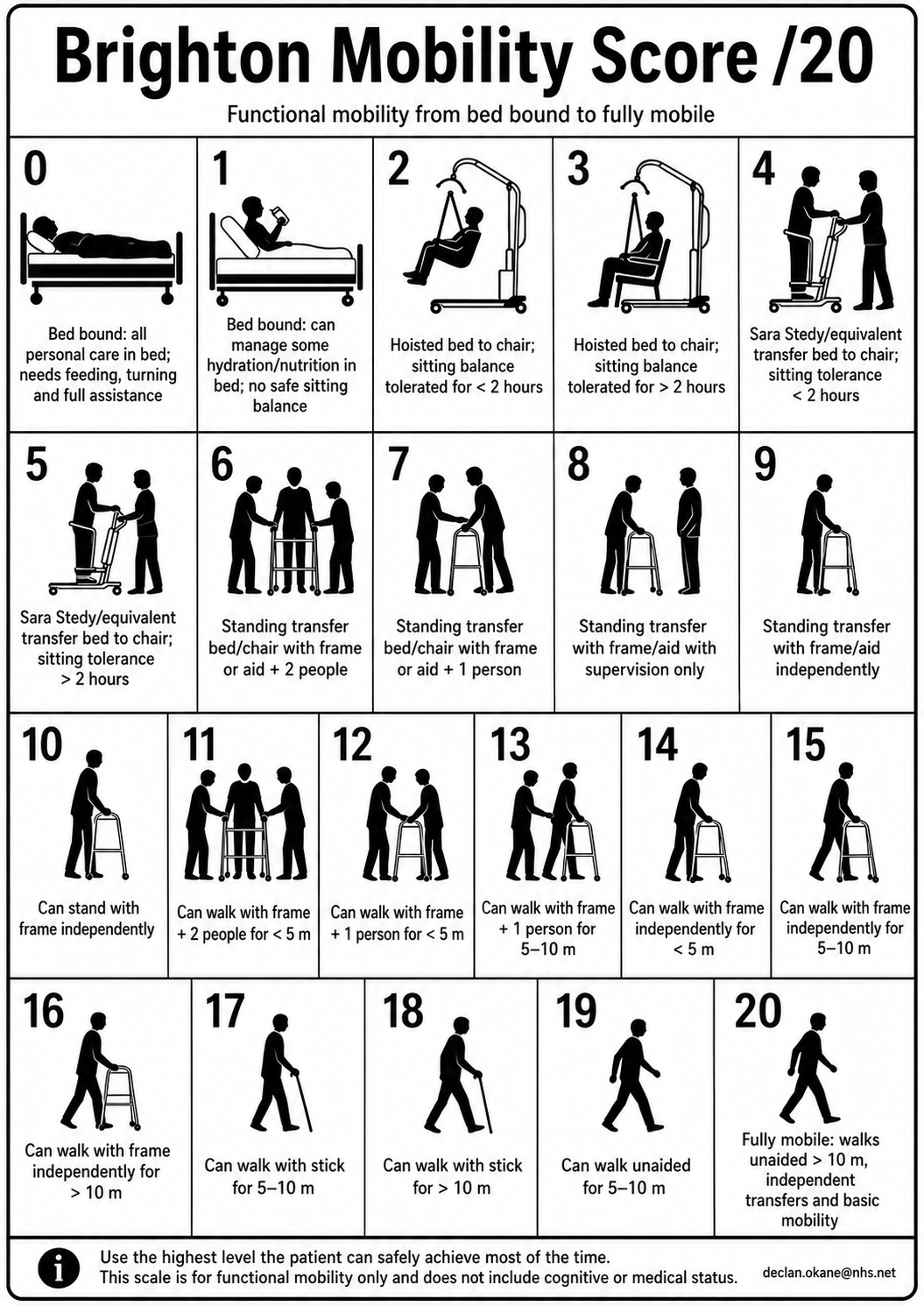
“How many transfers have you done today?” Life is about transfers. Lifting and moving our body weight safely and efficiently. How will our patients do it ? The ability to stand and walk and sit dictates our lives
- 🛏️ Got out of bed
- 🚽 Sat on toilet
- 🚶 Walked to kitchen and sat and ate breakfast
- 🚶♂️ Walk to bus stop and sat on bus...
- 🚶♂️ Got off bus and into hospital and lift to Level 8...
Patient Examples include:
- 🛏️ Bed to chair with 2/1 or sara stedy or frame or Independent
- 🚽 Chair to commode with 2/1 or sara stedy or frame or Independent
- 🚶 Sit to stand with 2 or 1 or independent
- 🚶♂️ Walk with 2 or 1 or independent
🧰 Common Equipment
- Hoists
- Sara Stedy
- Frames
- Sticks
- Banana boards
- Splints
- Chairs
- Toileting equipment
🧼 Activities of Daily Living - ADLs
These are the practical things that determine whether someone can live safely:
- Washing
- Dressing
- Toileting
- Feeding
- Transferring
- Mobilising
- Managing stairs
- Managing at home
For us: we take for granted
📝 What is Rehabilitation?
Rehabilitation is primarily about regaining lost function caused by a pathological process through structured activity.
Lost function may follow:
- 🦴 Falls and fractures - arms, hips, legs, necks
- 🧠 Stroke or neurological disease
- 🦠 Infection
- 🔥 Inflammation
- 😵💫 Delirium
- 🛏️ Deconditioning or lack of use ? why
The losses may include:
- 💪 Weakness of one or more limbs
- ⚖️ Loss of balance
- 🗣️ Speech impairment
- 🧠 Language impairment
- 🍽️ Swallowing problems
- 🚽 Bowel and bladder dysfunction
- 👁️ Visual problems
- 🦶 Neuropathy
- 🛏️ Deconditioning
Deconditioning may be physiological, but it is not quite the same as a clearly rehab-able pathological process.
✅ What Does Someone Need for Rehabilitation?
They need a rehab-able pathology.
Can anyone give examples?
- 🧠 Stroke
- 🦴 Fractures
- 🦠 Infection
- 🔥 Acute inflammation
- 😵💫 Delirium
- 🦵 Musculoskeletal injury
A useful way to think about this is to remember the healing and repair chapter in pathology. The body has highly evolved repair mechanisms: osteoblasts knit bone, white cells clear infection, glial cells clear oedema and blood products, wounds close, inflammation settles, and damaged tissue remodels. Without these processes, bones remain broken, pus stays in alveoli, cerebral haemorrhages do not resolve, wounds remain open, and bleeding continues. Rehabilitation aims to extract every possible functional gain from these biological repair processes.
🔬 Mechanisms of Recovery
| Pathology | Biological repair process | Rehabilitation role |
|---|---|---|
| 🦴 Fractured bone | Osteoblasts knit and repair bone | Maintain safe mobility, prevent stiffness, protect alignment |
| 🦵 Musculoskeletal injury | Scar tissue and connective tissue remodelling | Restore range, strength and confidence |
| 🧠 Ischaemic stroke | Penumbra reperfuses, oedema settles, neuroplasticity begins | Encourage safe movement, positioning and task practice |
| 🧠 Haemorrhagic stroke | Glia clear haematoma and oedema | Support recovery as mass effect and inflammation improve |
| 🦠 Infection | White blood cells clear pus from alveoli, urine, blood and tissue | Prevent bed rest complications and rebuild strength |
| 🔥 Inflammation | Inflammatory process settles | Restore movement once pain and swelling improve |
| 😵💫 Delirium | Trigger treated, brain function gradually improves | Re-orientate, mobilise, restore routine and function |
Roughly 70–90% of biological repair often occurs within the first 6 weeks, although smaller gains may continue for months, especially after neurological injury.
❌ What Is Not Usually a Rehab-able Pathology?
Some processes are progressive, degenerative or terminal, and may not produce meaningful functional gains despite intensive rehabilitation.
Examples include:
- 🧠 Worsening dementia: stepwise or gradual
- 🧠 Moderate to severe Parkinson’s disease
- 🧓 Frail older adults in the last few months of life, especially with multiple admissions
- 🧬 Neurodegeneration, such as chronic progressive MS or MND
- 🎗️ Advanced cancer, for example glioblastoma
- ❤️ Severe heart failure, lung failure, renal failure or persistent hypoxia
This is not pessimism. It is pragmatism. Rehabilitation has a cost - to the patient, the family, the MDT and the system.
⚖️ But Context Matters
A diagnosis alone should not automatically exclude rehabilitation.
These patients may still benefit:
- ✅ Mild dementia + pseudogout of the knee + loss of mobility + keen to engage
- ✅ Moderate Parkinson’s disease + CAP + acute loss of mobility
- ✅ Independent 90-year-old + delirium due to UTI + new mobility loss
- ✅ Mobile 90-year-old + fractured neck of femur
🧭 The key question is: “Is there a reversible or improving pathology that rehabilitation can build upon?”
⏰ When Should Rehabilitation Start?
Rehabilitation should happen during the healing window.
There is a ticking clock from the moment of injury or illness. Rehabilitation often needs to start early to be beneficial - not always when the patient is officially medically ready for discharge.
In stroke, rehabilitation starts on Day 1. 🧠🚶
Small improvements may continue up to 1 year and sometimes beyond, but the early window is crucial. If we are unsure, we can set short-term goals and review progress.
🏋️ Who Does the Rehabilitation?
The main person doing rehabilitation is the patient.
Therefore, the patient needs to:
- ✅ Agree to rehabilitation
- ✅ Be engaged and active
- ✅ Have some physical reserve
- ✅ Be involved in goal-setting
- ✅ Practise regularly
Do not send patients to rehabilitation who do not want to engage daily, get up daily and participate actively in therapy.
Always screen for depression and treat reversible causes of poor engagement, such as pain, postural hypotension, low mood, infection, anaemia, constipation or medication burden.
Discuss uncertainty at the MDT.
👩⚕️ Nursing Staff
Nursing staff are central to rehabilitation.
Sitting someone out in a chair is rehabilitation because it:
- 🪑 Activates sitting muscles
- 🫁 Reduces atelectasis
- 🧠 Improves alertness
- 🍽️ Helps eating and drinking
- 🚽 Supports toileting routines
- 🛏️ Reduces harms of bed rest
🦵 Therapists
Patients do the therapy that therapists prescribe: compliance is key.
Therapists assess, guide and prescribe rehabilitation.
They may decide when it is safe for other staff to:
- Hoist
- Use a Sara Stedy
- Walk with the patient
- Transfer the patient
- Practise specific exercises
I see therapists a bit like ski instructors or piano teachers. They show you what to do, but the patient still needs to practise - with staff support if needed and safe. Repetition is the key to being able to do most tasks well.
Early on, especially after stroke, therapists are often very hands-on because expert moving, handling and positioning are key to safety in patients with a dense hemiparesis.
📍 Where Does Rehabilitation Occur?
Rehabilitation can happen in many places:
- 🏥 In hospital
- 🛏️ At the bedside
- 🚶 In corridors
- 🪜 On stairs
- 🏋️ In therapy gyms
- 🏠 At home
- 🏢 In day centres
- 🛌 In rehabilitation beds
- 🏋️♂️ Sometimes in a local gym
There used to be hospital rehabilitation swimming pools! 🏊♂️ But we are not rehabilitating Aquaman. What people could do in water was not always extrapolatable to real life, and pools were expensive and time consuming.
👥 Roles of Therapists
🦵 Physiotherapists
Physiotherapists best understand:
- Form
- Movement
- Mobility
- Balance
- Limb function
- Safe transfers
- Gait and walking aids
They may use:
- Frames
- Sticks
- Sara Stedy
- Hoists
- Banana boards
- Splints
- Strength and balance exercises
🧺 Occupational Therapists
Occupational therapists focus on translating movement and function into real life.
They assess:
- Washing
- Dressing
- Feeding
- Toileting
- Kitchen tasks
- Home setup
- Equipment needs
- Cognitive and functional safety
🧺 In simple terms: physiotherapists help you move; occupational therapists help you live. Both help patients hit their own personal, individualised goals.
🗣️ Speech and Language Therapists
Speech and language therapists focus on:
- Speech
- Language
- Swallowing
- Communication
- Safe eating and drinking
- Aphasia and dysarthria support
🙌 Therapy Assistants
Therapy assistants can help continue a therapy programme once it has been assessed and prescribed.
They are incredibly valuable because rehabilitation requires repetition.
⏳ How Long Do We Continue Therapy For?
For as long as it is working and achieving results.
That is the key principle.
📈 How Do We Know Rehabilitation Is Working?
We set short-term and long-term rehabilitation goals.
Use SMART goals:
- Specific
- Measurable
- Achievable
- Relevant
- Time-bound
- Patient-centred
Examples:
- “Sit to stand with 2 people by 12/5/26.”
- “Walk independently by 1/6/26.”
- “Walk to the pub by 1/7/26.” 🍺🚶♂️
Progress should be tracked closely. If goals are missed, ask why. Is it pain? Fear? Delirium? Infection? Anaemia? Postural hypotension? Poor footwear? Cognition? Low mood? Unrealistic goals?
The MDT discussion is key. If the patient is repeatedly failing to hit goals and there is no improvement, we need to reconsider the plan.
🛠️ How Do We Hit the Goals?
There are two broad ways.
1️⃣ We Change the Patient with Rehabilitation
We improve:
- Strength
- Balance
- Confidence
- Endurance
- Coordination
- Transfers
- Walking
- Activities of daily living
2️⃣ We Change the World Around the Patient
We adapt the environment.
Examples:
- Cannot walk to the pub? Get an electric scooter. 🛵
- Cannot manage stairs? Arrange downstairs living.
- Cannot wash safely? Provide equipment or carers.
- Cannot live exactly as before? Create a safe microenvironment at home. 🏠
Good rehabilitation is not just about making the patient “normal” again. It is about making life work.
👵 Issues in Older Patients
Loss of function is part of ageing. It takes us 18 months to learn to walk, and in our 90s we may start to unlearn it.
Older frail patients may be:
- Tired
- Sarcopenic
- Cognitively impaired
- Frightened of falling
- Malnourished
- Anaemic
- Depressed
- Close to the end of life
Rehabilitation can exhaust them. In some cases, pushing harder may hasten decline rather than restore independence.
Infinite rehabilitation will not get many frail older patients back to their previous baseline.
🏥 The Risk of Inpatient Rehabilitation
Inpatient rehabilitation can be very helpful for selected patients.
But for others, it may mean spending 3 of their last 6 months in hospital, distant from family, spouse, home and familiar routines.
Some patients may have been better served by:
- 🏠 Going home earlier
- 👥 A package of care
- 🦵 Community physiotherapy
- 🧺 Occupational therapy equipment
- 🧑⚕️ GP and community follow-up
- 🫂 Honest conversations about realistic function
A rough clinical observation from rehabilitation work is:
- ⅓ improve
- ⅓ stay the same
- ⅓ get worse
Rehabilitation beds and therapists are valuable resources. They should not be used simply to kick difficult discharges into the long grass because we cannot imagine a different life for the patient.
🧭 The Key Clinical Attitude
Be pragmatic, holistic and sensitive.
Ask:
- What does the patient want?
- What is actually realistic?
- Is there a reversible pathology?
- Is the patient engaging?
- Are they improving?
- Are we prolonging hospitalisation without benefit?
- Are we promising recovery that will not happen?
Many people think, “They will walk once they get home.”
Sometimes they will. Often, they simply will not.
Do not over-promise. Select wisely.
Counsel the over optimistic patient of family:
Counsel the over optimistic MDT member.
Use a short term goal if unsure
Many people think, “They will walk once they get home.”
🛏️ Lastly
For all older inpatients:
⚰️ Bed rest is rehabilitation for the coffin.
Every 24 hours supine costs muscle and longevity.
If they are well enough, get them into a sturdy chair. 🪑
If they refuse to get up, then every day is mattress-changing day.
Learn to watch people move and walk.
I walk patients. It tests:
- 👁️ Vision
- 🧠 Neurology
- 🦴 Bones
- ⚖️ Balance
- 🧠 Cognition
- 💪 Strength
- ❤️ Confidence
- 🚶 Function
But do it safely. ✅
⚠️ Educational content only. This is not individual medical advice. Rehabilitation decisions should be made with the patient, carers and MDT, using local pathways, clinical judgement and appropriate risk assessment.
| The content on this website is provided for educational and informational purposes only to support exam preparation (e.g., MLA, MRCP, USMLE) and learning. This is NOT medical advice, diagnosis, treatment, or professional guidance. It does not replace consultation with a qualified healthcare professional, official guidelines (e.g., NICE, GMC, BNF), or supervised clinical practice. Always verify information with current, authoritative sources. Makindo and its contributors accept no liability for any reliance on this content, including errors, omissions, or any resulting harm, loss, or consequences. By using this site, you agree to these terms. |
|
|
Categories
- About
- Acute Medicine
- Anaesthetics and Critical Care
- Anatomy
- Anatomy and Physiology
- Biochemistry
- Book
- Cardiology
- Collections
- CompSci
- Crib Sheets
- Critical care
- Dental
- Dermatology
- Differentials
- Drugs
- ENT
- Electrocardiogram
- Embryology
- Emergency Medicine
- Endocrinology
- Ethics
- Foundation Doctors
- GCSE
- Gastroenterology
- General Practice
- Genetics
- Geriatric Medicine
- Geriatrics
- Guidelines
- Haematology
- Hepatology
- Immunology
- Infectious Diseases
- Infographic
- Investigations
- Lists
- MRCP
- Mandatory Training
- Medical Students
- Microbiology
- Nephrology
- Neurology
- Neurosurgery
- Nutrition
- OSCE
- Obstetrics Gynaecology
- Oncology
- Ophthalmology
- Oral Medicine and Dentistry
- Orthopaedics
- Paediatrics
- Palliative
- Palliative Care
- Pathology
- Pharmacology
- Physiology
- Procedures
- Psychiatry
- Public Health
- Radiology
- Respiratory
- Resuscitation
- Revision Topics
- Rheumatology
- Statistics and Research
- Stroke
- Surgery
- Toxicology
- Trauma and Orthopaedics
- USMLE
- Urology
- Vascular Surgery