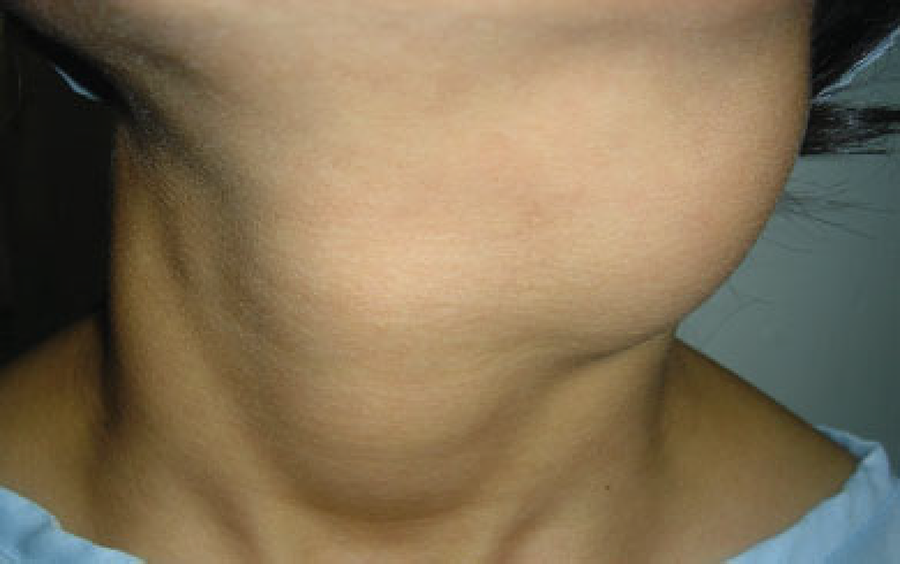
Branchial cleft cysts are painless, fluctuant lateral neck swellings, usually just anterior to the sternocleidomastoid (SCM). They are often found in children or young adults and may present after an upper respiratory tract infection draws attention to a previously unnoticed lump. 🧒🧑
📖 About
- Benign congenital anomaly due to incomplete involution of the branchial apparatus.
- Most arise from the second branchial cleft (≈ 90–95% of cases).
- They may remain asymptomatic until later childhood or early adulthood.
- Excision is curative, but recurrence can occur if the tract is not fully removed.
🧬 Aetiology
- Embryological failure to obliterate the second branchial cleft.
- Typically discovered in late childhood or young adults (often after infection).
👩⚕️ Clinical Features
- Location: Smooth, soft swelling in the upper neck, anterior to SCM.
- May present as a solitary, painless, slow-growing mass.
- Sometimes associated with a sinus or fistula opening to the skin, which may discharge.
- Becomes tender or enlarged with superimposed infection.
🔎 Subtypes
- Type I: Anterior to SCM, just deep to platysma.
- Type II: ⭐ Most common. Deep to SCM, lateral to the carotid space.
- Type III: Extends medially between internal & external carotids to the pharyngeal wall.
- Type IV: In pharyngeal mucosal space, medial to carotid sheath.
🧪 Investigations
- Ultrasound: Anechoic or hypoechoic cyst with posterior acoustic enhancement.
- CT scan: Well-circumscribed, low-attenuation cyst without enhancement.
- Histology: Cyst wall usually lined by squamous epithelium; may also have columnar ciliated epithelium.
⚠️ Differentials
- Thyroglossal duct cyst
- Cystic hygroma (lymphangioma)
- Dermoid cyst
- Necrotic metastatic lymph node (especially from HPV-related oropharyngeal SCC in adults >40 years)
💊 Management
- Exclude malignancy in adult patients with new lateral neck cysts.
- If asymptomatic → observation may be reasonable.
- If recurrently infected or cosmetically concerning → surgical excision.
- Complete excision can be challenging as tracts may pass near vital neurovascular structures (carotid sheath, cranial nerves).
- Antibiotics for secondary infection prior to definitive surgery.
