
| Download the amazing global Makindo app: ✅ Means NICE/National Guidelines 2026 compliant Android | Apple | |
|---|---|
| MEDICAL DISCLAIMER: Educational use only. Not for diagnosis or management. See below for full disclaimer. |
Granuloma annulare
Granuloma annulare is a harmless, benign condition. ✅ Not infectious, not contagious, and not allergy-related. Some forms have been linked with diabetes mellitus, though the exact cause is still uncertain.
📖 About
- Can affect all ages, but most common in children and young adults.
- Two main types:
- 🎯 Localized (most common) → rash on hands and feet.
- 🌐 Generalized → widespread rash affecting trunk and limbs.
- Often self-limiting, though persistent in some cases.
🧬 Aetiology
- Thought to represent a Type IV hypersensitivity reaction (T-cell–mediated immune response against dermal antigens).
- Associated with diabetes mellitus, thyroid disease, and rarely malignancy.
- Possible triggers: minor trauma, insect bites, infections, sun exposure.
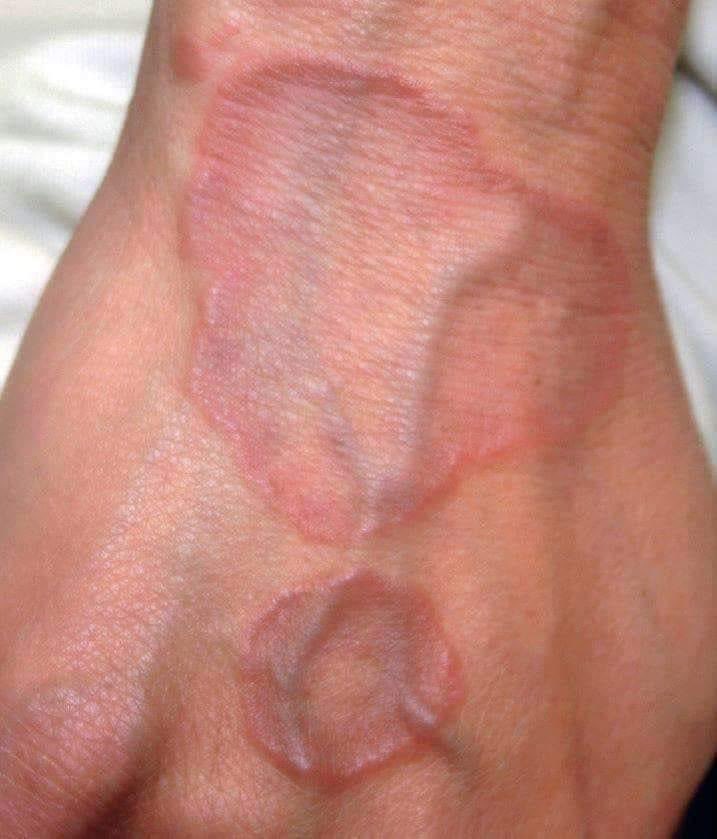
🩺 Clinical Features
- Typically non-itchy, smooth, circular or ring-shaped lesions.
- Lesions may be skin-coloured, pink, or violaceous.
- Common sites: hands, knuckles, elbows, and extensor forearms.
- Lesions may measure up to 5 cm in diameter.
- In generalized cases → multiple plaques across trunk and extremities.
🔍 Investigations
- 🩸 Blood glucose testing → screen for diabetes mellitus.
- 🔬 Skin biopsy in atypical cases → helps distinguish from tinea corporis (ringworm).
💊 Management
- 🌿 Reassurance: condition is benign and often resolves spontaneously within months–2 years.
- Localized disease:
- Topical corticosteroids to reduce inflammation.
- Intralesional corticosteroid injections for resistant plaques.
- Generalized or resistant disease:
- Systemic corticosteroids (short courses).
- Phototherapy (PUVA or narrowband UVB).
- Hydroxychloroquine or dapsone in selected severe cases.
- Patient education:
- Reassure that lesions are not contagious 👍.
- Encourage regular follow-up, especially if associated with systemic illness (e.g. diabetes, thyroid disease).
📚 References
- Smith, J. A., & Brown, L. (2019). Granuloma Annulare: Diagnosis and Management. Dermatology Journal.
- Jones, R. D. (2020). Skin Disorders and Diabetes Mellitus. Journal of Endocrinology.
- American Academy of Dermatology – Granuloma Annulare
| The content on this website is provided for educational and informational purposes only to support exam preparation (e.g., MLA, MRCP, USMLE) and learning. This is NOT medical advice, diagnosis, treatment, or professional guidance. It does not replace consultation with a qualified healthcare professional, official guidelines (e.g., NICE, GMC, BNF), or supervised clinical practice. Always verify information with current, authoritative sources. Makindo and its contributors accept no liability for any reliance on this content, including errors, omissions, or any resulting harm, loss, or consequences. By using this site, you agree to these terms. |
|
|
Categories
- About
- Acute Medicine
- Anaesthetics and Critical Care
- Anatomy
- Anatomy and Physiology
- Biochemistry
- Book
- Cardiology
- Collections
- CompSci
- Crib Sheets
- Critical care
- Dental
- Dermatology
- Differentials
- Drugs
- ENT
- Electrocardiogram
- Embryology
- Emergency Medicine
- Endocrinology
- Ethics
- Foundation Doctors
- GCSE
- Gastroenterology
- General Practice
- Genetics
- Geriatric Medicine
- Geriatrics
- Guidelines
- Haematology
- Hepatology
- Immunology
- Infectious Diseases
- Infographic
- Investigations
- Lists
- MRCP
- Mandatory Training
- Medical Students
- Microbiology
- Nephrology
- Neurology
- Neurosurgery
- Nutrition
- OSCE
- Obstetrics Gynaecology
- Oncology
- Ophthalmology
- Oral Medicine and Dentistry
- Orthopaedics
- Paediatrics
- Palliative
- Palliative Care
- Pathology
- Pharmacology
- Physiology
- Procedures
- Psychiatry
- Public Health
- Radiology
- Respiratory
- Resuscitation
- Revision Topics
- Rheumatology
- Statistics and Research
- Stroke
- Surgery
- Toxicology
- Trauma and Orthopaedics
- USMLE
- Urology
- Vascular Surgery