
| Download the amazing global Makindo app: ✅ Means NICE/National Guidelines 2026 compliant Android | Apple | |
|---|---|
| MEDICAL DISCLAIMER: Educational use only. Not for diagnosis or management. See below for full disclaimer. |
Internal Capsule
Related Subjects: |Medulla Oblongata |Midbrain |Pons |Caudate Nucleus |Putamen and Globus Pallidus |Cerebral Cortex |Internal Capsule |Cavernous sinus |Basal Ganglia |Brainstem Anatomy |Thalamic Anatomy |Caudate Nucleus
Structure and function
The internal capsule is a white matter structure located in the brain, specifically in the cerebral hemisphere. It is a V-shaped structure when viewed in a horizontal section, consisting of compact bundles of myelinated fibers that connect the cerebral cortex to the brainstem and spinal cord. The internal capsule is divided into three major parts:
🔬Anatomy
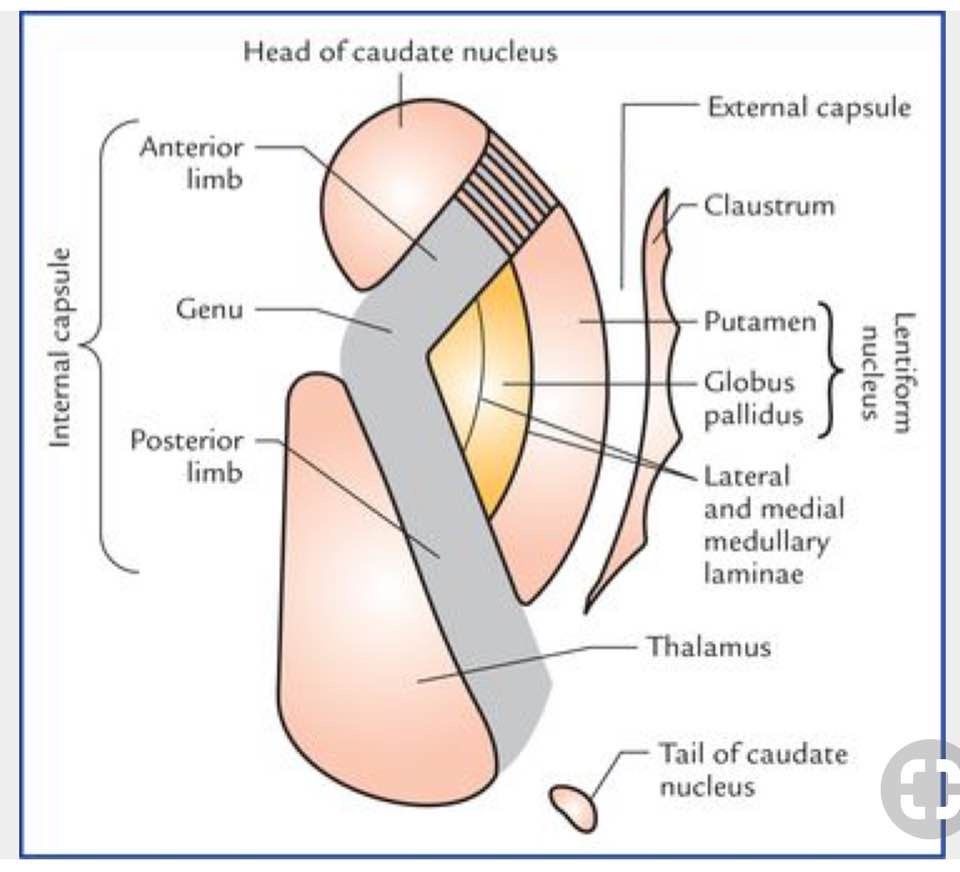
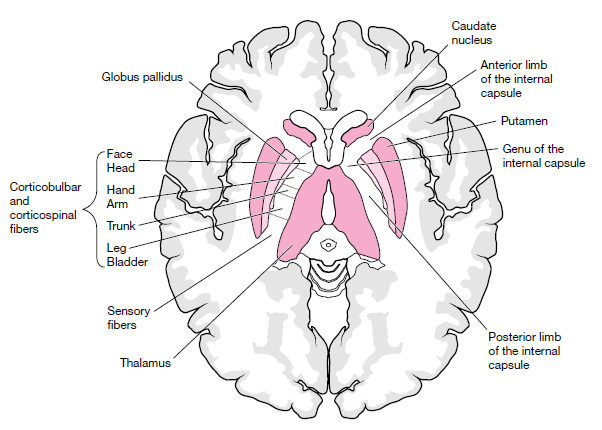
The internal capsule is a white matter structure located in the brain, specifically in the cerebral hemisphere. It is a V-shaped structure when viewed in a horizontal section, consisting of compact bundles of myelinated fibers that connect the cerebral cortex to the brainstem and spinal cord. The internal capsule is divided into three major parts:
- Anterior limb: Located between the head of the caudate nucleus and the lentiform nucleus.
- Genu: The bend in the V-shape of the internal capsule, located at the junction between the anterior and posterior limbs.
- Posterior limb: Located between the thalamus and the lentiform nucleus.
Function
The internal capsule plays a critical role in the relay of information between the cerebral cortex and lower brain structures such as the brainstem and spinal cord. The fibers within the internal capsule can be classified based on their function:
- Corticospinal tract: Contains motor fibers that run from the motor cortex to the spinal cord, involved in the control of voluntary movements.
- Corticobulbar tract: Contains fibers that control the muscles of the face, head, and neck by connecting the motor cortex to the cranial nerve nuclei in the brainstem.
- Thalamocortical and corticothalamic fibers: These fibers carry sensory information from the thalamus to the sensory cortex and vice versa, essential for sensory perception.
- Frontopontine fibers: Connect the frontal cortex with the pons, playing a role in motor control and cognitive functions.
Blood Supply
The internal capsule is supplied by several small arteries, which makes it particularly vulnerable to ischaemic events, such as strokes. The primary blood supply includes:
- Lenticulostriate arteries: Branches of the middle cerebral artery that supply the anterior and posterior limbs of the internal capsule.
- Anterior choroidal artery: A branch of the internal carotid artery that supplies the posterior limb of the internal capsule.
- Recurrent artery of Heubner: A branch of the anterior cerebral artery that supplies the anterior limb of the internal capsule.
Damage to the internal capsule, such as from a stroke, can lead to significant motor and sensory deficits depending on the affected area. For instance, damage to the corticospinal tract in the internal capsule can result in contralateral hemiparesis (weakness on the opposite side of the body).