
| Download the amazing global Makindo app: ✅ Means NICE/National Guidelines 2026 compliant Android | Apple | |
|---|---|
| MEDICAL DISCLAIMER: Educational use only. Not for diagnosis or management. See below for full disclaimer. |
Cardiopulmonary bypass
Related Subjects: |Assessing Chest Pain |Acute Coronary Syndrome (ACS) General |Cardiopulmonary bypass
🫀 Cardiopulmonary bypass (CPB) is an extracorporeal circulation system used during many forms of cardiac surgery. It temporarily takes over the functions of the heart and lungs, allowing the surgeon to operate on a relatively still, decompressed, and blood-reduced operative field while maintaining systemic perfusion and gas exchange.
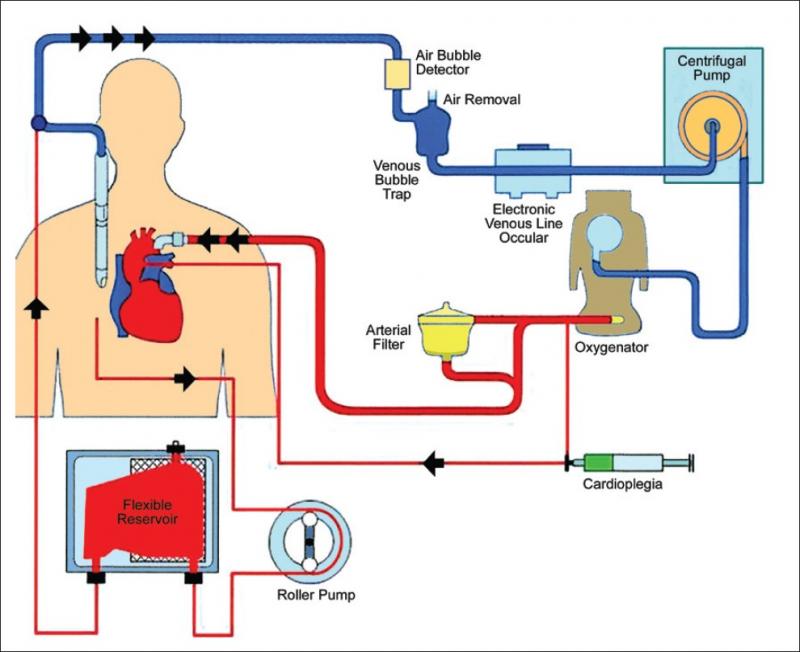
📖 About Cardiopulmonary Bypass
Cardiopulmonary bypass is commonly used in procedures such as coronary artery bypass grafting (CABG), valve surgery, repair of congenital cardiac defects, and other complex open cardiac operations. Venous blood is drained from the patient into an extracorporeal circuit, passes through a pump and membrane oxygenator, is filtered and temperature-controlled, and is then returned to the arterial circulation.
⚙️ Main Components
- Venous cannulation: blood is drained from the venous system, commonly via the right atrium or separate vena caval cannulation depending on the operation.
- Pump: modern CPB circuits use either roller pumps or centrifugal pumps to generate flow.
- Membrane oxygenator: this is the standard modern oxygenator and provides gas exchange while avoiding direct blood-gas bubbling.
- Heat exchanger: allows controlled cooling or rewarming of blood.
- Arterial filter and return line: oxygenated blood is returned, usually via an aortic cannula.
- Reservoir, suction, and cardiotomy systems: help manage circuit volume and salvage blood from the operative field.
🧬 How it works
- Venous blood is diverted out of the body into the CPB circuit.
- The oxygenator adds oxygen and removes carbon dioxide.
- The pump maintains systemic blood flow and organ perfusion.
- Blood temperature can be adjusted according to operative requirements.
- For many intracardiac procedures, the aorta is cross-clamped and cardioplegia is given to arrest and protect the myocardium.
❄️ Temperature Management and Myocardial Protection
- CPB may be performed under normothermia or varying degrees of hypothermia, depending on the procedure.
- Cooling reduces metabolic demand and may provide organ protection during periods of reduced perfusion or circulatory arrest.
- When the heart is arrested, cardioplegia is used to reduce myocardial oxygen demand and protect against ischaemic injury.
- Profound hypothermia is reserved for selected specialist procedures and should not be described as “mild hypothermia”.
🩸 Anticoagulation
- CPB requires systemic anticoagulation, usually with heparin.
- Anticoagulation is monitored intra-operatively, commonly using the activated clotting time (ACT).
- At the end of bypass, heparin is typically reversed with protamine.
🚨 Complications and Physiological Effects
- Systemic inflammatory response due to blood contact with the extracorporeal circuit.
- Bleeding and coagulopathy.
- Air or particulate embolism.
- Neurological complications, including stroke or postoperative cognitive dysfunction.
- Renal, pulmonary, and myocardial dysfunction.
- Haemolysis and platelet activation/consumption.
🔄 Off-pump versus on-pump surgery
- Many CABG procedures are traditionally performed on-pump with CPB.
- Off-pump CABG avoids CPB and may reduce some bypass-related complications in selected patients.
- However, off-pump surgery is technically more demanding and is not suitable for every case.
🧠 Key Clinical Points
- CPB does not simply “replace the heart”; it provides extracorporeal circulation and gas exchange while surgery is performed.
- A still and blood-reduced surgical field often requires both CPB and aortic cross-clamping/cardioplegia.
- Membrane oxygenators are the modern standard; bubble oxygenators are mainly of historical importance.
- Understanding CPB complications is essential when assessing postoperative cardiac surgical patients.
✅ Conclusion
Cardiopulmonary bypass is a cornerstone of modern cardiac surgery. It allows complex open cardiac operations by maintaining circulation and oxygenation while facilitating myocardial arrest and operative exposure. Although highly effective, CPB has important physiological consequences, particularly inflammatory activation, coagulopathy, and embolic risk, so its use requires meticulous anticoagulation, perfusion management, temperature control, and postoperative monitoring.
| The content on this website is provided for educational and informational purposes only to support exam preparation (e.g., MLA, MRCP, USMLE) and learning. This is NOT medical advice, diagnosis, treatment, or professional guidance. It does not replace consultation with a qualified healthcare professional, official guidelines (e.g., NICE, GMC, BNF), or supervised clinical practice. Always verify information with current, authoritative sources. Makindo and its contributors accept no liability for any reliance on this content, including errors, omissions, or any resulting harm, loss, or consequences. By using this site, you agree to these terms. |
|
|
Categories
- About
- Acute Medicine
- Anaesthetics and Critical Care
- Anatomy
- Anatomy and Physiology
- Biochemistry
- Book
- Cardiology
- Collections
- CompSci
- Crib Sheets
- Critical care
- Dental
- Dermatology
- Differentials
- Drugs
- ENT
- Electrocardiogram
- Embryology
- Emergency Medicine
- Endocrinology
- Ethics
- Foundation Doctors
- GCSE
- Gastroenterology
- General Practice
- Genetics
- Geriatric Medicine
- Geriatrics
- Guidelines
- Haematology
- Hepatology
- Immunology
- Infectious Diseases
- Infographic
- Investigations
- Lists
- MRCP
- Mandatory Training
- Medical Students
- Microbiology
- Nephrology
- Neurology
- Neurosurgery
- Nutrition
- OSCE
- Obstetrics Gynaecology
- Oncology
- Ophthalmology
- Oral Medicine and Dentistry
- Orthopaedics
- Paediatrics
- Palliative
- Palliative Care
- Pathology
- Pharmacology
- Physiology
- Procedures
- Psychiatry
- Public Health
- Radiology
- Respiratory
- Resuscitation
- Revision Topics
- Rheumatology
- Statistics and Research
- Stroke
- Surgery
- Toxicology
- Trauma and Orthopaedics
- USMLE
- Urology
- Vascular Surgery