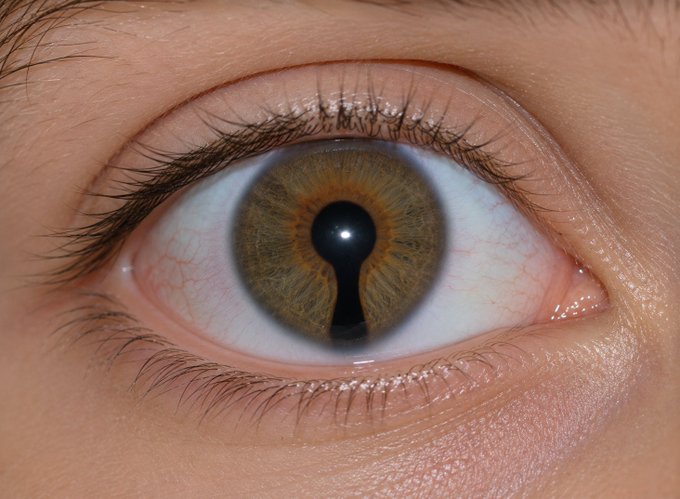
Coloboma
👁️ Coloboma is a congenital eye defect caused by incomplete closure of the embryonic optic fissure.
It may affect the iris, retina, choroid, optic disc or eyelid.
Severity ranges from a small keyhole-shaped pupil to significant visual impairment if the posterior segment or optic nerve is involved.
🔍 Clinical Features
- 🔑 Keyhole-shaped or irregular pupil if iris coloboma is present.
- 👁️ Reduced visual acuity if the macula or optic nerve is involved.
- 🌗 Visual field defect.
- ☀️ Photophobia or glare.
- 👀 Strabismus or nystagmus in more severe cases.
- ↔️ May be unilateral or bilateral.
- 😶 May be found incidentally if mild and anterior.
🧬 Embryology / Pathophysiology
- 🧫 During eye development, the embryonic optic fissure normally closes early in fetal life.
- 🚪 Failure of closure leaves a tissue gap, creating a coloboma.
- 📍 The functional impact depends on the site: iris-only disease may be cosmetic, while retinal, choroidal, macular or optic nerve involvement may impair vision.
⚠️ Associations
- 👁️ Microphthalmia.
- 🌫️ Cataract.
- ⚡ Retinal detachment.
- 🧬 CHARGE syndrome.
- 🫀 Craniofacial, cardiac, renal or neurological anomalies.
- 👨👩👧 Family history of congenital eye abnormality.
🧪 Assessment
- 👁️ Check visual acuity.
- 🔴 Check red reflex, especially in babies and children.
- 🔍 Examine pupil shape and ocular alignment.
- 👀 Look for strabismus, nystagmus or abnormal fixation.
- 🏥 Refer to ophthalmology for dilated fundal examination.
- 🧬 Consider genetics or paediatric assessment if bilateral, syndromic features or systemic abnormalities are present.
✅ Management
- ✅ No treatment may be needed for a small isolated iris coloboma if vision is normal.
- 🕶️ Tinted lenses or cosmetic contact lenses may help glare, photophobia or appearance.
- 👓 Correct refractive error.
- 👶 Treat amblyopia early in children to protect visual development.
- ⚡ Monitor for retinal complications, especially retinal detachment.
- 🧬 Provide genetic counselling where inherited or syndromic disease is suspected.
🧠 Important Clinical Point
💡 The key distinction is between a mainly cosmetic anterior coloboma and posterior segment involvement.
An isolated iris coloboma may have little functional impact, whereas chorioretinal, macular or optic nerve coloboma can affect visual acuity, visual fields and retinal stability.
📞 Refer
- 🏥 Any suspected new diagnosis of coloboma.
- 👁️ Reduced vision.
- 🔴 Abnormal red reflex.
- 👀 Strabismus or nystagmus.
- ↔️ Bilateral disease.
- 🧬 Suspected syndromic features or systemic abnormalities.
- 🚨 Symptoms of retinal detachment: flashes, floaters or curtain-like visual loss.
🚩 Red Flags
- ⚡ New flashes or floaters.
- 🌑 Curtain-like loss of vision.
- 👁️ Sudden reduction in visual acuity.
- 🔴 Abnormal red reflex in a child.
- 👶 Poor visual behaviour, failure to fix and follow, or new squint in infancy.
📌 Exam Pearls
- 💡 Coloboma is due to incomplete closure of the embryonic optic fissure.
- 💡 Iris coloboma classically causes a keyhole pupil.
- 💡 Posterior coloboma is more likely to affect vision.
- 💡 Bilateral coloboma or systemic features should prompt syndromic/genetic consideration.
- 💡 Retinal detachment symptoms require urgent ophthalmology assessment.