
| Download the amazing global Makindo app: ✅ Means NICE/National Guidelines 2026 compliant Android | Apple | |
|---|---|
| MEDICAL DISCLAIMER: Educational use only. Not for diagnosis or management. See below for full disclaimer. |
Sjögren’s syndrome
Related Subjects: |Relapsing Polychondritis |Reactive Arthritis |Raynaud's Phenomenon |Polymyositis |Dermatomyositis |Polyarteritis nodosa |Osteoporosis |Rheumatoid Arthritis |Systemic Sclerosis (Scleroderma) |Rheumatology Autoantibodies |Overlap Syndrome |Sjögren’s syndrome
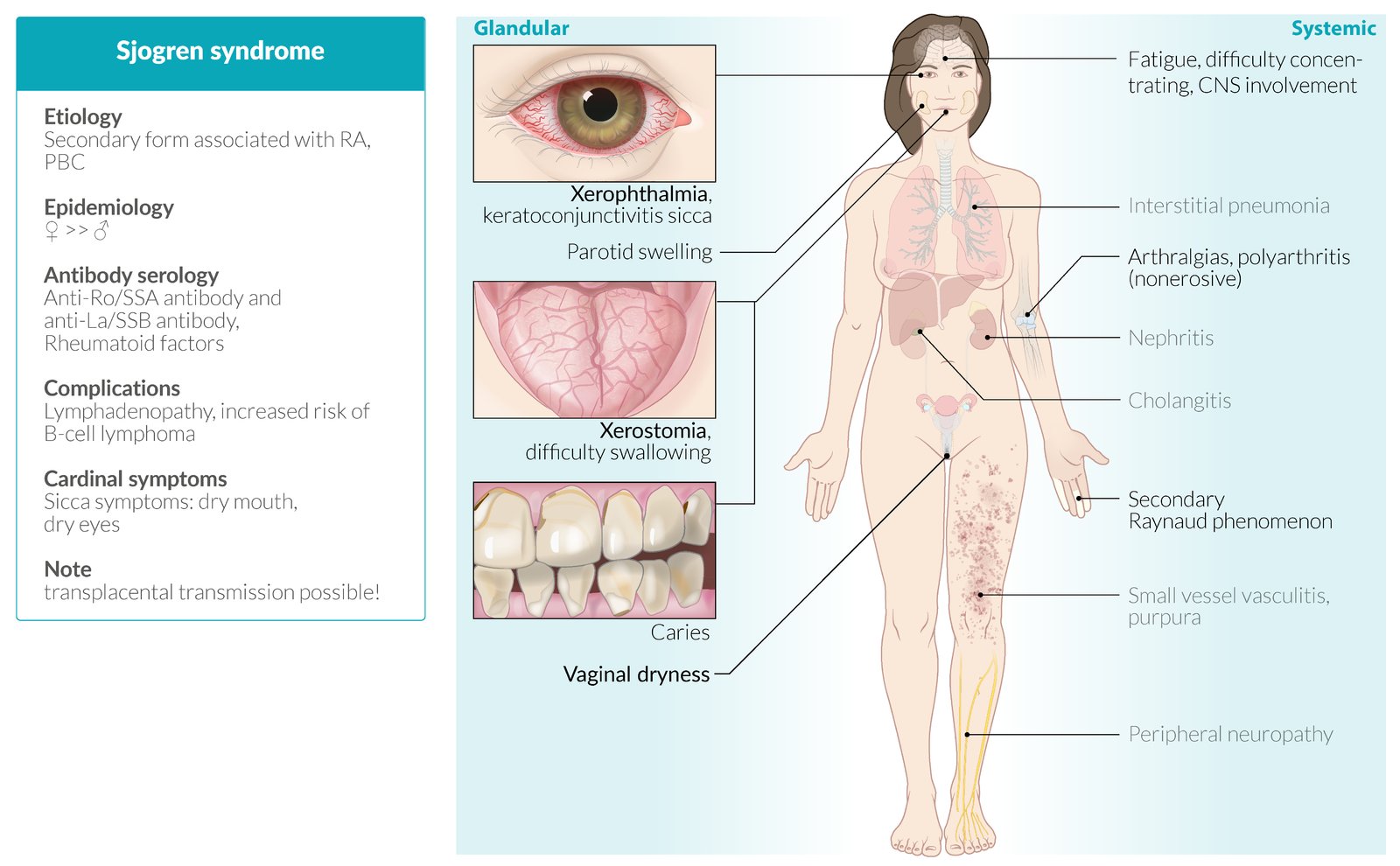
💧 Sjögren’s syndrome is a chronic autoimmune disorder characterised by inflammation and fibrosis of exocrine glands, leading to dryness of eyes, mouth, and vagina (sicca complex). ⚠️ Remember: Systemic involvement and an increased risk of lymphoma make this more than just a “dryness” condition.
📘 About
- Autoimmune destruction of lacrimal and salivary glands → sicca syndrome (xerophthalmia + xerostomia).
- Dryness may also affect skin and vagina.
- Named after Henrik Sjögren, Swedish ophthalmologist (1933).
🧬 Types
- Primary Sjögren’s Syndrome (PSS): Isolated autoimmune disease, often in middle-aged women. ~50% are RF-positive.
- Secondary Sjögren’s Syndrome: Occurs with another autoimmune condition:
- Rheumatoid arthritis
- SLE, scleroderma
- Primary biliary cirrhosis (95% RF-positive)
🔎 Aetiology
- Chronic lymphocytic infiltration and fibrosis of exocrine glands (esp. lacrimal and salivary).
- Autoimmune basis with HLA-B8/DR3 association.
- Environmental triggers + genetic susceptibility.
🩺 Clinical Features
- Demographics: Female:male ratio ≈ 9:1, onset typically age 30–50.
- Dry mouth (xerostomia): Dental caries, parotid enlargement, halitosis.
- Dry eyes (keratoconjunctivitis sicca): Grittiness, irritation, keratitis. Positive Schirmer’s test.
- Vaginal dryness: Dyspareunia, recurrent infections.
- Arthralgia/arthritis: May be erosive.
- Systemic: Fatigue, myalgia, vasculitis, neuropathy, lymphadenopathy.
- Other: Raynaud’s phenomenon, pancreatitis, renal tubular acidosis.
🔗 Associations
- Autoimmune thyroid disease
- Autoimmune hepatitis
- Primary biliary cirrhosis
- Non-Hodgkin’s B-cell lymphoma (increased risk, esp. with persistent parotid swelling).
🧪 Investigations
- FBC: Anaemia, leukopenia.
- Inflammatory markers: ↑ ESR/CRP.
- Autoantibodies: RF (~38%), ANA (~80%), Anti-Ro (SSA ~60%), Anti-La (SSB ~26%).
- Pregnancy note: Anti-Ro/La can cross placenta → fetal congenital heart block (≈5%).
- Serum: Polyclonal hypergammaglobulinaemia.
- Ocular: Schirmer’s test (<5 mm wetting in 5 min = positive); Rose Bengal dye shows punctate keratitis.
- Biopsy: Labial salivary gland → lymphocytic infiltration.
💊 Management
- Symptomatic: Artificial tears (hypromellose), saliva substitutes, regular hydration, vaginal lubricants.
- Ocular: Ophthalmology referral; ciclosporin eyedrops (recently licensed).
- Musculoskeletal/systemic: NSAIDs, hydroxychloroquine, methotrexate, or corticosteroids if severe.
- Lifestyle: Good oral hygiene, avoid anticholinergics, dental surveillance.
📚 References
Cases - Sjögren’s Syndrome
- Case 1 - Classic sicca symptoms 👄👁️: A 55-year-old woman presents with 2 years of dry mouth, difficulty swallowing dry food, and gritty eyes. Exam: dental caries and reduced tear production (positive Schirmer’s test). Serology: anti-Ro and anti-La positive. Diagnosis: primary Sjögren’s syndrome. Managed with artificial tears, saliva substitutes, and hydroxychloroquine for fatigue/arthralgia.
- Case 2 - Secondary Sjögren’s with RA 🤲: A 62-year-old woman with established rheumatoid arthritis develops new complaints of dry eyes and dry mouth. She also reports recurrent parotid swelling. Serology: rheumatoid factor positive, anti-Ro positive. Diagnosis: secondary Sjögren’s syndrome. Managed alongside her RA with immunomodulators and symptomatic relief for sicca features.
- Case 3 - Complication (lymphoma risk) 🎗️: A 59-year-old woman with known Sjögren’s presents with persistent unilateral parotid gland enlargement, night sweats, and weight loss. Imaging and biopsy confirm non-Hodgkin lymphoma. Diagnosis: MALT lymphoma complicating Sjögren’s syndrome. Managed with haematology input and systemic therapy.
Teaching Point 🩺: Sjögren’s syndrome is an autoimmune exocrinopathy causing sicca symptoms (dry eyes, dry mouth). It may be primary or secondary (commonly with RA or SLE). Always monitor for complications such as parotid enlargement, systemic involvement, and lymphoma.
| The content on this website is provided for educational and informational purposes only to support exam preparation (e.g., MLA, MRCP, USMLE) and learning. This is NOT medical advice, diagnosis, treatment, or professional guidance. It does not replace consultation with a qualified healthcare professional, official guidelines (e.g., NICE, GMC, BNF), or supervised clinical practice. Always verify information with current, authoritative sources. Makindo and its contributors accept no liability for any reliance on this content, including errors, omissions, or any resulting harm, loss, or consequences. By using this site, you agree to these terms. |
|
|
Categories
- About
- Acute Medicine
- Anaesthetics and Critical Care
- Anatomy
- Anatomy and Physiology
- Biochemistry
- Book
- Cardiology
- Collections
- CompSci
- Crib Sheets
- Critical care
- Dental
- Dermatology
- Differentials
- Drugs
- ENT
- Electrocardiogram
- Embryology
- Emergency Medicine
- Endocrinology
- Ethics
- Foundation Doctors
- GCSE
- Gastroenterology
- General Practice
- Genetics
- Geriatric Medicine
- Geriatrics
- Guidelines
- Haematology
- Hepatology
- Immunology
- Infectious Diseases
- Infographic
- Investigations
- Lists
- MRCP
- Mandatory Training
- Medical Students
- Microbiology
- Nephrology
- Neurology
- Neurosurgery
- Nutrition
- OSCE
- Obstetrics Gynaecology
- Oncology
- Ophthalmology
- Oral Medicine and Dentistry
- Orthopaedics
- Paediatrics
- Palliative
- Palliative Care
- Pathology
- Pharmacology
- Physiology
- Procedures
- Psychiatry
- Public Health
- Radiology
- Respiratory
- Resuscitation
- Revision Topics
- Rheumatology
- Statistics and Research
- Stroke
- Surgery
- Toxicology
- Trauma and Orthopaedics
- USMLE
- Urology
- Vascular Surgery