Respiratory Spirometry and Flow Volume Loops
Related Subjects: Asthma
|Acute Severe Asthma
|Respiratory Failure
|Cardiac Physiology
|Renal Physiology
|Liver Physiology
|Pulmonary Physiology
|Pancreas Physiology
|Spleen Physiology
|Gastrointestinal tract Physiology
|Brainstem Physiology
|Bone Physiology
Spirometry
-
Spirometry is a diagnostic test used to assess lung function by measuring the volume and speed of air a person can exhale. It provides key insights into conditions such as chronic obstructive pulmonary disease (COPD) and asthma.
-
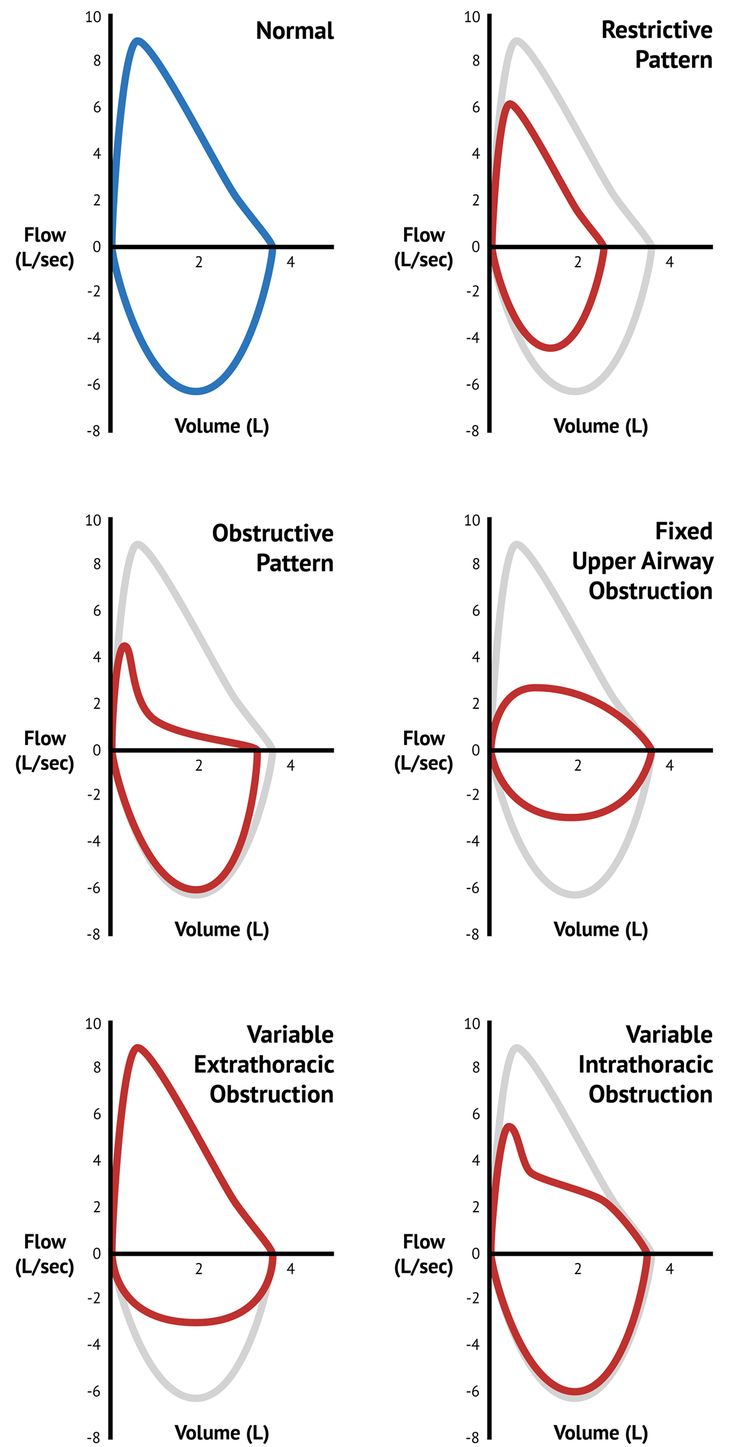
The procedure involves blowing out as forcefully and quickly as possible into a specialized device called a spirometer. When both maximal exhalation and inhalation are measured, the result is often represented as a 'Flow Volume Loop' .
-
During the test:
- You will be seated, and your nose may be sealed with a nose clip to ensure all airflow is directed through the mouth.
- You will be asked to breathe normally into a mouthpiece, take a deep breath, and then exhale as hard and as fast as possible until your lungs feel empty.
- This process is repeated at least three times, with adequate rest between attempts to ensure accuracy and consistency.
-
After the initial test, spirometry may be repeated following the administration of an inhaler or nebulizer to assess any improvement in airway function as a result of the medication.
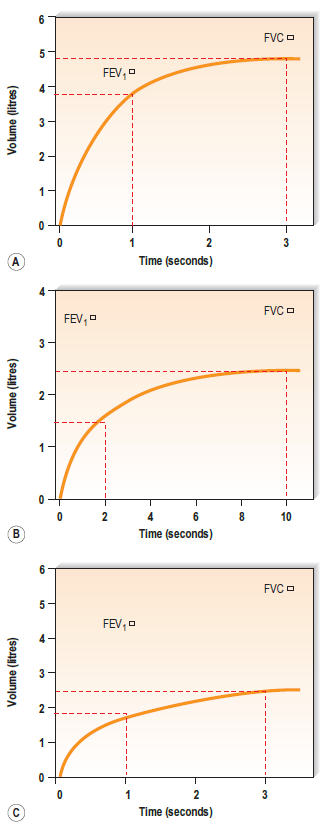
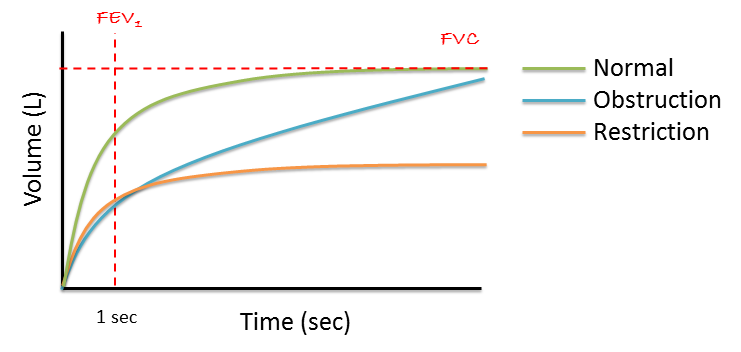
Flow Volume Loop
Forced Expiratory Volume in 1 Second (FEV1)
- FEV1 is the volume of air forcefully exhaled in the first second of a maximal exhalation.
Forced Vital Capacity (FVC)
- FVC is the total volume of air that can be forcefully exhaled following a maximal inhalation.
- The FEV1/FVC ratio is a key parameter:
- If the ratio is <80%, it indicates the presence of an obstructive defect, as seen in conditions like COPD or asthma.
Summary of Lung Volumes
- Tidal Volume (TV): The volume of air exchanged during normal, quiet breathing. (Approx. 7 cm³/kg body weight)
- Inspiratory Reserve Volume (IRV): The maximum volume of air that can be inhaled beyond the tidal volume. (Approx. 3.3 L in men, 1.9 L in women)
- Expiratory Reserve Volume (ERV): The maximum volume of air that can be exhaled beyond the tidal volume. (Approx. 1.0 L in men, 0.7 L in women)
- Residual Volume (RV): The volume of air remaining in the lungs after maximum expiration. (Approx. 1.2 L in men, 1.1 L in women)
- Inspiratory Capacity (IC): The sum of TV and IRV.
- Functional Residual Capacity (FRC): The sum of ERV and RV, representing the volume left in the lungs at the end of normal expiration.
- Total Lung Capacity (TLC): The sum of TV, IRV, ERV, and RV. TLC increases in conditions like emphysema due to reduced lung elasticity.
- Vital Capacity (VC): The maximum volume of air that can be exhaled after a maximal inhalation (TV + IRV + ERV).
Additional Notes
- Spirometry as a Diagnostic Tool: Helps identify obstructive (e.g., COPD) or restrictive (e.g., pulmonary fibrosis) lung conditions.
- Post-Bronchodilator Test: Used to differentiate reversible airway obstruction (e.g., asthma) from irreversible conditions (e.g., COPD).
- It is essential that the test is performed under the guidance of trained personnel to ensure accurate results.
