🌸 About the Menstrual Cycle
The menstrual cycle is a regular natural process in the female reproductive system, involving the uterus and ovaries, that prepares the body for pregnancy. It is divided into several phases, each marked by specific hormonal and physiological changes.
The average cycle lasts about 28 days (range 21–35 days in adults).
📆 Phases of the Menstrual Cycle
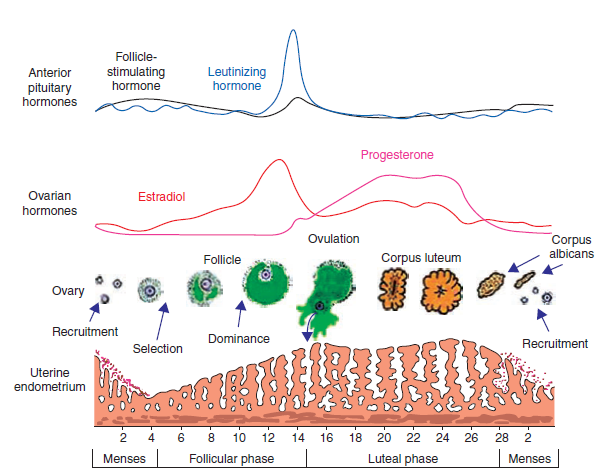
- Menstrual Phase (Days 1–5): Shedding of the endometrium → menstrual bleeding. Triggered by declining estrogen and progesterone.
- Follicular Phase (Days 1–13): Ovarian follicles mature under FSH; estrogen rises; endometrium thickens. Ends with LH surge.
- Ovulation (~Day 14): Egg released from dominant follicle; triggered by LH and FSH peaks. Fertilisation may occur.
- Luteal Phase (Days 15–28): Corpus luteum forms → secretes progesterone (± estrogen). Prepares endometrium. If no fertilisation → hormone drop → cycle restarts.
🧬 Hormonal Regulation
- GnRH: Pulsatile release from hypothalamus → stimulates FSH & LH.
- FSH: Follicle growth + estrogen production.
- LH: Ovulation trigger + corpus luteum progesterone.
- Estrogen: Endometrial proliferation, feedback on GnRH/FSH/LH.
- Progesterone: Maintains endometrium, inhibits further ovulation.
⚖️ Physiological Changes
- Endometrium:
- Proliferative phase (estrogen-driven thickening).
- Secretory phase (progesterone-driven maintenance).
- Menstrual phase (shedding if no pregnancy).
- Cervical Mucus: Estrogen → thin & watery (fertile); Progesterone → thick & sticky (infertile).
- Basal Body Temperature: Small rise post-ovulation (progesterone effect); can be used for fertility tracking.
💡 Clinical Relevance
- Disorders: Amenorrhoea, Dysmenorrhoea, Menorrhagia, Irregular cycles.
- Hormonal Contraception: Prevents ovulation + alters mucus/endometrium.
- Fertility Awareness: Uses cycle tracking for conception or contraception.
📖 Summary
The menstrual cycle is a finely tuned process regulated by hypothalamic–pituitary–ovarian hormones.
It prepares the body for pregnancy via cyclical ovarian and endometrial changes.
Knowledge of these phases is essential for managing reproductive health, fertility awareness, and treating menstrual disorders.
