OSCE Examining for Finger Clubbing
Related Subjects:
|Lung Cancer
|Idiopathic Pulmonary Fibrosis
|Diffuse Parenchymal Lung disease
|Asbestos Related Lung disease
|Sarcoidosis
|Coal Worker's Pneumoconiosis
|Silicosis
|Farmer's Lung
|Cryptogenic Organising Pneumonia (COP-BOOP)
|Extrinsic Allergic alveolitis (Hypersensitivity)
|Byssinosis
|Pneumoconiosis
|Cor Pulmonale
|Chest X Ray Interpretation
ℹ️ About
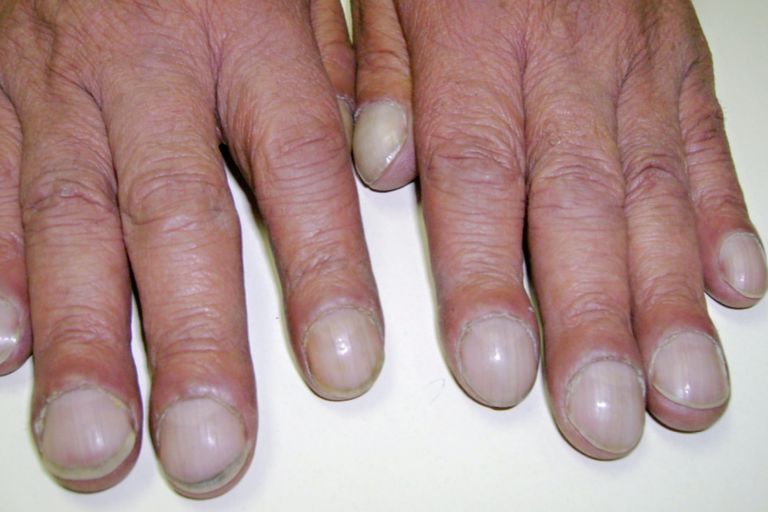
- Clubbing is an increased amount of soft tissue in the terminal phalanx of the fingers and toes, concentrated around the nail base.
- It is best identified by inspecting the nails (fingers and toes) from the side and palpating for sponginess of the nail bed.
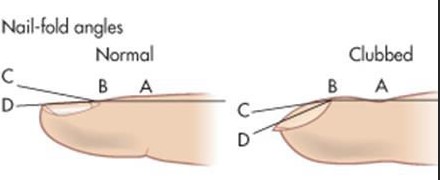
- Gross clubbing gives fingers a drumstick appearance, while mild clubbing manifests as a loss of the angle at the nail base and a spongy feel to the nail bed.
- In some cases, clubbing can be benign and inherited as a familial trait.
Examination - Look at the hands
- General Preparation
- Wash hands thoroughly.
- Ensure that the patient is comfortable.
- Introduce yourself and obtain consent for the examination.
- Check that the patient's hands are not tender or sore before examination.
- Examine the hands carefully, including both the palm and dorsum.
- Look for clues to underlying causes, such as:
- Cachexia and nicotine staining, which may suggest lung cancer.
- Use of oxygen, which could indicate fibrosing alveolitis or bronchiectasis.
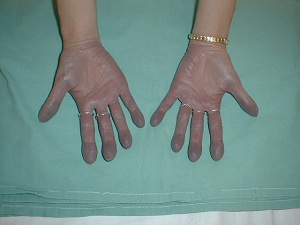
- Central cyanosis, which is suggestive of congenital cyanotic heart disease.
- Splinter haemorrhages, which may indicate infective endocarditis.
- Patient under 40 years old, which might suggest cystic fibrosis or congenital heart disease.
- Observe the fingers for any bulbous swelling.
- Inspect the nails laterally for a loss of the normal nail angle (the angle between the nail and the nail bed).
- Consider requesting a chest X-ray (CXR) to look for conditions such as tumours, fibrosis, bronchiectasis, empyema, or congenital heart disease.
Causes
- Respiratory (NOT ASTHMA OR COPD)
- Lung Cancer
- Idiopathic Pulmonary Fibrosis
- Empyema
- Lung Abscess
- Bronchiectasis
- Cystic Fibrosis
- Cardiac (NOT Ischaemic Heart Disease)
- Congenital Cyanotic Heart Disease
- Infective Endocarditis
- Atrial Myxoma
- Gastrointestinal
- Cirrhosis
- Primary Biliary Cirrhosis
- Ulcerative Colitis
- Crohn's Disease
- Coeliac Disease
- Leiomyoma of the Oesophagus or Achalasia
- Inherited
- Autosomal Dominant Familial Clubbing
- Local Vascular Causes
- Bronchial Arteriovenous Aneurysm
- Axillary Artery Aneurysm
Clubbing Images
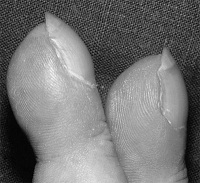
Clubbing and cyanosis: