🩺 Introduction
The WHO Surgical Safety Checklist is a structured patient safety tool designed to reduce avoidable surgical harm.
It was launched in 2008 under the "Safe Surgery Saves Lives" initiative and has since become mandatory in many healthcare systems (including the NHS).
📚 Background and Rationale
Surgery saves lives but carries significant risks - WHO estimated that 234 million operations are performed annually worldwide, with complication rates of up to 25% in some settings.
Errors such as wrong-site surgery, retained instruments, and unrecognised bleeding can be prevented by structured communication and checks.
The checklist creates “pause points” where the surgical team reviews critical safety steps together.
🗂️ Structure of the Checklist
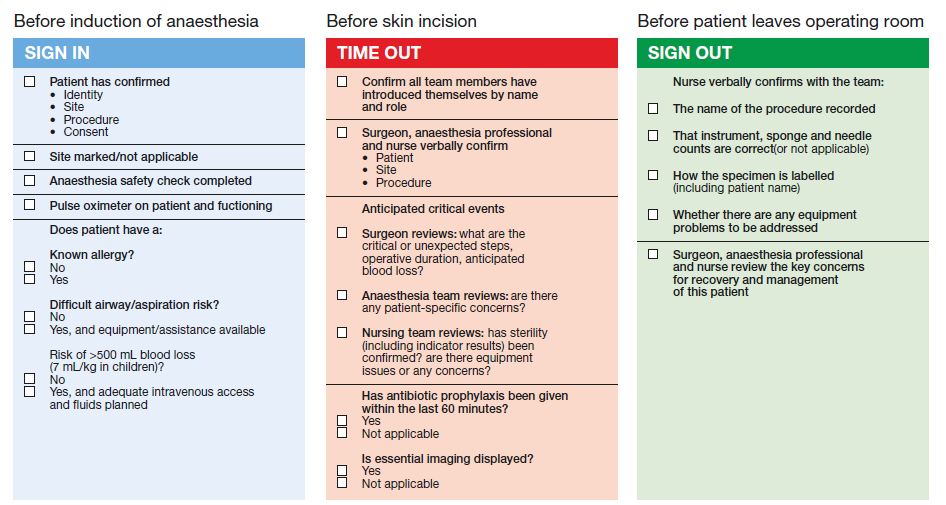
The checklist is divided into three phases, corresponding to natural pauses in the surgical process:
- ✅ Before Anaesthesia (“Sign In”)
- Confirm patient identity, procedure, and surgical site (using wristband & consent form).
- Check allergies, airway risk, VTE risk, and anticipated blood loss.
- Ensure anaesthetic machine check and monitoring are complete.
- ⏸️ Before Skin Incision (“Time Out”)
- Team introductions (“name and role”) → builds accountability and communication.
- Reconfirm patient identity, procedure, and surgical site marking.
- Surgeon shares anticipated critical steps and blood loss risk.
- Anaesthetist and scrub nurse highlight key concerns (e.g., antibiotics given, special equipment).
- 📤 Before Leaving OR (“Sign Out”)
- Count instruments, needles, and swabs → prevents retained items.
- Confirm specimen labelling and documentation.
- Review equipment issues or problems encountered.
- Agree post-op care plan and communicate to recovery team.
📊 Implementation and Impact
- Large multi-centre trials (e.g. NEJM 2009) showed complication rates fell by >30% and mortality halved after adoption.
- Improves team culture: empowers nurses and junior staff to speak up.
- Has been adapted in the NHS “Five Steps to Safer Surgery”.
- Effective in both low-resource and high-resource settings.
⚠️ Challenges and Future Directions
- Variable compliance - some teams see it as “tick-box” rather than meaningful safety dialogue.
- Cultural barriers - reluctance to challenge hierarchy in the OR.
- Solutions include: leadership training, simulation practice, and digital checklists linked to electronic records.
🚨 Quick Reference: WHO Surgical Safety Checklist
Before Anaesthesia (Sign In)
🧾 Confirm identity, consent, allergies, airway, blood risk
Before Incision (Time Out)
🧍 Team introductions, site & procedure check, antibiotics, anticipate critical events
Before Leaving OR (Sign Out)
🔢 Count instruments/swabs, label specimens, review issues, confirm post-op plan
✅ Conclusion
The WHO Surgical Safety Checklist is a simple but powerful intervention that transforms operating theatres into safer systems.
By embedding structured communication and safety checks, it reduces complications, saves lives, and improves teamwork.
Its success depends not just on the checklist itself, but on fostering a culture of safety and openness where every team member has a voice.
📚 References
