
| Download the amazing global Makindo app: ✅ Means NICE/National Guidelines 2026 compliant Android | Apple | |
|---|---|
| MEDICAL DISCLAIMER: Educational use only. Not for diagnosis or management. See below for full disclaimer. |
Ophthalmic Nerve
Related Subjects: |Olfactory Nerve |Optic Nerve |Oculomotor Nerve |Trochlear Nerve |Trigeminal Nerve |Abducent Nerve |Facial Nerve |Vestibulocochlear Nerve |Glossopharyngeal Nerve |Vagus Nerve |Accessory Nerve |Hypoglossal Nerve
The ophthalmic nerve is the first branch (V1) of the trigeminal nerve (cranial nerve V), which is primarily responsible for transmitting sensory information from the upper part of the face, including the eyes, forehead, and scalp. The ophthalmic nerve is purely sensory and plays a critical role in protecting the eye by providing sensation to the cornea, conjunctiva, and skin of the upper eyelid and forehead.
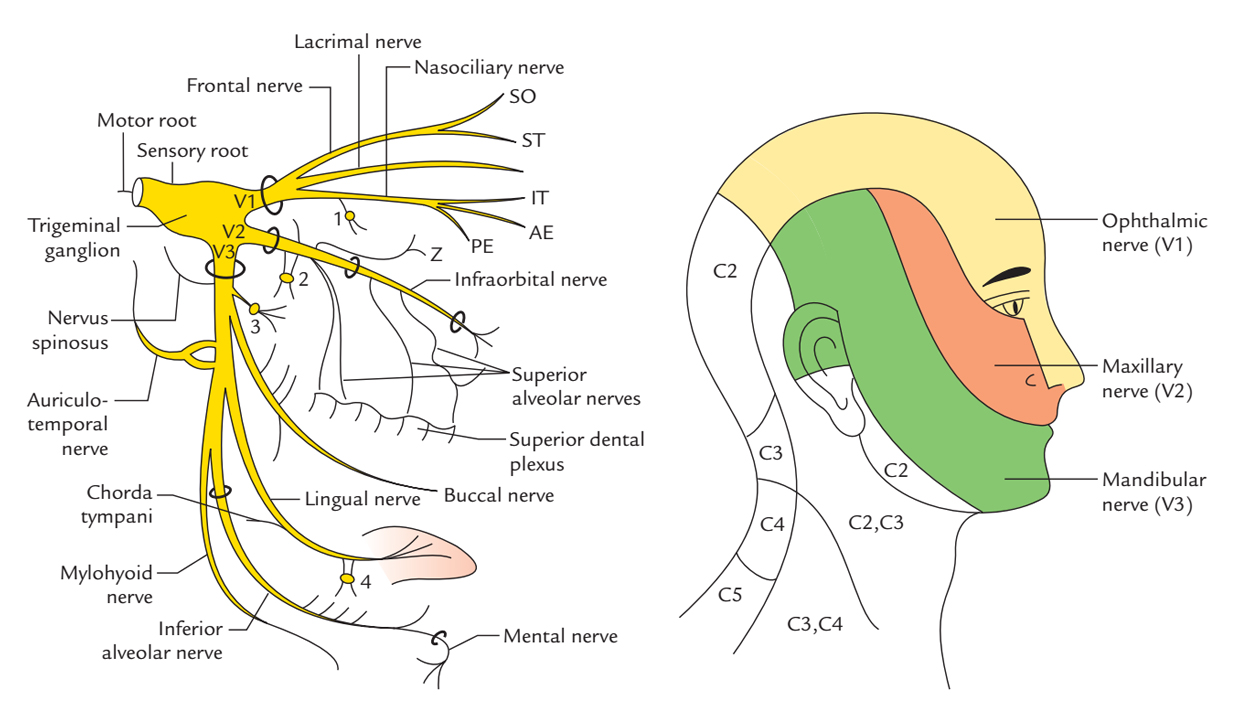
Course of the V1 Ophthalmic Nerve
The ophthalmic nerve originates from the trigeminal ganglion and travels through the cavernous sinus before entering the orbit via the superior orbital fissure. It then divides into three main branches:
- Frontal Nerve: The largest branch, which further divides into the supraorbital and supratrochlear nerves. These nerves provide sensation to the forehead, scalp, and upper eyelid.
- Lacrimal Nerve: Provides sensory innervation to the lacrimal gland, conjunctiva, and lateral part of the upper eyelid.
- Nasociliary Nerve: Gives rise to several branches, including the long ciliary nerves (which provide sensation to the cornea), the infratrochlear nerve, and branches that innervate the nasal cavity.
Branches of the Ophthalmic Nerve
- Frontal Nerve:
- Supraorbital Nerve: Supplies the forehead, scalp, and upper eyelid.
- Supratrochlear Nerve: Supplies the skin of the forehead close to the midline, the bridge of the nose, and the upper eyelid.
- Lacrimal Nerve: Provides sensory innervation to the lacrimal gland, the conjunctiva, and the skin of the lateral upper eyelid.
- Nasociliary Nerve:
- Long Ciliary Nerves: Provide sensation to the cornea and sclera.
- Infratrochlear Nerve: Supplies the skin of the upper nose and the medial part of the upper eyelid.
- Ethmoidal Nerves: Anterior and posterior branches supply the nasal cavity and the ethmoid air cells.
Functions
- Sensory Innervation: The ophthalmic nerve provides sensation to the cornea, conjunctiva, upper eyelid, forehead, and scalp, playing a crucial role in protecting the eye from foreign bodies and irritants.
- Reflex Actions: The ophthalmic nerve is involved in the corneal reflex, where stimulation of the cornea leads to involuntary blinking, protecting the eye from potential damage.
Clinical Significance
- Herpes Zoster Ophthalmicus: Reactivation of the varicella-zoster virus (which causes chickenpox) in the ophthalmic nerve can lead to shingles affecting the forehead, scalp, and eye. This condition can cause severe pain and potentially lead to complications like keratitis and vision loss.
- Trigeminal Neuralgia: The ophthalmic nerve can be involved in trigeminal neuralgia, a condition characterized by sudden, severe, and shock-like facial pain. Although less common than involvement of the other trigeminal branches, when affected, it can cause intense pain in the forehead and eye area.
- Corneal Reflex Testing: The ophthalmic nerve is tested clinically through the corneal reflex. Failure of this reflex may indicate damage to the nerve or its associated brainstem pathways.
Summary
The ophthalmic nerve is a critical sensory nerve responsible for the sensation of the upper face, including the eye, forehead, and scalp. It plays a vital role in protecting the eye and is involved in several reflex actions. Understanding its anatomy and clinical significance is crucial, particularly in the context of conditions like herpes zoster ophthalmicus and trigeminal neuralgia.