
| Download the amazing global Makindo app: ✅ Means NICE/National Guidelines 2026 compliant Android | Apple | |
|---|---|
| MEDICAL DISCLAIMER: Educational use only. Not for diagnosis or management. See below for full disclaimer. |
Chronic Kidney Disease (CKD) ✅
Related Subjects: |Metabolic acidosis |Lactic acidosis |Acute Kidney Injury (AKI) / Acute Renal Failure |Renal/Kidney Physiology |Chronic Kidney Disease (CKD) |Anaemia in Chronic Kidney Disease |Analgesic Nephropathy |Medullary Sponge kidney |IgA Nephropathy (Berger's disease) |HIV associated nephropathy (HIVAN) |Balkan endemic nephropathy (BEN) |Autosomal Dominant Polycystic kidney disease
📖 About (NICE-aligned)
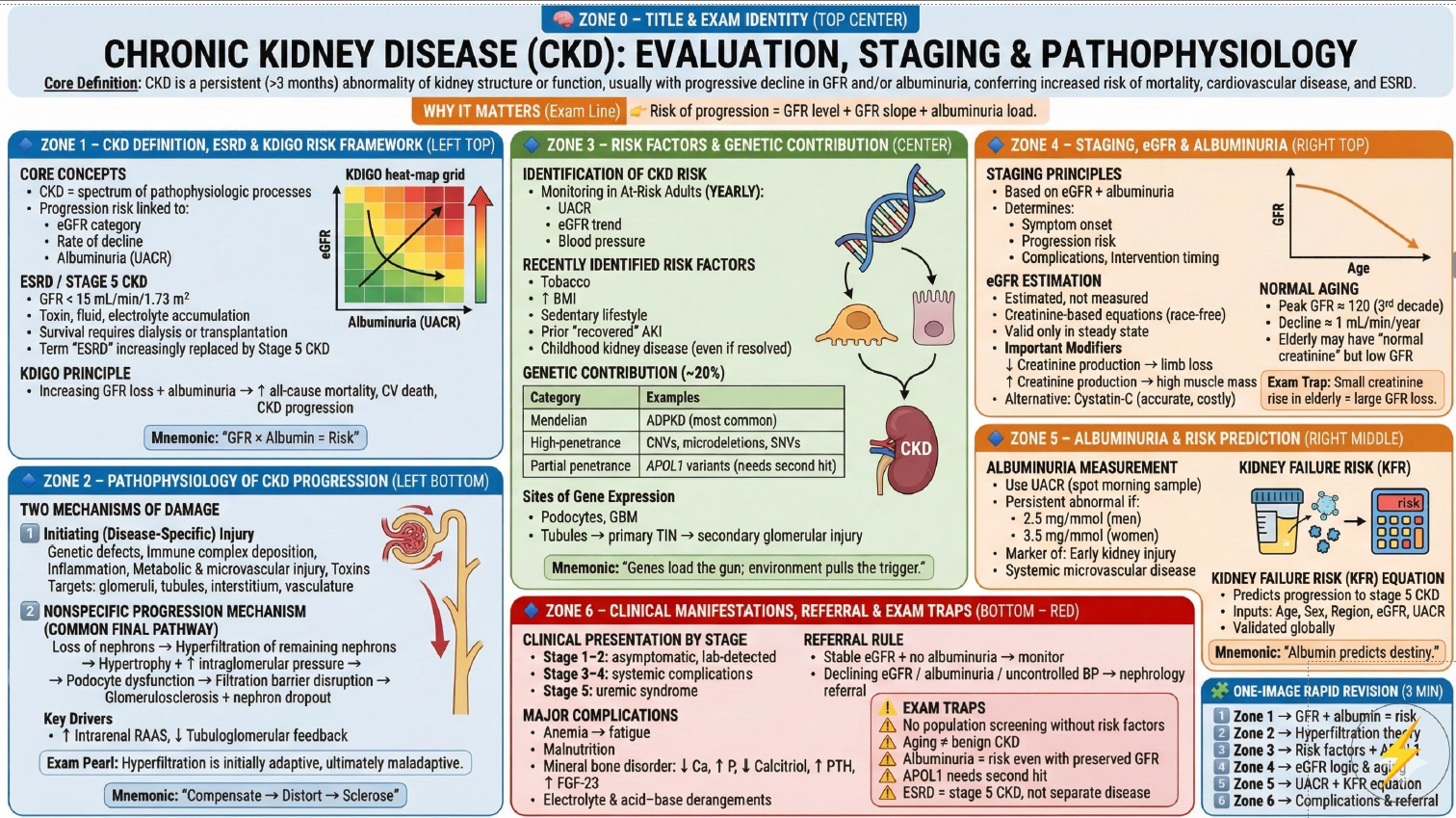
- Chronic Kidney Disease (CKD): abnormal kidney structure/function present for ≥3 months.
- Includes: eGFR <60 mL/min/1.73m2 on ≥2 occasions ≥90 days apart (with or without markers), or markers of kidney damage (e.g. albuminuria, haematuria of renal origin, structural disease) even if eGFR is ≥60.
- Why it matters: increasing ACR and falling eGFR predict higher risk of CKD progression, AKI, and cardiovascular events.
- The leading cause of death is cardiovascular disease
🫘 CKD: Summary Box
| Area | Key markers | Main interventions |
|---|---|---|
| Diagnosis / staging | eGFR, urine ACR, urinalysis, BP | Confirm chronicity >3 months where possible; stage by G category and ACR category; assess cause and progression risk. |
| Progression risk | Falling eGFR, rising ACR, haematuria, BP, diabetes control | Optimise BP, diabetes, ACEi/ARB where indicated, SGLT2 inhibitor if eligible, smoking cessation, salt reduction, avoid NSAIDs/nephrotoxins. |
| Blood pressure | Clinic/home BP, ACR, potassium, creatinine/eGFR | Target usually <140/90; lower target may be used with significant albuminuria. ACEi/ARB particularly important with diabetes or albuminuria. |
| Diabetes / renal protection | HbA1c, eGFR, ACR, potassium | Individualise HbA1c target; consider ACEi/ARB and SGLT2 inhibitor where eligible; review metformin and other drug doses as eGFR falls. |
| Cardiovascular risk | Lipids, BP, smoking, diabetes, QRISK context | Offer statin therapy, usually atorvastatin; address smoking, weight, exercise, BP and diabetes. |
| Anaemia of CKD | Hb, ferritin, transferrin saturation, B12/folate, CRP | Look for iron deficiency and other causes; iron replacement and ESA therapy usually via renal pathways when indicated. |
| Electrolytes / acid-base | Potassium, bicarbonate, U&E, medication review | Manage hyperkalaemia, acidosis and drug contributors; review ACEi/ARB, MRA, NSAIDs, trimethoprim and potassium supplements. |
| Fluid / salt | Weight, oedema, BP, JVP, urine output | Salt reduction, diuretics if overloaded, monitor renal function and electrolytes. |
| CKD-MBD | Calcium, phosphate, PTH, ALP, vitamin D | Manage hyperphosphataemia with diet/binders; correct vitamin D deficiency; renal specialist input for severe PTH disturbance. |
| Do-not-miss complications | Painful skin lesions, lytic bone lesions, severe PTH/Ca/PO₄ disturbance | Consider calciphylaxis with painful necrotic skin lesions and brown tumour with lytic bone lesions plus severe hyperparathyroidism. |
| Referral triggers | Rapid eGFR fall, ACR ≥70, ACR ≥30 with haematuria, resistant HTN, suspected renal cause | Refer/discuss with renal team for rapid progression, heavy albuminuria, glomerulonephritis features, advanced CKD, recurrent hyperkalaemia or uncertainty. |
📊 CKD Classification (use GFR + ACR)
- GFR categories (G):
- G1: ≥90 (CKD only if markers present)
- G2: 60–89 (CKD only if markers present)
- G3a: 45–59
- G3b: 30–44
- G4: 15–29
- G5: <15 (kidney failure)
- Albuminuria categories (A, by urine ACR):
- A1: <3 mg/mmol
- A2: 3–30 mg/mmol
- A3: >30 mg/mmol
🔖 Practical suffixes
- T = transplant recipient (e.g. CKD G3bA2T)
- D = dialysis (e.g. CKD G5D)
- Tip: NICE uses A1–A3 (ACR categories) rather than a “P” suffix; record the A category and the ACR value.
🧬 Aetiology (common)
- Diabetes mellitus
- Hypertension/vascular disease
- Glomerulonephritis.
- Polycystic kidney disease
- Reflux/tubulointerstitial disease
- Obstructive uropathy.
- Systemic disease (e.g. lupus, vasculitis)
- Medicines (e.g. NSAIDs, lithium)
- Myeloma (when suggested by phenotype).
🧠 Pathophysiology hook: falling eGFR reflects nephron loss; rising ACR reflects glomerular/endothelial injury. Albuminuria is a powerful “vascular damage” marker, so NICE stratifies BP targets and referral thresholds by ACR as well as GFR.
🧪 Diagnosis (NICE)
- Confirm chronicity: in a new reduced eGFR, repeat within 2 weeks to exclude AKI/acute deterioration; define progression using multiple readings over ≥90 days.
- Urine ACR: use ACR (more sensitive than PCR). If initial ACR 3–70, confirm on a repeat early-morning sample; no repeat needed if ACR ≥70.
- Urinalysis: haematuria/protein; consider renal-origin haematuria implications.
- Bloods: U&E/eGFR, potassium, bicarbonate, FBC, HbA1c (if diabetes), lipids; calcium/phosphate/PTH if advanced CKD or symptoms.
- Renal ultrasound if accelerated progression, persistent haematuria, obstruction symptoms, FHx ADPKD >20y, or eGFR <30 (G4–G5).
📉 Monitoring frequency (minimum eGFR checks per year – NICE Table 2)
- G1–G2: A1 = 0–1; A2 = 1; A3 = 1+
- G3a: A1 = 1; A2 = 1; A3 = 2
- G3b: A1 = 1–2; A2 = 2; A3 = 2+
- G4: A1 = 2; A2 = 2; A3 = 3
- G5: A1 = 4; A2 = 4+; A3 = 4+
- ACR monitoring: individualise based on risk and whether a change would alter management.
🎯 Blood pressure targets (NICE NG203)
- ACR <70 mg/mmol: aim clinic BP <140/90 (systolic target range 120–139).
- ACR ≥70 mg/mmol: aim clinic BP <130/80 (systolic target range 120–129).
- Frailty/multimorbidity: individualise (see NICE hypertension guidance).
💊 Proteinuria-lowering / kidney-protective therapy (NICE)
- Diabetes + ACR ≥3: offer ACEi or ARB titrated to the highest licensed tolerated dose.
- Hypertension + ACR >30 (A3): offer ACEi or ARB titrated to highest tolerated dose.
- No diabetes + ACR ≥70: refer and offer ACEi or ARB.
- RAAS safety: check eGFR and potassium before starting; repeat 1–2 weeks after starting and after each dose increase; avoid routine start if baseline K+ >5.0 mmol/L.
💔 CV risk reduction
- Statin: offer atorvastatin 20 mg for people with CKD (unless contraindicated/not appropriate).
- Smoking cessation, exercise, weight and dietary salt reduction are core interventions.
- Antiplatelet therapy is for secondary prevention when indicated, balancing bleeding risk.
🩸 Anaemia of CKD (NICE)
- Investigate/manage if Hb ≤110 g/L (or symptomatic).
- Diagnostic clue: if eGFR >60, anaemia is unlikely due to CKD; if eGFR <30, CKD is often contributory but still consider other causes.
- ESA targets: do not correct to normal; typically maintain Hb 100–120 g/L in adults; avoid Hb >120 g/L (CV risk).
 class="notebox">
🦴 CKD-MBD means chronic kidney disease–mineral and bone disorder. As GFR falls, phosphate excretion drops, vitamin D activation falls, calcium may fall, and PTH rises. This causes bone disease, vascular calcification, fracture risk and, rarely, severe complications such as calciphylaxis or brown tumours.
class="notebox">
🦴 CKD-MBD means chronic kidney disease–mineral and bone disorder. As GFR falls, phosphate excretion drops, vitamin D activation falls, calcium may fall, and PTH rises. This causes bone disease, vascular calcification, fracture risk and, rarely, severe complications such as calciphylaxis or brown tumours.
- Monitor calcium, phosphate, PTH, alkaline phosphatase and vitamin D as CKD advances, especially in CKD G4-G5 and dialysis patients.
- Persistent hyperphosphataemia should be managed with dietary phosphate reduction, dietetic input and phosphate binders according to local renal pathways.
- Interpret results together: do not treat phosphate, calcium or PTH in isolation.
- Refer/discuss with renal specialists if phosphate or PTH remains high, calcium is abnormal, symptoms develop, or CKD is advanced.
🧪 Why phosphate rises in CKD
- Healthy kidneys excrete dietary phosphate.
- In CKD, phosphate retention stimulates FGF23 and reduces active vitamin D production.
- Reduced active vitamin D lowers gut calcium absorption.
- Low calcium, high phosphate and low active vitamin D drive secondary hyperparathyroidism.
- Long-standing severe hyperparathyroidism can cause high-turnover bone disease and tertiary hyperparathyroidism.
📊 What to monitor
| Test | Why it matters |
|---|---|
| Phosphate | High levels contribute to secondary hyperparathyroidism, bone disease and vascular calcification. |
| Calcium | May be low in CKD-MBD, but can become high with calcium binders, vitamin D analogues or tertiary hyperparathyroidism. |
| PTH | Rises in secondary hyperparathyroidism; very high levels suggest severe renal bone disease. |
| ALP | High bone ALP may suggest high-turnover renal bone disease. |
| Vitamin D | Deficiency worsens secondary hyperparathyroidism and should be corrected where appropriate. |
🍽️ Management of Hyperphosphataemia
- Diet: reduce high-phosphate foods and phosphate additives; involve a renal dietitian where possible.
- Phosphate binders: taken with meals to bind dietary phosphate in the gut.
- Calcium-based binders: e.g. calcium acetate or calcium carbonate; avoid excess calcium load if hypercalcaemia or vascular calcification risk.
- Non-calcium binders: e.g. sevelamer, lanthanum or iron-based binders; often used if calcium-based binders are unsuitable or hypercalcaemia develops.
- Dialysis patients: phosphate control also depends on dialysis adequacy and adherence to binders.
💊 Calcium and Non-Calcium Phosphate Binders
🦴 Phosphate binders are used for persistent hyperphosphataemia in advanced CKD, usually CKD G4-G5 or dialysis. They must be taken with meals, because they bind dietary phosphate in the gut. NICE recommends calcium acetate first-line in adults unless unsuitable; use non-calcium binders if calcium-based binders are not tolerated or if calcium load is a concern.
| Type | Drug | Typical adult starting dose | Key points |
|---|---|---|---|
| Calcium-based | Calcium acetate | 1 tablet with each meal, adjusted to phosphate and calcium.
Common strengths: 475 mg or 950 mg. |
First-line in NICE. Avoid/reduce if hypercalcaemia, low PTH/adynamic bone risk, severe vascular calcification concern or constipation. |
| Calcium-based | Calcium carbonate | 1 tablet with meals, adjusted to response.
Often chewable preparations. |
Alternative if calcium acetate is not tolerated or unpalatable. Same cautions: hypercalcaemia, constipation and excess calcium load. |
| Non-calcium | Sevelamer carbonate | 800 mg TDS with meals, titrated to phosphate.
Powder preparations also exist. |
Use when calcium-based binder is unsuitable, poorly tolerated, or hypercalcaemia/vascular calcification risk is present. Can cause GI upset and drug-binding interactions. |
| Non-calcium | Lanthanum carbonate | 500 mg TDS with meals, titrated to phosphate. | Chewable/crushable binder. Usually renal specialist-directed. GI side effects common. |
| Non-calcium / iron-based | Sucroferric oxyhydroxide | 500 mg TDS with meals, titrated to phosphate. | Lower tablet burden may help adherence. Can cause diarrhoea and dark stools. Specialist/renal-directed. |
| Non-calcium / iron-based | Ferric citrate | Taken with meals; dose varies by product and renal protocol. | May increase iron stores. Monitor ferritin/TSAT and GI effects. Local availability varies. |
| Aluminium-based | Aluminium hydroxide | Specialist short-course only. | Generally avoided long term because of aluminium accumulation, bone disease and neurotoxicity risk. |
🧠 Choosing a Binder
- Use calcium acetate first-line if calcium is not high and calcium load is acceptable.
- Use calcium carbonate if calcium acetate is not tolerated or is unpalatable.
- Use sevelamer if hypercalcaemia, vascular calcification concern, low PTH/adynamic bone risk, or intolerance of calcium-based binders.
- Use specialist options such as lanthanum or iron-based binders if phosphate remains high or tablet burden/adherence is a problem.
- Review phosphate, corrected calcium, PTH, ALP, vitamin D, adherence and diet before escalating treatment.
⚠️ Prescribing pearl: Calcium binders add calcium load, so they can worsen hypercalcaemia and may contribute to vascular calcification in high-risk patients. Non-calcium binders avoid calcium loading but are often more expensive and usually renal specialist-led.
💊 PTH / Vitamin D Management
- Correct modifiable drivers first: hyperphosphataemia, hypocalcaemia and vitamin D deficiency.
- Specialists may use active vitamin D analogues, calcimimetics such as cinacalcet, or parathyroidectomy in severe refractory hyperparathyroidism.
- Avoid over-suppression of PTH, as this can contribute to low-turnover/adynamic bone disease.
🚩 Rare but Important CKD-MBD Complications
- Calciphylaxis: painful retiform purpura, livedoid plaques, ulceration or necrotic skin lesions, usually in advanced CKD/dialysis. It is associated with high mortality and needs urgent renal, dermatology and tissue viability input.
- Brown tumour: focal lytic bone lesion due to severe secondary or tertiary hyperparathyroidism. It may mimic metastasis or myeloma and is associated with very high PTH and renal osteodystrophy.
- Check calcium, phosphate, PTH, ALP, vitamin D and renal function; consider imaging and biopsy depending on presentation.
🧠 Teaching point: CKD-MBD is not just “low calcium”. The usual sequence is phosphate retention → reduced active vitamin D → hypocalcaemic drive → secondary hyperparathyroidism. Severe disease can damage both bone and blood vessels, so painful necrotic skin lesions or unexplained lytic bone lesions in CKD should trigger specialist review.
🧯 Metabolic acidosis (NICE)
- Consider oral sodium bicarbonate if eGFR <30 (G4–G5) and serum bicarbonate <20 mmol/L.
🚑 When to refer (NICE NG203)
- KFRE: 5-year risk of needing RRT >5% (4-variable KFRE).
- ACR ≥70 mg/mmol (unless due to diabetes and already appropriately treated).
- ACR >30 with haematuria.
- Progression: sustained eGFR drop ≥25% with category change in 12 months, or ≥15 mL/min/1.73m2 per year.
- Resistant hypertension despite ≥4 agents, suspected genetic/rare CKD, suspected renal artery stenosis.
📚 References
- NICE NG203: Chronic kidney disease: assessment and management (Published 25 Aug 2021; last updated 24 Nov 2021)
- NICE NG203 Recommendations (BP targets, ACR confirmation, referral criteria, RAAS monitoring, anaemia, bicarbonate)
- NICE CKS: Chronic kidney disease
- NICE QS5: Statins for people with CKD (atorvastatin 20 mg)
| The content on this website is provided for educational and informational purposes only to support exam preparation (e.g., MLA, MRCP, USMLE) and learning. This is NOT medical advice, diagnosis, treatment, or professional guidance. It does not replace consultation with a qualified healthcare professional, official guidelines (e.g., NICE, GMC, BNF), or supervised clinical practice. Always verify information with current, authoritative sources. Makindo and its contributors accept no liability for any reliance on this content, including errors, omissions, or any resulting harm, loss, or consequences. By using this site, you agree to these terms. |
|
|
Categories
- About
- Acute Medicine
- Anaesthetics and Critical Care
- Anatomy
- Anatomy and Physiology
- Biochemistry
- Book
- Cardiology
- Collections
- CompSci
- Crib Sheets
- Critical care
- Dental
- Dermatology
- Differentials
- Drugs
- ENT
- Electrocardiogram
- Embryology
- Emergency Medicine
- Endocrinology
- Ethics
- Foundation Doctors
- GCSE
- Gastroenterology
- General Practice
- Genetics
- Geriatric Medicine
- Geriatrics
- Guidelines
- Haematology
- Hepatology
- Immunology
- Infectious Diseases
- Infographic
- Investigations
- Lists
- MRCP
- Mandatory Training
- Medical Students
- Microbiology
- Nephrology
- Neurology
- Neurosurgery
- Nutrition
- OSCE
- Obstetrics Gynaecology
- Oncology
- Ophthalmology
- Oral Medicine and Dentistry
- Orthopaedics
- Paediatrics
- Palliative
- Palliative Care
- Pathology
- Pharmacology
- Physiology
- Procedures
- Psychiatry
- Public Health
- Radiology
- Respiratory
- Resuscitation
- Revision Topics
- Rheumatology
- Statistics and Research
- Stroke
- Surgery
- Toxicology
- Trauma and Orthopaedics
- USMLE
- Urology
- Vascular Surgery