
| Download the amazing global Makindo app: ✅ Means NICE/National Guidelines 2026 compliant Android | Apple | |
|---|---|
| MEDICAL DISCLAIMER: Educational use only. Not for diagnosis or management. See below for full disclaimer. |
Low CSF pressure Headache
Related Subjects:Migraine |Basilar Migraine |Cluster Headaches |Sumatriptan |Tension Headache |Analgesic Overuse Headache |Headaches in General
🧠 Low CSF Pressure Headache (also called CSF leak headache or intracranial hypotension) occurs when cerebrospinal fluid (CSF) pressure falls below normal. This usually results from a spinal CSF leak, either spontaneous or iatrogenic. The hallmark is a postural headache-worse upright, relieved by lying flat.
📌 About
- Results from a reduction in CSF volume/pressure due to leakage.
- Leads to brain sagging within the skull, causing pain, cranial nerve stretch, and venous engorgement.
- Most often linked to lumbar puncture or spontaneous dural tear, but also seen after trauma or surgery.
🧬 Aetiology
- Spontaneous CSF Leak: Small dural tear, often thoracic or cervical spine. Associated with connective tissue disorders (e.g., Marfan, Ehlers–Danlos).
- Post-Lumbar Puncture: Commonest iatrogenic cause; dural puncture may not fully seal.
- Trauma: Spinal or head trauma tearing the dura.
- Post-Surgical: Especially after spinal/neurosurgical procedures.
- Connective Tissue Disorders: Weakened dura predisposes to leaks.
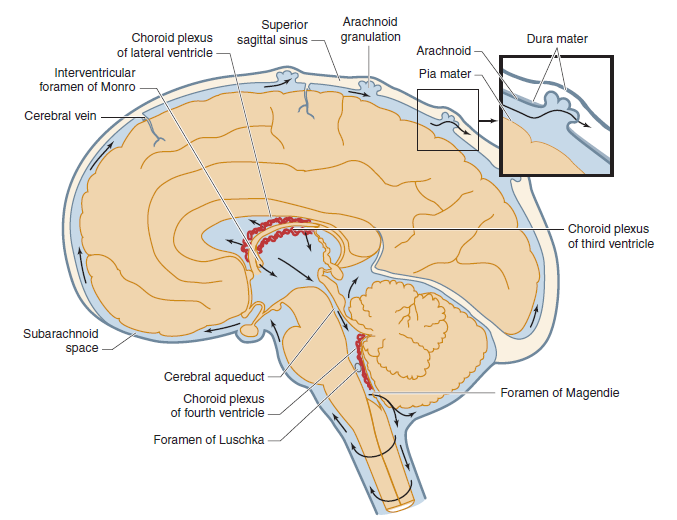
💡 CSF circulation: Produced by the choroid plexus in ventricles → flows via aqueducts & foramina → circulates in subarachnoid space → absorbed by arachnoid granulations → venous system. A leak disrupts this balance → ↓ intracranial pressure.
🩺 Clinical Features
- Headache: Diffuse, throbbing, often occipital. Worsens upright, relieved supine (orthostatic headache).
- May be worse in the morning and improve with rest.
- Associated symptoms: nausea, vomiting, neck stiffness, tinnitus, hearing changes.
- Cranial nerve palsies (esp. CN VI → diplopia) due to traction.
- Rare: cognitive slowing, encephalopathy, or coma in severe untreated cases ⚠️.
🔍 Investigations
- MRI brain with gadolinium: Shows diffuse meningeal enhancement, “brain sagging,” or subdural hygromas.
- Spinal MRI or CT myelography: To locate the leak (contrast extravasation).
- Intrathecal contrast MRI: High sensitivity for pinpointing leaks.
- Radioisotope cisternography: Rarely used now.
💊 Management
- Conservative: Bed rest, oral/IV fluids, caffeine (vasoconstrictor, ↑CSF production).
- Epidural Blood Patch: Standard treatment for post–lumbar puncture headache. Injected autologous blood seals leak; success rates >90%.
- Surgical Repair: Required for persistent or recurrent leaks (direct dural closure or fibrin glue).
- Symptomatic: Analgesics, antiemetics, avoidance of straining.
- Monitoring: Recurrence possible, esp. in connective tissue disorders.
📈 Prognosis
- Most post-LP leaks resolve with an epidural blood patch.
- Spontaneous leaks may require repeat interventions but often respond to targeted patches or repair.
- Untreated, chronic CSF hypotension can lead to subdural haematomas or permanent neurological deficits.
| The content on this website is provided for educational and informational purposes only to support exam preparation (e.g., MLA, MRCP, USMLE) and learning. This is NOT medical advice, diagnosis, treatment, or professional guidance. It does not replace consultation with a qualified healthcare professional, official guidelines (e.g., NICE, GMC, BNF), or supervised clinical practice. Always verify information with current, authoritative sources. Makindo and its contributors accept no liability for any reliance on this content, including errors, omissions, or any resulting harm, loss, or consequences. By using this site, you agree to these terms. |
|
|
Categories
- About
- Acute Medicine
- Anaesthetics and Critical Care
- Anatomy
- Anatomy and Physiology
- Biochemistry
- Book
- Cardiology
- Collections
- CompSci
- Crib Sheets
- Critical care
- Dental
- Dermatology
- Differentials
- Drugs
- ENT
- Electrocardiogram
- Embryology
- Emergency Medicine
- Endocrinology
- Ethics
- Foundation Doctors
- GCSE
- Gastroenterology
- General Practice
- Genetics
- Geriatric Medicine
- Geriatrics
- Guidelines
- Haematology
- Hepatology
- Immunology
- Infectious Diseases
- Infographic
- Investigations
- Lists
- MRCP
- Mandatory Training
- Medical Students
- Microbiology
- Nephrology
- Neurology
- Neurosurgery
- Nutrition
- OSCE
- Obstetrics Gynaecology
- Oncology
- Ophthalmology
- Oral Medicine and Dentistry
- Orthopaedics
- Paediatrics
- Palliative
- Palliative Care
- Pathology
- Pharmacology
- Physiology
- Procedures
- Psychiatry
- Public Health
- Radiology
- Respiratory
- Resuscitation
- Revision Topics
- Rheumatology
- Statistics and Research
- Stroke
- Surgery
- Toxicology
- Trauma and Orthopaedics
- USMLE
- Urology
- Vascular Surgery