
| Download the amazing global Makindo app: ✅ Means NICE/National Guidelines 2026 compliant Android | Apple | |
|---|---|
| MEDICAL DISCLAIMER: Educational use only. Not for diagnosis or management. See below for full disclaimer. |
Types of Joints
Related Subjects: |Shoulder Joint Structure and Form |Knee Joint Structure and Form |Wrist Joint Structure and Form |Types of Joints
Types of Joints
Joints, also known as articulations, are connections between bones in the skeletal system. They provide mobility and hold the skeleton together. Joints can be classified based on their structure and function.
Structural Classification of Joints
- Fibrous Joints :
- Bones are connected by dense fibrous connective tissue.
- No joint cavity is present.
- Types:
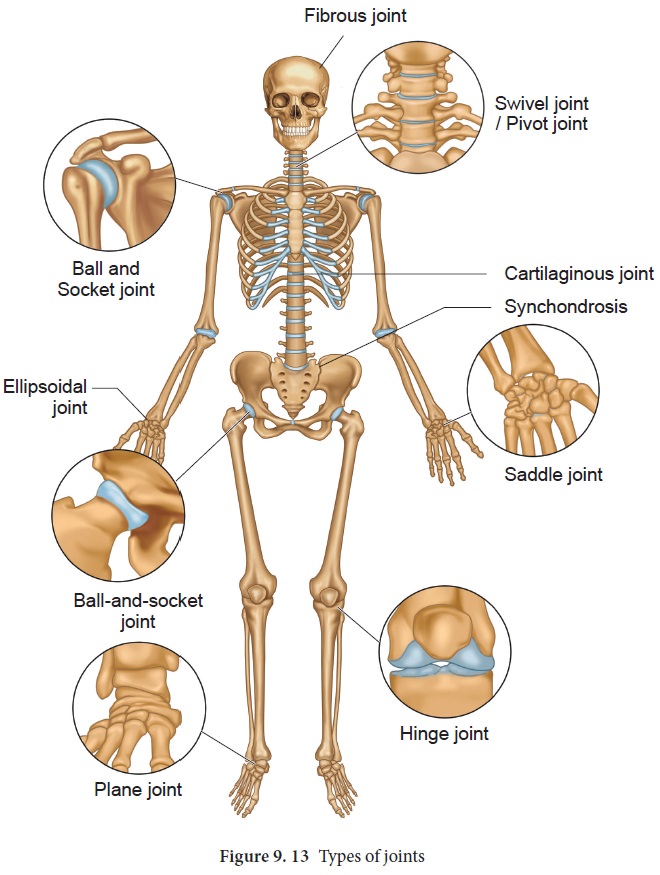
- Sutures : Found between the bones of the skull; immovable.
- Syndesmoses : Bones are connected by ligaments; allow slight movement (e.g., the distal connection between the tibia and fibula).
- Gomphoses : Peg-in-socket fibrous joint; found in teeth and their sockets.
- Cartilaginous Joints :
- Bones are united by cartilage.
- No joint cavity is present.
- Types:
- Synchondroses : Hyaline cartilage unites bones; mostly immovable (e.g., the epiphyseal plates in growing bones).
- Symphyses : Fibrocartilage unites bones; slightly movable (e.g., intervertebral discs, pubic symphysis).
- Synovial Joints :
- Characterized by a fluid-filled joint cavity.
- Allow a wide range of movements.
- Types:
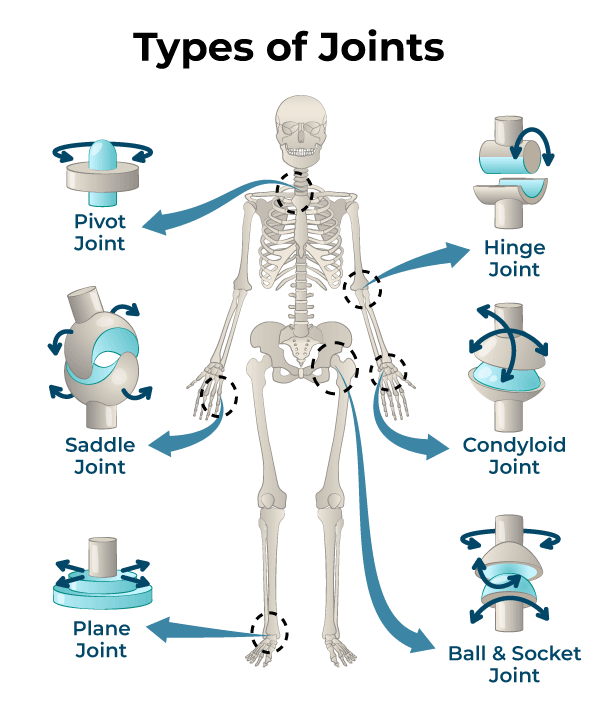
- Plane Joints : Allow gliding or sliding movements (e.g., intercarpal joints).
- Hinge Joints : Allow movement in one plane (flexion and extension) (e.g., elbow and knee joints).
- Pivot Joints : Allow rotational movement around a single axis (e.g., atlantoaxial joint).
- Condyloid (Ellipsoidal) Joints : Allow movement in two planes (e.g., wrist joint).
- Saddle Joints : Allow movement in two planes with greater freedom (e.g., carpometacarpal joint of the thumb).
- Ball-and-Socket Joints : Allow movement in multiple planes and rotation (e.g., shoulder and hip joints).
Functional Classification of Joints
- Synarthroses :
- Immovable joints.
- Examples: Sutures of the skull, gomphoses.
- Amphiarthroses :
- Slightly movable joints.
- Examples: Syndesmoses, symphyses.
- Diarthroses :
- Freely movable joints.
- All synovial joints fall into this category.
- Examples: Shoulder, hip, knee, and elbow joints.
Summary
Joints are crucial for movement and stability in the skeletal system. They can be classified based on their structure (fibrous, cartilaginous, and synovial) and function (synarthroses, amphiarthroses, and diarthroses). Understanding the different types of joints helps in diagnosing joint-related issues and planning appropriate treatments.