
| Download the amazing global Makindo app: ✅ Means NICE/National Guidelines 2026 compliant Android | Apple | |
|---|---|
| MEDICAL DISCLAIMER: Educational use only. Not for diagnosis or management. See below for full disclaimer. |
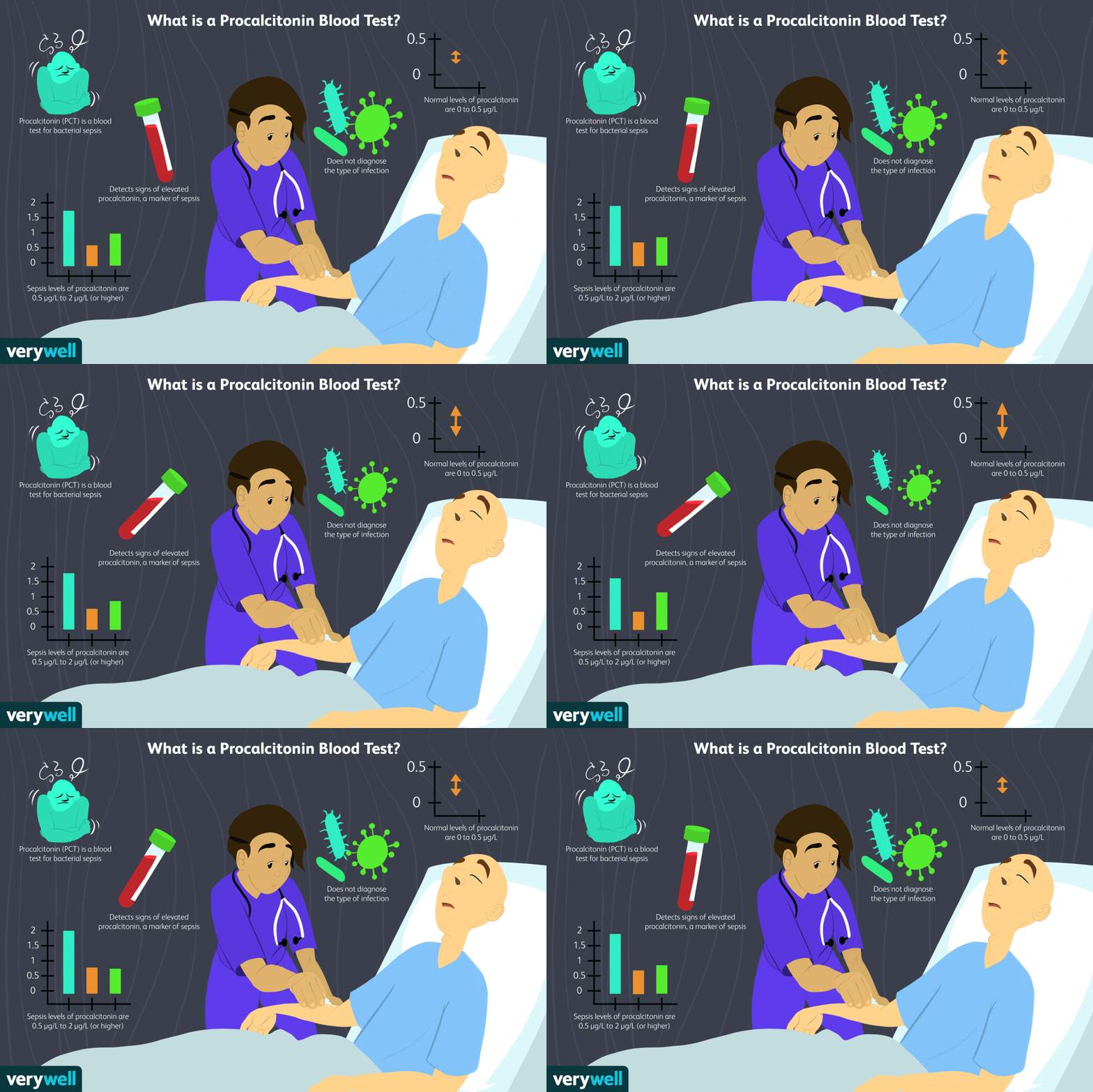
Procalcitonin (PCT) 🧪
Procalcitonin (PCT) is the 116–amino-acid precursor of calcitonin. In health, it is produced in thyroid C-cells and rapidly cleaved, so circulating levels are negligible. In systemic bacterial infection, however, PCT is synthesised ubiquitously by parenchymal tissues (lung, liver, kidney, adipose), making it a useful biomarker of bacterial-driven inflammation.
🧠 Physiology
Bacterial endotoxin and pro-inflammatory cytokines (IL-1β, TNF-α, IL-6) upregulate CALC-1 gene expression outside the thyroid, leading to a rapid rise in circulating PCT. Crucially, interferon-γ-prominent in viral infections and autoimmune disease-suppresses PCT production. This physiological “brake” explains why PCT tends to remain low in viral illness and sterile inflammation, unlike CRP.
⏱️ Kinetics
- Rise: detectable within 4–6 hours of bacterial insult
- Peak: ~12–24 hours
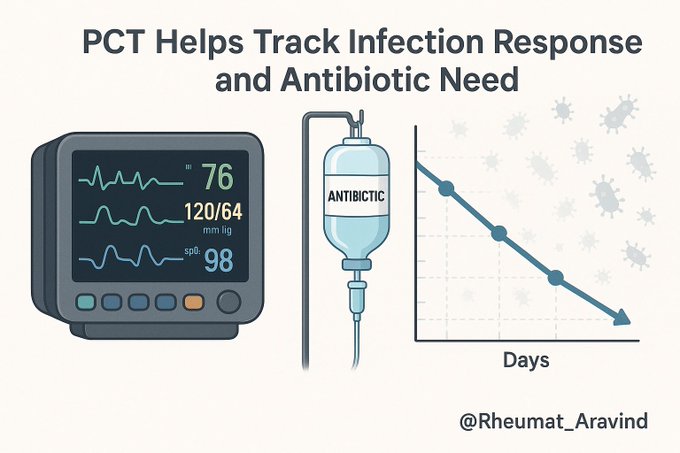
- Half-life: ~24 hours (falls predictably if source control achieved)
- Clinical implication: serial measurements are more informative than a single value
🩺 Clinical Uses
- Sepsis & ICU: Supports early recognition of bacterial sepsis and antibiotic stewardship; falling PCT supports de-escalation.
- Respiratory infection: Helps distinguish bacterial pneumonia from viral/LRTI phenotypes when used with clinical assessment.
- Rheumatology: In conditions like SLE, CRP may rise during flares, but PCT usually remains low; a raised PCT should prompt infection work-up.
⚖️ Interpreting PCT with CRP
- High CRP + Normal PCT: Likely autoimmune or sterile inflammation
- High CRP + High PCT: Suggests bacterial infection
- Normal CRP + High PCT: Early bacterial infection or non-inflammatory context
🧬 Pathology & Pitfalls
- False negatives: Localised infections (e.g. abscess, osteomyelitis)
- False positives: Major surgery, trauma, cardiogenic shock, severe burns
- Renal impairment: Reduced clearance may modestly elevate baseline levels
🇬🇧 UK Context & Teaching Pearl
In the NHS, PCT is most useful when embedded in protocol-driven pathways (e.g. ICU sepsis bundles) rather than as a stand-alone test. It should never override clinical judgement, cultures, or imaging.
📌 Makindo pearl: CRP tells you there is “fire” (inflammation). PCT helps decide whether the “smoke” is bacterial. Use both, trend them, and always interpret in clinical context.
| The content on this website is provided for educational and informational purposes only to support exam preparation (e.g., MLA, MRCP, USMLE) and learning. This is NOT medical advice, diagnosis, treatment, or professional guidance. It does not replace consultation with a qualified healthcare professional, official guidelines (e.g., NICE, GMC, BNF), or supervised clinical practice. Always verify information with current, authoritative sources. Makindo and its contributors accept no liability for any reliance on this content, including errors, omissions, or any resulting harm, loss, or consequences. By using this site, you agree to these terms. |
|
|
Categories
- About
- Acute Medicine
- Anaesthetics and Critical Care
- Anatomy
- Anatomy and Physiology
- Biochemistry
- Book
- Cardiology
- Collections
- CompSci
- Crib Sheets
- Critical care
- Dental
- Dermatology
- Differentials
- Drugs
- ENT
- Electrocardiogram
- Embryology
- Emergency Medicine
- Endocrinology
- Ethics
- Foundation Doctors
- GCSE
- Gastroenterology
- General Practice
- Genetics
- Geriatric Medicine
- Geriatrics
- Guidelines
- Haematology
- Hepatology
- Immunology
- Infectious Diseases
- Infographic
- Investigations
- Lists
- MRCP
- Mandatory Training
- Medical Students
- Microbiology
- Nephrology
- Neurology
- Neurosurgery
- Nutrition
- OSCE
- Obstetrics Gynaecology
- Oncology
- Ophthalmology
- Oral Medicine and Dentistry
- Orthopaedics
- Paediatrics
- Palliative
- Palliative Care
- Pathology
- Pharmacology
- Physiology
- Procedures
- Psychiatry
- Public Health
- Radiology
- Respiratory
- Resuscitation
- Revision Topics
- Rheumatology
- Statistics and Research
- Stroke
- Surgery
- Toxicology
- Trauma and Orthopaedics
- USMLE
- Urology
- Vascular Surgery