
| Download the amazing global Makindo app: ✅ Means NICE/National Guidelines 2026 compliant Android | Apple | |
|---|---|
| MEDICAL DISCLAIMER: Educational use only. Not for diagnosis or management. See below for full disclaimer. |
Pituitary Apoplexy
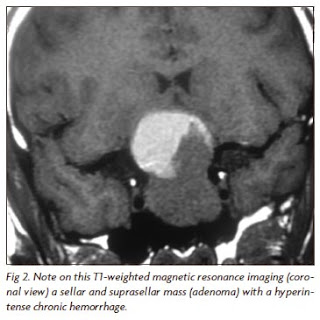
⚡ A pituitary tumour may haemorrhage or infarct → seen especially in large macroadenomas. This is a true endocrine & neurosurgical emergency. Pituitary tumour outgrows its blood supply or is compromised by a fall in blood pressure.
🧾 Causes
- 🏥 Existing Adenoma: Most cases occur in pre-existing pituitary macroadenomas.
- 💉 Anticoagulation therapy: ↑ risk of haemorrhage.
- 🩺 Major surgery/trauma: Physical stress as a trigger.
- 🤰 Pregnancy: Hormonal changes increase risk.
- ❤️ Hypertension: Increases chance of pituitary bleed.
- ☢️ Radiotherapy: May precipitate apoplexy.
- ⚗️ Other: Pituitary stimulation tests, infections.
🤒 Clinical Presentation
- 💥 Sudden severe "thunderclap" headache.
- 👁️ Visual loss, bitemporal hemianopia, ophthalmoplegia.
- 🧠 Collapse, delirium, ↓ consciousness or coma.
- 🩸 Hypotension due to acute secondary hypoadrenalism.
- Can mimic subarachnoid haemorrhage.
🔎 Investigations
- 🧪 Bloods: FBC, U&E, LFT, clotting profile.
- 🧬 Endocrine tests: Cortisol, ACTH, TFTs, PRL.
- 🖥️ MRI: Gold standard for detecting pituitary haemorrhage/infarct.
- 🩻 CT: Useful acutely but less sensitive than MRI.
- 👁️ Visual fields: Assess visual loss/field defects.
🏥 Management
|
💉 Immediate IV Hydrocortisone 100–200 mg stat, then 6-hourly IM/IV.
🧠 Urgent neurosurgical referral → transsphenoidal decompression if visual compromise or reduced GCS. 🔄 Endocrinology + neurosurgery joint management essential. 📋 Post-op: monitor pituitary function; switch to oral hydrocortisone if stable. |
📊 Prognosis
- Depends on speed of recognition + treatment.
- 👁️ Visual recovery: Best if decompression performed early.
- 🧬 Endocrine: Many require lifelong hormone replacement due to hypopituitarism.
📚 References
| The content on this website is provided for educational and informational purposes only to support exam preparation (e.g., MLA, MRCP, USMLE) and learning. This is NOT medical advice, diagnosis, treatment, or professional guidance. It does not replace consultation with a qualified healthcare professional, official guidelines (e.g., NICE, GMC, BNF), or supervised clinical practice. Always verify information with current, authoritative sources. Makindo and its contributors accept no liability for any reliance on this content, including errors, omissions, or any resulting harm, loss, or consequences. By using this site, you agree to these terms. |
|
|
Categories
- About
- Acute Medicine
- Anaesthetics and Critical Care
- Anatomy
- Anatomy and Physiology
- Biochemistry
- Book
- Cardiology
- Collections
- CompSci
- Crib Sheets
- Critical care
- Dental
- Dermatology
- Differentials
- Drugs
- ENT
- Electrocardiogram
- Embryology
- Emergency Medicine
- Endocrinology
- Ethics
- Foundation Doctors
- GCSE
- Gastroenterology
- General Practice
- Genetics
- Geriatric Medicine
- Geriatrics
- Guidelines
- Haematology
- Hepatology
- Immunology
- Infectious Diseases
- Infographic
- Investigations
- Lists
- MRCP
- Mandatory Training
- Medical Students
- Microbiology
- Nephrology
- Neurology
- Neurosurgery
- Nutrition
- OSCE
- Obstetrics Gynaecology
- Oncology
- Ophthalmology
- Oral Medicine and Dentistry
- Orthopaedics
- Paediatrics
- Palliative
- Palliative Care
- Pathology
- Pharmacology
- Physiology
- Procedures
- Psychiatry
- Public Health
- Radiology
- Respiratory
- Resuscitation
- Revision Topics
- Rheumatology
- Statistics and Research
- Stroke
- Surgery
- Toxicology
- Trauma and Orthopaedics
- USMLE
- Urology
- Vascular Surgery