
| Download the amazing global Makindo app: ✅ Means NICE/National Guidelines 2026 compliant Android | Apple | |
|---|---|
| MEDICAL DISCLAIMER: Educational use only. Not for diagnosis or management. See below for full disclaimer. |
The Brachial plexus
Related Subjects: |Radial Nerve |Median Nerve |Ulnar Nerve |Musculocutaneous nerve |Axillary nerve |Brachial plexus |Dermatomes
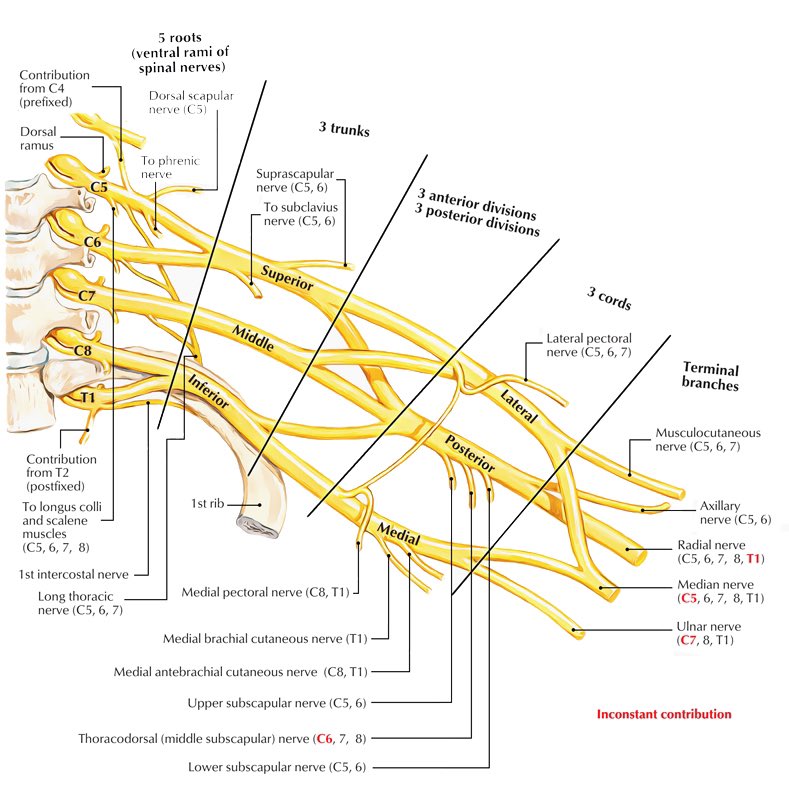
The brachial plexus is a complex network of nerves that originates from the spinal cord in the neck and provides motor and sensory innervation to the shoulder, arm, forearm, and hand.
Anatomy of the Brachial Plexus
- Roots :
- Formed by the anterior rami of spinal nerves C5, C6, C7, C8, and T1.
- Trunks :
- Upper Trunk : Formed by C5 and C6 roots.
- Middle Trunk : Continuation of C7 root.
- Lower Trunk : Formed by C8 and T1 roots.
- Divisions :
- Each trunk splits into anterior and posterior divisions.
- Cords :
- Lateral Cord : anterior divisions of upper & middle trunks.
- Posterior Cord : posterior divisions of all trunks.
- Medial Cord : anterior division of lower trunk.
- Terminal Branches :
- Musculocutaneous : flexor compartment of arm.
- Axillary : deltoid, teres minor.
- Radial : extensors of arm & forearm.
- Median : most forearm flexors + thenar muscles.
- Ulnar : flexor carpi ulnaris, intrinsic hand muscles.
Mnemonic
👉 “Randy Travis Drinks Cold Beer” = Roots → Trunks → Divisions → Cords → Branches.
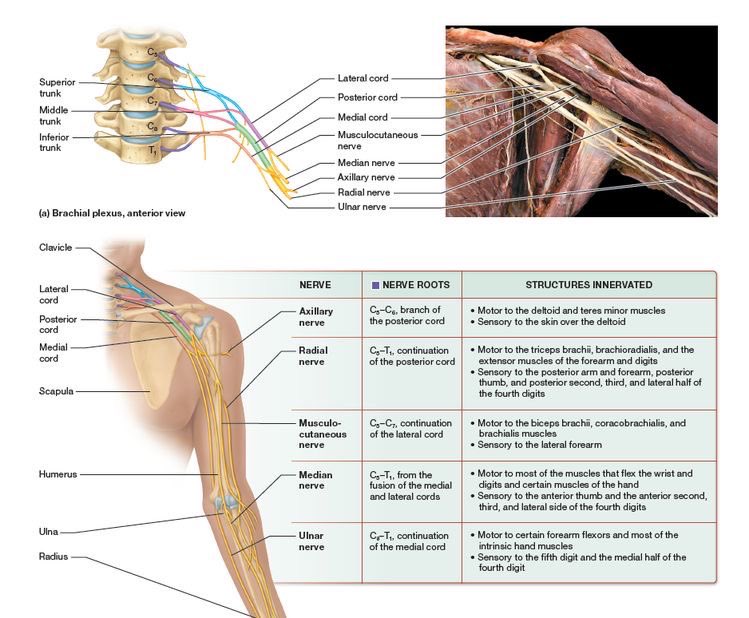
Functions of the Brachial Plexus
- Motor: Shoulder, arm, forearm, and hand movement.
- Sensory: Skin of shoulder, arm, forearm, and hand.
Key Clinical Syndromes
- Erb's Palsy (C5–C6): “Waiter’s tip” → loss of abduction, flexion, and supination.
- Klumpke’s Palsy (C8–T1): Claw hand ± Horner’s syndrome.
- Radial Nerve Injury: Wrist drop, sensory loss dorsum hand.
- Median Nerve Injury: Thenar wasting, loss of thumb opposition, sensory loss radial 3½ digits.
- Ulnar Nerve Injury: Intrinsic weakness, clawing of medial fingers, sensory loss ulnar 1½ digits.
- Winged Scapula: Long thoracic nerve damage → serratus anterior paralysis.
- Thoracic Outlet Syndrome: Compression at thoracic outlet → pain, weakness, numbness.
Summary Table – Nerves, Roots, Muscles, Sensory
| Nerve | Roots | Key Muscles | Key Sensory Supply |
|---|---|---|---|
| Musculocutaneous | C5–C7 | Biceps, brachialis, coracobrachialis | Lateral forearm |
| Axillary | C5–C6 | Deltoid, teres minor | Regimental badge area (lateral shoulder) |
| Radial | C5–T1 | Triceps, forearm extensors | Dorsum of hand, posterior arm |
| Median | C5–T1 | Forearm flexors, thenar muscles | Palmar thumb, index, middle, radial half ring finger |
| Ulnar | C8–T1 | FCU, medial FDP, intrinsic hand muscles | Little finger + ulnar half ring finger |
Diagnostic Techniques
- Clinical Exam: Motor & sensory mapping.
- Electromyography (EMG) + Nerve Conduction: Distinguish myopathy vs neuropathy.
- Imaging: MRI / ultrasound to assess compressions or trauma.
Summary
The brachial plexus supplies motor and sensory function to the upper limb. Key exam pearls: 👉 Erb’s palsy = Waiter’s tip, Klumpke’s = Claw hand ± Horner’s. 👉 Mnemonic “Randy Travis Drinks Cold Beer” helps recall its structure. 👉 Injury patterns are highly testable in OSCEs and exams.
| The content on this website is provided for educational and informational purposes only to support exam preparation (e.g., MLA, MRCP, USMLE) and learning. This is NOT medical advice, diagnosis, treatment, or professional guidance. It does not replace consultation with a qualified healthcare professional, official guidelines (e.g., NICE, GMC, BNF), or supervised clinical practice. Always verify information with current, authoritative sources. Makindo and its contributors accept no liability for any reliance on this content, including errors, omissions, or any resulting harm, loss, or consequences. By using this site, you agree to these terms. |
|
|
Categories
- About
- Acute Medicine
- Anaesthetics and Critical Care
- Anatomy
- Anatomy and Physiology
- Biochemistry
- Book
- Cardiology
- Collections
- CompSci
- Crib Sheets
- Critical care
- Dental
- Dermatology
- Differentials
- Drugs
- ENT
- Electrocardiogram
- Embryology
- Emergency Medicine
- Endocrinology
- Ethics
- Foundation Doctors
- GCSE
- Gastroenterology
- General Practice
- Genetics
- Geriatric Medicine
- Geriatrics
- Guidelines
- Haematology
- Hepatology
- Immunology
- Infectious Diseases
- Infographic
- Investigations
- Lists
- MRCP
- Mandatory Training
- Medical Students
- Microbiology
- Nephrology
- Neurology
- Neurosurgery
- Nutrition
- OSCE
- Obstetrics Gynaecology
- Oncology
- Ophthalmology
- Oral Medicine and Dentistry
- Orthopaedics
- Paediatrics
- Palliative
- Palliative Care
- Pathology
- Pharmacology
- Physiology
- Procedures
- Psychiatry
- Public Health
- Radiology
- Respiratory
- Resuscitation
- Revision Topics
- Rheumatology
- Statistics and Research
- Stroke
- Surgery
- Toxicology
- Trauma and Orthopaedics
- USMLE
- Urology
- Vascular Surgery