
| Download the amazing global Makindo app: ✅ Means NICE/National Guidelines 2026 compliant Android | Apple | |
|---|---|
| MEDICAL DISCLAIMER: Educational use only. Not for diagnosis or management. See below for full disclaimer. |
Complement
Related Subjects: |Major Histocompatibility complex |Immune response |Complement |Opsonisation |Toll-like Receptors (TLRs) |Immunoglobulins |Immunology |X linked Agammaglobulinaemia (Bruton) |X-linked lymphoproliferative disease (Children) |Chediak Higashi syndrome |Common variable immunodeficiency |Severe combined immunodeficiency disorders |DiGeorge syndrome (thymic aplasia) |Selective IgA deficiency |Wiskott-Aldrich syndrome (Children) |T lymphocytes
🛡️ The complement system is a tightly regulated cascade of plasma proteins that forms a central bridge between innate and adaptive immunity. It amplifies antibody function, enhances phagocytosis, recruits inflammatory cells, and can directly destroy pathogens through membrane pore formation. Physiologically, complement acts as a “biological alarm system” - rapidly triggered by microbes, immune complexes, or damaged tissue.
🔑 Core Principles
- System Architecture
- ⚙️ Comprises >30 circulating and membrane-bound proteins.
- Main effector components: C1–C9.
- Includes regulators (Factor H, CD55, CD59) and receptors (CR1–CR4).
- Proteins circulate in inactive pro-enzyme form → rapid amplification when triggered.
- Cascade Logic
- Each activation step cleaves the next component → exponential signal amplification.
- Small triggers generate large inflammatory and opsonic responses.
- Unchecked activation risks host tissue injury.
🛣️ Pathways of Complement Activation
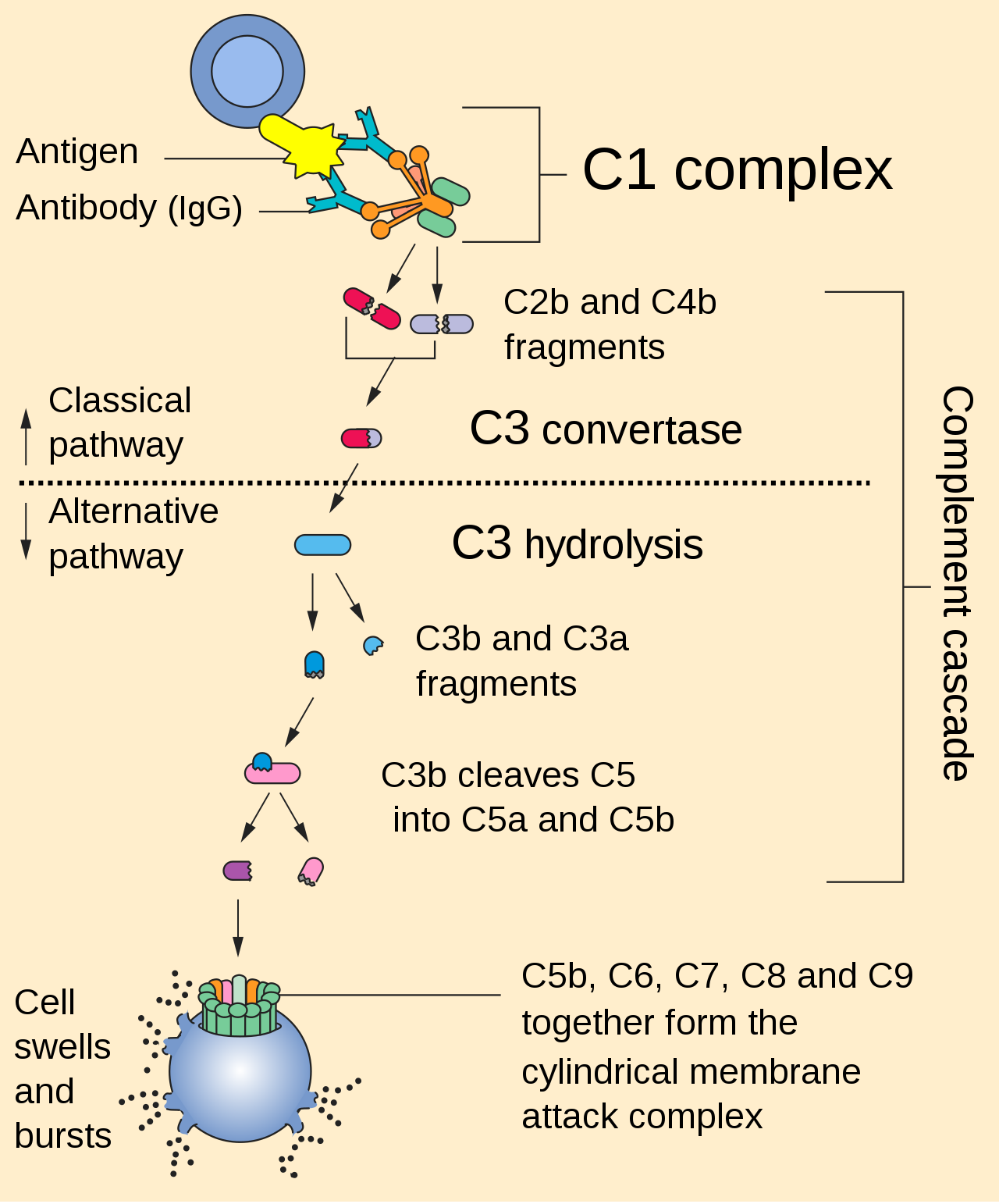
- 📘 Classical Pathway (Antibody-Dependent)
- Triggered by IgG or IgM bound to antigen.
- C1q binds Fc region → activates C1r and C1s.
- C4 and C2 cleavage → C3 convertase (C4b2a).
- Links adaptive immunity to innate effector mechanisms.
- 📗 Lectin Pathway (Pattern Recognition)
- Triggered by mannose-binding lectin (MBL) or ficolins.
- Recognises microbial carbohydrates.
- MASP activation → C4b2a formation.
- Functions independently of antibodies.
- 📙 Alternative Pathway (Spontaneous Surveillance)
- Continuous low-level C3 hydrolysis (“tick-over”).
- C3b binds microbial surfaces.
- Forms C3bBb convertase.
- Stabilised by properdin.
- Key first-line defence mechanism.
⚔️ Effector Functions
- 🖇️ Opsonisation
- C3b/iC3b coat pathogens.
- Bind CR1/CR3 on phagocytes.
- Greatly enhances phagocytosis.
- 💥 Membrane Attack Complex (MAC)
- C5b–C9 assemble into transmembrane pores.
- Causes osmotic lysis.
- Especially effective against Neisseria species.
- 🔥 Inflammatory Signalling
- Anaphylatoxins: C3a, C4a, C5a.
- C5a is the most potent chemoattractant.
- Promotes mast cell degranulation and vascular permeability.
- 🧹 Immune Complex Clearance
- Complexes bind CR1 on erythrocytes.
- Transported to liver and spleen.
- Removed by macrophages.
- Prevents immune complex deposition.
🧯 Regulation and Host Protection
- Key Regulatory Proteins
- 🧩 Factor H → inhibits alternative pathway on host cells.
- 🚫 CD55 (DAF) → accelerates convertase decay.
- 🛑 CD59 (Protectin) → blocks MAC insertion.
- 🔒 C1 Inhibitor (C1-INH) → suppresses classical/lectin pathways.
🏥 Clinical Relevance
- 🧬 Complement Deficiencies
- C3 deficiency → severe recurrent infections.
- C5–C9 deficiency → Neisseria susceptibility.
- Early component deficiency → SLE risk.
- 🌙 Paroxysmal Nocturnal Haemoglobinuria (PNH)
- PIGA mutation → loss of CD55/CD59.
- Uncontrolled MAC-mediated haemolysis.
- High thrombotic risk.
- 🤒 Immune-Mediated Injury
- SLE, vasculitis, RA, glomerulonephritis.
- Driven by immune complex–complement activation.
- 💊 Targeted Therapy
- Eculizumab/ravulizumab → C5 inhibition.
- Used in PNH, aHUS, C3 glomerulopathy.
📌 Summary
🧩 The complement system integrates innate surveillance with adaptive immunity.
Its core actions are opsonisation, inflammation, cytolysis, and immune complex clearance.
Clinical disease reflects imbalance: deficiency → infection; excess → autoimmunity and tissue damage.
Understanding regulation is central to modern immunotherapy.
| The content on this website is provided for educational and informational purposes only to support exam preparation (e.g., MLA, MRCP, USMLE) and learning. This is NOT medical advice, diagnosis, treatment, or professional guidance. It does not replace consultation with a qualified healthcare professional, official guidelines (e.g., NICE, GMC, BNF), or supervised clinical practice. Always verify information with current, authoritative sources. Makindo and its contributors accept no liability for any reliance on this content, including errors, omissions, or any resulting harm, loss, or consequences. By using this site, you agree to these terms. |
|
|
Categories
- About
- Acute Medicine
- Anaesthetics and Critical Care
- Anatomy
- Anatomy and Physiology
- Biochemistry
- Book
- Cardiology
- Collections
- CompSci
- Crib Sheets
- Critical care
- Dental
- Dermatology
- Differentials
- Drugs
- ENT
- Electrocardiogram
- Embryology
- Emergency Medicine
- Endocrinology
- Ethics
- Foundation Doctors
- GCSE
- Gastroenterology
- General Practice
- Genetics
- Geriatric Medicine
- Geriatrics
- Guidelines
- Haematology
- Hepatology
- Immunology
- Infectious Diseases
- Infographic
- Investigations
- Lists
- MRCP
- Mandatory Training
- Medical Students
- Microbiology
- Nephrology
- Neurology
- Neurosurgery
- Nutrition
- OSCE
- Obstetrics Gynaecology
- Oncology
- Ophthalmology
- Oral Medicine and Dentistry
- Orthopaedics
- Paediatrics
- Palliative
- Palliative Care
- Pathology
- Pharmacology
- Physiology
- Procedures
- Psychiatry
- Public Health
- Radiology
- Respiratory
- Resuscitation
- Revision Topics
- Rheumatology
- Statistics and Research
- Stroke
- Surgery
- Toxicology
- Trauma and Orthopaedics
- USMLE
- Urology
- Vascular Surgery