
| Download the amazing global Makindo app: ✅ Means NICE/National Guidelines 2026 compliant Android | Apple | |
|---|---|
| MEDICAL DISCLAIMER: Educational use only. Not for diagnosis or management. See below for full disclaimer. |
Candida Skin Infections ✅
🍄🔥 Candidal skin infection is a superficial yeast infection, usually caused by Candida albicans. It favours warm, moist, occluded skin folds such as the groin, axillae, inframammary folds, abdominal folds, perineum and interdigital spaces.
⚠️ Risk Factors
- 🍬 Diabetes mellitus.
- ⚖️ Obesity.
- 🤰 Pregnancy.
- 🛡️ Immunosuppression.
- 💊 Recent antibiotics.
- 💧 Incontinence, sweating or chronic maceration.
- 🧦 Occlusive clothing or dressings.
- 🛏️ Reduced mobility or skin folds kept persistently moist.
🔍 Clinical Features
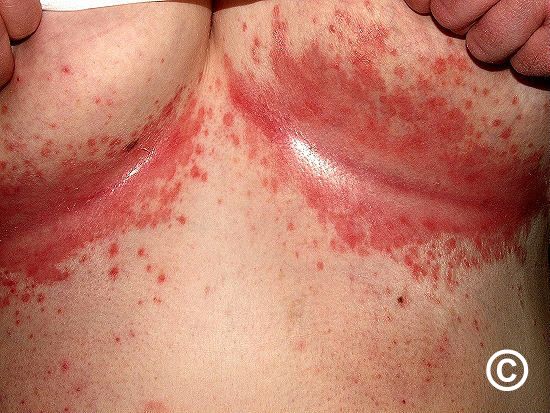
- 🔴 Bright red, moist erythema in a skin fold.
- 🔥 Itch, soreness, burning or tenderness.
- 💧 Maceration, fissuring or superficial scaling.
- ✨ Satellite papules or pustules around the main rash.
- 🦠 Consider bacterial infection if painful, weeping, crusted or malodorous.
💡 The classic clue is erythematous intertrigo with satellite pustules. Candida overgrows when the stratum corneum is macerated, so successful treatment requires both antifungal therapy and correction of the moist skin environment.
🤔 Differential Diagnosis
- 🍄 Tinea cruris or tinea corporis.
- 🩷 Flexural psoriasis.
- 🌿 Eczema or contact dermatitis.
- 🦠 Erythrasma.
- 🔥 Bacterial intertrigo.
- 🌫️ Seborrhoeic dermatitis.
🧪 Investigations
- 👀 Usually a clinical diagnosis.
- 🔬 Consider skin swab, scraping or fungal culture if diagnosis is uncertain.
- 🍬 Check HbA1c or glucose if recurrent, extensive or risk factors for diabetes.
- 🧫 Consider bacterial swab if cellulitis, weeping, crusting, malodour or treatment failure.
- 🛡️ Consider HIV/immunosuppression review if severe, recurrent or unusual.
✅ NICE-Aligned Management
- 🧼 Keep the area clean and dry.
- 💨 Reduce friction, sweating and occlusion.
- 👕 Advise loose, breathable clothing.
- 🧻 Use absorbent material in large skin folds if appropriate.
- 🍬 Optimise diabetes control where relevant.
- 🍄 Prescribe a topical imidazole antifungal for adults.
- 💊 Options include clotrimazole, econazole, miconazole or ketoconazole.
- 📚 Apply according to product instructions, BNF and local formulary guidance.
💊 If Inflamed or Itchy
- 🍄 Continue topical antifungal treatment.
- 🔥 Consider a short course of mild topical corticosteroid if inflammation or itch is troublesome.
- 🧴 Hydrocortisone 1% may be used briefly with antifungal cover.
- 🚫 Avoid potent topical steroids in flexures unless specialist advised.
- ⚠️ Never use topical steroid alone for suspected fungal infection.
🚩 Severe, Recurrent or Refractory Disease
- 🔁 Reassess the diagnosis and adherence.
- 🍬 Review diabetes, immunosuppression, obesity, incontinence and occlusion.
- 🔬 Consider fungal microscopy and culture.
- 💊 Oral antifungal treatment is not routinely needed for uncomplicated localised disease.
- 👩⚕️ Consider specialist advice before systemic treatment, especially in pregnancy, liver disease, immunosuppression or complex polypharmacy.
💊 Prescribing Notes
- 🍄 Topical imidazoles are first-line for most localised adult cases.
- ⚠️ Miconazole may interact with warfarin; check current guidance.
- 💊 Systemic azoles have important interactions, including warfarin, some statins, sulfonylureas and QT-prolonging drugs.
- 🤰 Check pregnancy and breastfeeding guidance before prescribing.
- 🧫 Treat secondary bacterial infection only if there is clinical evidence of bacterial infection.
📞 Refer or Seek Advice
- ❓ Diagnostic uncertainty.
- 🗺️ Severe, extensive or recurrent infection.
- ❌ Failure of appropriate topical treatment.
- 🛡️ Immunocompromised patient.
- 🚨 Rapid progression, ulceration, necrosis, cellulitis or systemic symptoms.
- 🩸 Suspected invasive or systemic fungal infection.
🧠 Clinical Pearls
- 💡 Satellite pustules support Candida.
- 💡 Tinea often has an annular scaly edge with central clearing.
- 💡 Flexural psoriasis is often smooth, shiny and sharply demarcated.
- 💡 Erythrasma may fluoresce coral-pink under Wood lamp.
- 💡 Persistent “Candida” is often moisture, friction, steroid use, diabetes or misdiagnosis.
🖼️ Candida Intertrigo
⚕️ Disclaimer
This article is for clinician education and revision. Prescribing should follow current NICE CKS, local antimicrobial guidance, the BNF, patient-specific contraindications and senior or specialist advice where needed.
| The content on this website is provided for educational and informational purposes only to support exam preparation (e.g., MLA, MRCP, USMLE) and learning. This is NOT medical advice, diagnosis, treatment, or professional guidance. It does not replace consultation with a qualified healthcare professional, official guidelines (e.g., NICE, GMC, BNF), or supervised clinical practice. Always verify information with current, authoritative sources. Makindo and its contributors accept no liability for any reliance on this content, including errors, omissions, or any resulting harm, loss, or consequences. By using this site, you agree to these terms. |
|
|
Categories
- About
- Acute Medicine
- Anaesthetics and Critical Care
- Anatomy
- Anatomy and Physiology
- Biochemistry
- Book
- Cardiology
- Collections
- CompSci
- Crib Sheets
- Critical care
- Dental
- Dermatology
- Differentials
- Drugs
- ENT
- Electrocardiogram
- Embryology
- Emergency Medicine
- Endocrinology
- Ethics
- Foundation Doctors
- GCSE
- Gastroenterology
- General Practice
- Genetics
- Geriatric Medicine
- Geriatrics
- Guidelines
- Haematology
- Hepatology
- Immunology
- Infectious Diseases
- Infographic
- Investigations
- Lists
- MRCP
- Mandatory Training
- Medical Students
- Microbiology
- Nephrology
- Neurology
- Neurosurgery
- Nutrition
- OSCE
- Obstetrics Gynaecology
- Oncology
- Ophthalmology
- Oral Medicine and Dentistry
- Orthopaedics
- Paediatrics
- Palliative
- Palliative Care
- Pathology
- Pharmacology
- Physiology
- Procedures
- Psychiatry
- Public Health
- Radiology
- Respiratory
- Resuscitation
- Revision Topics
- Rheumatology
- Statistics and Research
- Stroke
- Surgery
- Toxicology
- Trauma and Orthopaedics
- USMLE
- Urology
- Vascular Surgery