Cell Biology
🧱 Structure of the Cell Membrane
- The cell membrane (plasma membrane) is a thin, flexible barrier that surrounds the cell. It maintains cell integrity and regulates the movement of substances in and out. Its design is best explained by the fluid mosaic model 🧩, which highlights its dynamic and flexible nature.
- Phospholipid Bilayer: The foundation is a double layer of phospholipids.
🟡 Hydrophilic heads face outward (towards extracellular fluid and cytoplasm).
⚫ Hydrophobic tails face inward, away from water.
- Membrane Proteins: Essential for transport, signalling, and anchoring.
- Integral proteins: Span the entire bilayer; act as channels, carriers, or receptors.
- Peripheral proteins: Loosely attached on the surface; support structure and signalling.
- Cholesterol: 🧴 Scattered throughout the bilayer, it adds rigidity while maintaining fluidity - preventing the membrane from becoming too rigid (at low temps) or too fluid (at high temps).
- Carbohydrate Chains: 🍬 Attached to proteins (glycoproteins) or lipids (glycolipids) on the outer surface. They function in cell recognition, immune defence, and intercellular communication.
- Fluid Mosaic Model: Emphasises that components (lipids, proteins, carbohydrates) move fluidly within the bilayer - giving flexibility, adaptability, and resilience to the membrane.
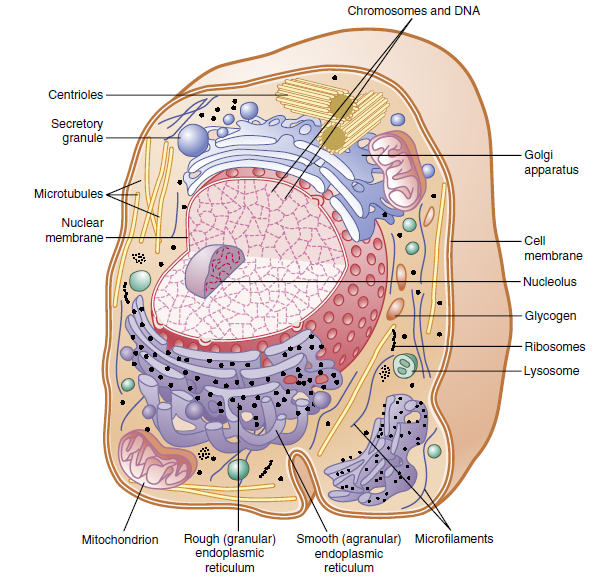
📌 Teaching Pearl: The cell membrane is not just a “barrier” - it’s an active communication hub, essential for signalling, nutrient uptake, and maintaining ion gradients ⚡.
🌊 Diffusion
Diffusion = random movement of molecules from an area of high concentration ➝ low concentration, driven by kinetic energy.
In cells, diffusion allows gases, nutrients, and ions to move across membranes without energy input.
- Simple Diffusion: Passive movement through the lipid bilayer (if lipid-soluble, e.g. O₂, CO₂) or via water-filled channels in proteins. Rate depends on substance concentration, molecular motion, and available openings.
- Facilitated Diffusion: Requires carrier proteins 🚪. The molecule binds to a transporter, which changes shape to shuttle it across (e.g. glucose transport via GLUT proteins).
- Key Point: Both simple and facilitated diffusion are passive processes - no ATP is needed ⚡.
⚡ Intracellular vs Extracellular Electrolyte Concentrations
| Electrolyte/Substance |
Intracellular (mM) |
Extracellular (mM) |
| 🔵 Sodium (Na⁺) |
10–15 |
135–145 |
| 🟢 Potassium (K⁺) |
140–150 |
3.5–5.0 |
| ⚪ Calcium (Ca²⁺) |
<0.001 |
2.0–2.5 |
| 🟡 Chloride (Cl⁻) |
4–30 |
95–105 |
| 🟤 Bicarbonate (HCO₃⁻) |
10–20 |
22–28 |
| 🟣 Magnesium (Mg²⁺) |
20–30 |
0.7–1.0 |
| 🍬 Glucose |
~1.0 |
5.0–6.0 |
| 🧩 Amino Acids |
200 |
2.0 |
💡 Clinical Insight:
The steep Na⁺ and K⁺ gradients are maintained by the sodium–potassium pump (Na⁺/K⁺-ATPase). This pump is vital for nerve conduction, muscle contraction, and maintaining cell volume. Disturbances in these gradients (e.g. hypokalaemia, hyponatraemia) ➝ severe clinical consequences.
