Motor End Plate
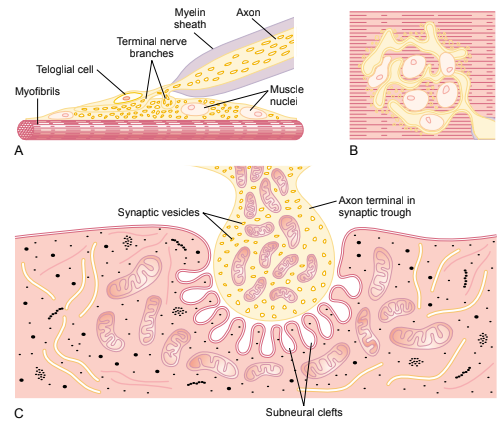
The motor end plate (neuromuscular junction, NMJ) is a specialised synapse between a motor neuron and a skeletal muscle fibre.
It converts an electrical nerve impulse into a chemical signal (acetylcholine release) and then back into an electrical signal in the muscle.
This process is essential for voluntary movement, reflexes, and fine motor control. 💪
🧬 Structure
- Axon Terminal: End of the motor neuron containing synaptic vesicles filled with acetylcholine (ACh). ⚡🧪
- Synaptic Cleft: Narrow gap (~50 nm) between neuron and muscle. ACh diffuses across this space. 🌊
- Motor End Plate (muscle membrane): Specialised region of the sarcolemma with:
- Deep junctional folds → ↑ surface area for receptors.
- High density of nicotinic ACh receptors (nAChRs).
⚙️ Function
- 📡 Signal Transmission: Nerve impulse arrives → Ca²⁺ channels open → vesicles release ACh into synaptic cleft.
- 🔑 ACh Binding: ACh binds to nAChRs → Na⁺ influx → depolarisation → end plate potential (EPP).
- 🔗 Excitation–Contraction Coupling: Action potential spreads across sarcolemma & T-tubules → Ca²⁺ released from sarcoplasmic reticulum → actin–myosin cross-bridge cycling → contraction.
- 🛑 Signal Termination: Acetylcholinesterase (AChE) rapidly breaks down ACh into acetate + choline, preventing overstimulation.
🩺 Clinical Relevance
- 😴 Myasthenia Gravis: Autoantibodies block ACh receptors → fluctuating muscle weakness (esp. ocular, bulbar muscles).
- ☠️ Botulism: Botulinum toxin prevents ACh release → flaccid paralysis.
- 💉 Neuromuscular Blocking Agents: Used in anaesthesia (e.g., suxamethonium, vecuronium) → reversible muscle paralysis.
- 🥵 Organophosphate poisoning: Inhibits AChE → excessive ACh → continuous depolarisation → paralysis.
📌 Summary
The motor end plate is a finely tuned synapse linking the nervous system to muscle contraction.
Its integrity is essential for movement, and disruption (autoimmune, toxic, or pharmacological) can produce weakness or paralysis.
🎯 It is a major therapeutic and pathological target in clinical medicine.
