
| Download the amazing global Makindo app: ✅ Means NICE/National Guidelines 2026 compliant Android | Apple | |
|---|---|
| MEDICAL DISCLAIMER: Educational use only. Not for diagnosis or management. See below for full disclaimer. |
Squamous Cell Carcinoma
Related Subjects: |Nikolsky's sign |Koebner phenomenon |Erythema Multiforme |Pyoderma gangrenosum |Erythema Nodosum |Dermatitis Herpetiformis |Lichen Planus |Acanthosis Nigricans |Acne Rosacea |Acne Vulgaris |Alopecia |Vitiligo |Urticaria |Basal Cell Carcinoma |Malignant Melanoma |Squamous Cell Carcinoma |Mycosis Fungoides (Sezary Syndrome) |Xeroderma pigmentosum |Bullous Pemphigoid |Pemphigus Vulgaris |Seborrheic Dermatitis |Pityriasis/Tinea versicolor infections |Pityriasis rosea |Scabies |Dermatomyositis |Toxic Epidermal Necrolysis |Stevens-Johnson Syndrome |Atopic Eczema/Atopic Dermatitis |Psoriasis
📖 About
- Squamous Cell Carcinoma (SCC) is a malignant tumour of keratinocytes arising from the epidermis.
- It is the second most common skin cancer after basal cell carcinoma (BCC).
- SCC is locally invasive and slower growing than melanoma, but unlike BCC it carries a real risk of metastasis.
- Most often found on sun-exposed skin in older adults.
🌞 Causes / Risk Factors
- UV radiation (sunlight or tanning beds) - cumulative lifelong exposure is the strongest factor.
- Pre-malignant skin lesions: actinic keratosis, leukoplakia.
- Chronic inflammation or scars (e.g. Marjolin’s ulcer in burns or ulcers).
- Ionising radiation, tar, soot, oils, smoking, arsenic exposure.
- Immunosuppression - organ transplant patients, HIV.
- Increasing age due to cumulative DNA damage.
👀 Clinical Features
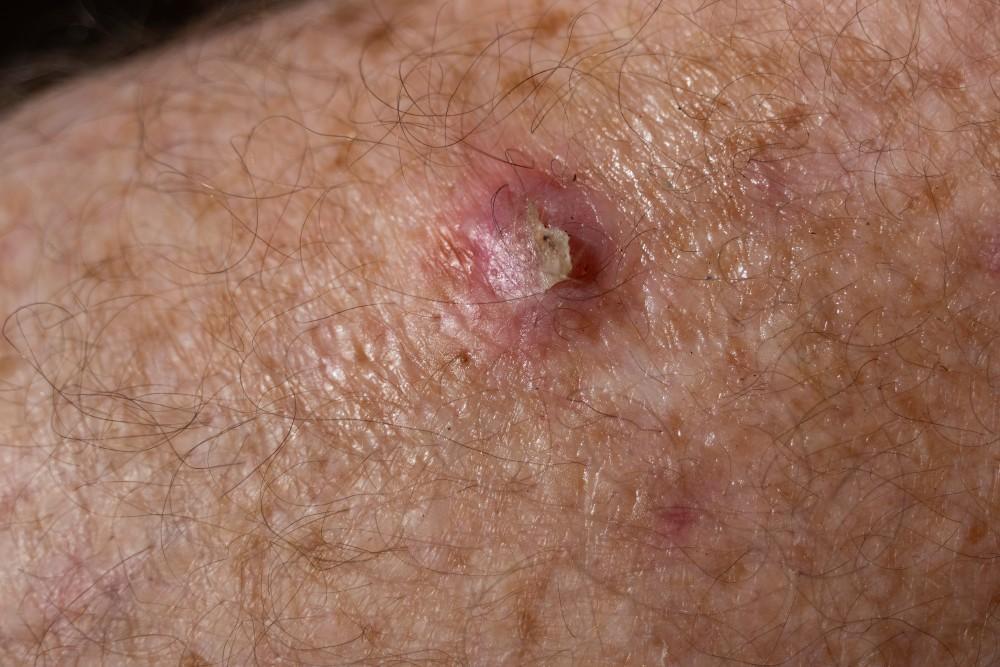
- Non-healing ulcer or crusted, scaly nodule with a firm, indurated edge.
- Most often on face, lips, ears, scalp, and hands.
- May bleed, crust, or become painful.
- Advanced disease → invasion of deeper tissue, perineural spread, or metastasis to lymph nodes.
- High-risk SCC: lesions on lip/ear, diameter >2cm, depth >4mm, poorly differentiated histology, or in immunosuppressed patients.
🧩 Bowen’s Disease
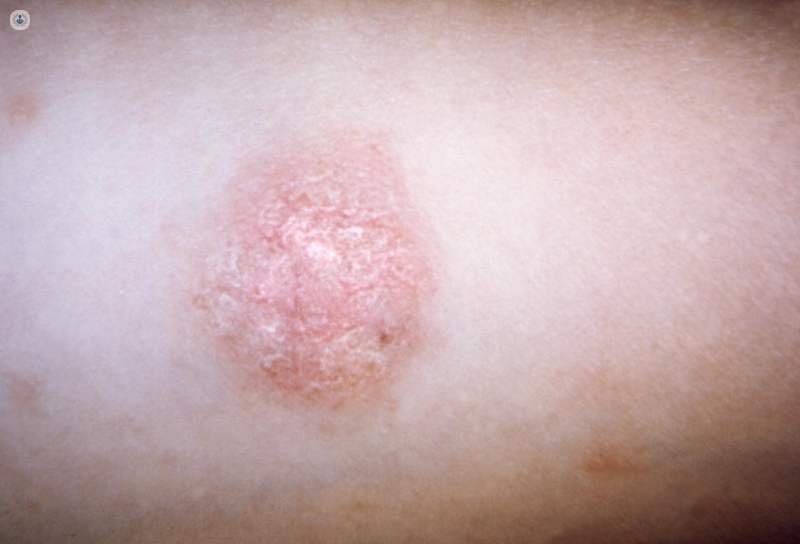
- Bowen’s disease = SCC in situ (confined to the epidermis).
- Presents as a scaly, erythematous plaque resembling psoriasis or eczema but persistent.
- 10–20% risk of progression to invasive SCC if untreated.
🧪 Investigations
- Skin biopsy - diagnostic, showing atypical squamous cells invading dermis.
- Lymph node assessment - FNA or biopsy if palpable.
- Imaging (CT/MRI) - advanced or high-risk lesions.
💊 Management
- Bowen’s disease:
- Curettage + cautery, cryotherapy, or photodynamic therapy.
- Topical 5-fluorouracil or imiquimod may be used.
- Invasive SCC:
- Surgical excision with adequate margins (4–6 mm for low-risk, wider for high-risk).
- Mohs micrographic surgery - best for cosmetically sensitive or recurrent lesions (lips, eyelids, nose).
- Radiotherapy - option for inoperable cases or adjuvant in high-risk SCC.
- Systemic therapy: Rare; immunotherapy (e.g., PD-1 inhibitors like cemiplimab) in metastatic/unresectable SCC.
- Follow-up: Every 3–6 months initially, due to risk of recurrence and new primary tumours.
🔮 Prognosis
- Early-detected SCC has an excellent prognosis.
- 5-year survival >90% if localised, but lower with nodal/distant spread.
- High-risk lesions need closer surveillance and MDT input.
| The content on this website is provided for educational and informational purposes only to support exam preparation (e.g., MLA, MRCP, USMLE) and learning. This is NOT medical advice, diagnosis, treatment, or professional guidance. It does not replace consultation with a qualified healthcare professional, official guidelines (e.g., NICE, GMC, BNF), or supervised clinical practice. Always verify information with current, authoritative sources. Makindo and its contributors accept no liability for any reliance on this content, including errors, omissions, or any resulting harm, loss, or consequences. By using this site, you agree to these terms. |
|
|
Categories
- About
- Acute Medicine
- Anaesthetics and Critical Care
- Anatomy
- Anatomy and Physiology
- Biochemistry
- Book
- Cardiology
- Collections
- CompSci
- Crib Sheets
- Critical care
- Dental
- Dermatology
- Differentials
- Drugs
- ENT
- Electrocardiogram
- Embryology
- Emergency Medicine
- Endocrinology
- Ethics
- Foundation Doctors
- GCSE
- Gastroenterology
- General Practice
- Genetics
- Geriatric Medicine
- Geriatrics
- Guidelines
- Haematology
- Hepatology
- Immunology
- Infectious Diseases
- Infographic
- Investigations
- Lists
- MRCP
- Mandatory Training
- Medical Students
- Microbiology
- Nephrology
- Neurology
- Neurosurgery
- Nutrition
- OSCE
- Obstetrics Gynaecology
- Oncology
- Ophthalmology
- Oral Medicine and Dentistry
- Orthopaedics
- Paediatrics
- Palliative
- Palliative Care
- Pathology
- Pharmacology
- Physiology
- Procedures
- Psychiatry
- Public Health
- Radiology
- Respiratory
- Resuscitation
- Revision Topics
- Rheumatology
- Statistics and Research
- Stroke
- Surgery
- Toxicology
- Trauma and Orthopaedics
- USMLE
- Urology
- Vascular Surgery