Anatomy and Physiology of Cilia
Related Subjects:
|Abdominal Anatomy
|Brainstem Anatomy
|Thalamic Anatomy
|Cilia structure and function
Structure
- Motile cilia :
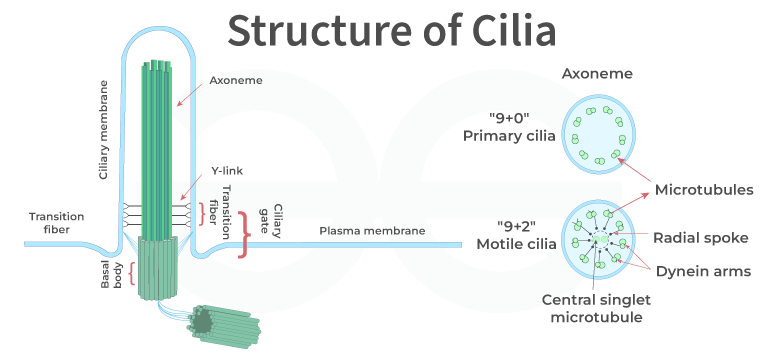
- Have a "9+2" arrangement, consisting of 9 outer microtubule doublets surrounding 2 central singlet microtubules, known as the axoneme.
- The outer doublets are connected by dynein arms, which enable movement.
- Motile cilia are commonly found in the respiratory epithelium, fallopian tubes, and other tissues where fluid or particle movement is necessary.
- Basal body :
- Located at the base of the cilium, just below the cell membrane, and consists of 9 microtubule triplets with no central microtubules (similar to a centriole).
- The basal body anchors the cilium to the cell and initiates the assembly of the axoneme.
- Non-motile (primary) cilia :
- These cilia lack the central microtubule pair, having a "9+0" arrangement, and are not involved in movement.
- Primary cilia function as sensory organelles that detect environmental signals, involved in signal transduction, and help regulate processes such as cell growth and differentiation.
- Non-motile cilia are found in almost all cells and have a role in mechanosensation, especially in the kidney and other tissues.
Function
- Motile cilia :
- Facilitate the movement of fluids, mucus, or particles across the surface of the epithelium.
- In the respiratory tract, motile cilia help clear mucus and trapped pathogens, a process vital for lung health (mucociliary clearance).
- In the fallopian tubes, motile cilia aid in the movement of the ovum toward the uterus.
- Non-motile cilia (Primary cilia):
- Act as sensory organelles, detecting changes in the extracellular environment and transmitting signals inside the cell.
- Play crucial roles in cellular signaling pathways, such as Hedgehog, Wnt, and PDGF (platelet-derived growth factor) signaling, which are important for tissue development and maintenance.
- Dysfunction in primary cilia can lead to diseases such as polycystic kidney disease, mitral valve prolapse, and retinal degeneration.
Axonemal Dynein
- Axonemal dynein is an ATPase that links the outer microtubule doublets within the axoneme.
- It generates the force necessary for ciliary movement by causing the sliding of adjacent microtubule doublets. This sliding results in the bending of the cilia, producing coordinated beating or movement.
- Dynein arms alternate between attachment and detachment from adjacent doublets, leading to ciliary motion in a wave-like pattern, essential for effective fluid or particle transport.
Ciliary Coordination
- Gap junctions : Enable synchronized ciliary movement, allowing cilia on adjacent cells to beat in a coordinated fashion, generating a unified flow across the epithelial surface.
- This coordination is vital in tissues such as the respiratory tract, where the simultaneous beating of thousands of cilia helps clear mucus and debris from the lungs.
Clinical Relevance
- Ciliopathies :
- Genetic disorders affecting the structure or function of cilia can lead to ciliopathies, a group of conditions that impact various organs due to defective ciliary function.
- Examples include:
- Polycystic Kidney Disease (PKD) : Caused by defects in primary cilia in kidney cells, leading to uncontrolled cell growth and fluid-filled cyst formation in the kidneys.
- Kartagener syndrome : A subtype of primary ciliary dyskinesia (PCD) where motile cilia are defective, leading to chronic respiratory infections, bronchiectasis, and situs inversus.
- Bardet-Biedl syndrome : A multisystem ciliopathy affecting the kidneys, eyes, limbs, and other organs due to defects in primary cilia.
- Respiratory diseases :
- Impaired motile cilia in the respiratory epithelium can lead to conditions like chronic bronchitis and sinusitis, where mucus clearance is compromised, resulting in recurrent infections.
- Infertility :
- Defective motile cilia in the reproductive tract can lead to infertility in females due to impaired movement of the ovum through the fallopian tubes. In males, defective flagella in sperm (similar in structure to cilia) can cause immotile sperm, leading to male infertility.
