
| Download the amazing global Makindo app: ✅ Means NICE/National Guidelines 2026 compliant Android | Apple | |
|---|---|
| MEDICAL DISCLAIMER: Educational use only. Not for diagnosis or management. See below for full disclaimer. |
Hypoglossal Nerve (Cranial Nerve XII)
Related Subjects: |Olfactory Nerve |Optic Nerve |Oculomotor Nerve |Trochlear Nerve |Trigeminal Nerve |Abducent Nerve |Facial Nerve |Vestibulocochlear Nerve |Glossopharyngeal Nerve |Vagus Nerve |Accessory Nerve |Hypoglossal Nerve
The hypoglossal nerve, also known as cranial nerve XII, is responsible for motor control of the muscles of the tongue. It plays a critical role in swallowing, speech, and the movements of the tongue.
Anatomy of the Hypoglossal Nerve
- Origin :
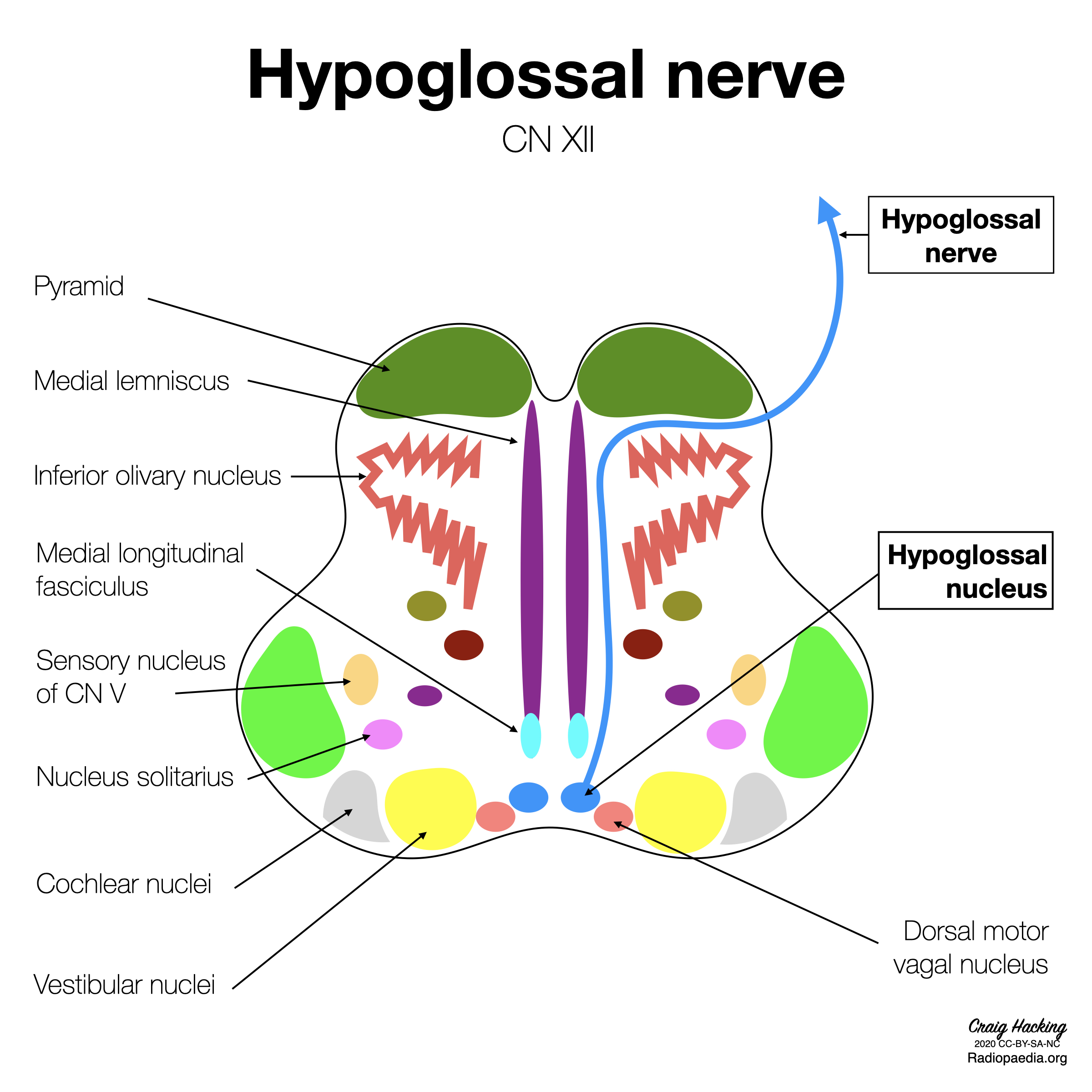
- Arises from the hypoglossal nucleus in the medulla oblongata of the brainstem.
- Course :
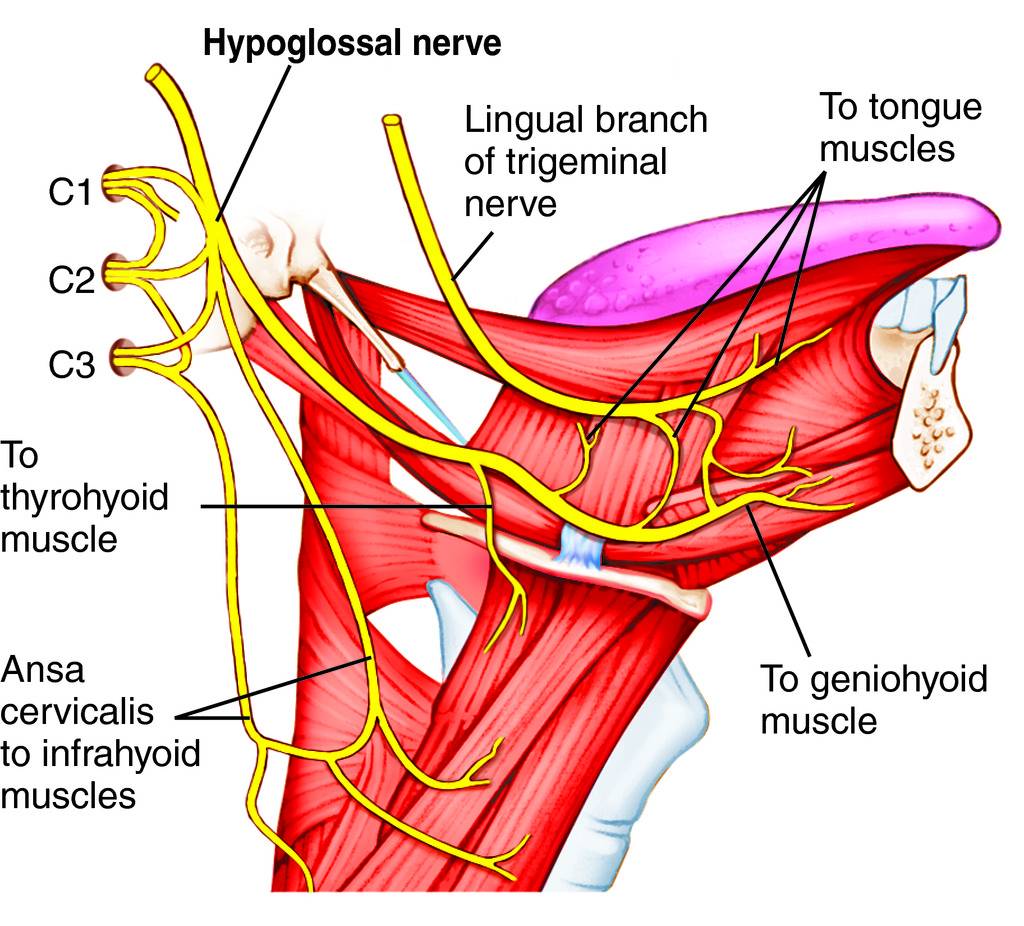
- Exits the skull through the hypoglossal canal.
- Travels downward and forward between the internal carotid artery and internal jugular vein.
- Passes deep to the posterior belly of the digastric muscle and the stylohyoid muscle.
- Continues to the tongue, innervating the intrinsic and extrinsic muscles.
Functions of the Hypoglossal Nerve
- Controls the movements of the intrinsic and extrinsic muscles of the tongue.
- Essential for speech articulation, swallowing, and manipulation of food during mastication.
Clinical Relevance
- Hypoglossal Nerve Palsy :
- Results from damage to the hypoglossal nerve.
- Symptoms: Unilateral paralysis of the tongue, atrophy of tongue muscles on the affected side, and deviation of the tongue toward the affected side when protruded.
- Causes: Tumours, stroke, trauma, or infections affecting the nerve's course.
- Treatment: Depends on the underlying cause; may include surgical intervention, physical therapy, or addressing the primary condition.
- Bulbar Palsy :
- Characterized by the impairment of cranial nerves IX, X, XI, and XII.
- Symptoms: Dysarthria (difficulty speaking), dysphagia (difficulty swallowing), and tongue atrophy.
- Causes: Motor neuron disease, brainstem strokes, or other neurological conditions.
- Treatment: Supportive care, speech therapy, and management of the underlying condition.
- Hypoglossal Nerve Testing :
- Assessment includes observing tongue movements, checking for atrophy or fasciculations, and evaluating speech and swallowing functions.
- Clinical tests: Asking the patient to stick out their tongue and move it side to side, observing for deviation or weakness.
Summary
The hypoglossal nerve is crucial for the motor control of the tongue, influencing speech, swallowing, and food manipulation. It originates from the medulla oblongata, travels through the hypoglossal canal, and innervates the tongue muscles. Damage to the hypoglossal nerve can lead to conditions such as hypoglossal nerve palsy and bulbar palsy, requiring appropriate diagnosis and treatment.