
| Download the amazing global Makindo app: ✅ Means NICE/National Guidelines 2026 compliant Android | Apple | |
|---|---|
| MEDICAL DISCLAIMER: Educational use only. Not for diagnosis or management. See below for full disclaimer. |
Caudate Nucleus
Related Subjects: |Medulla Oblongata |Midbrain |Pons |Caudate Nucleus |Putamen and Globus Pallidus |Cerebral Cortex |Internal Capsule |Cavernous sinus |Basal Ganglia |Brainstem Anatomy |Thalamic Anatomy |Caudate Nucleus
The Caudate Nucleus is a C-shaped 🌀 subcortical grey matter structure forming part of the striatum (caudate + putamen). It is a key component of the basal ganglia circuitry, essential for motor planning, executive cognition, reward processing, and behavioural regulation. Embryologically derived from the telencephalon, it forms part of the dorsal striatum and participates in cortico-striato-thalamo-cortical loops 🔁.
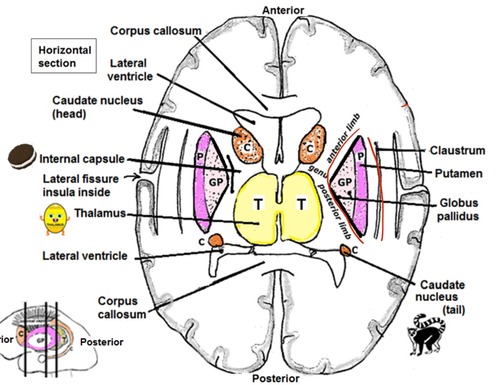
📍 Gross Anatomy
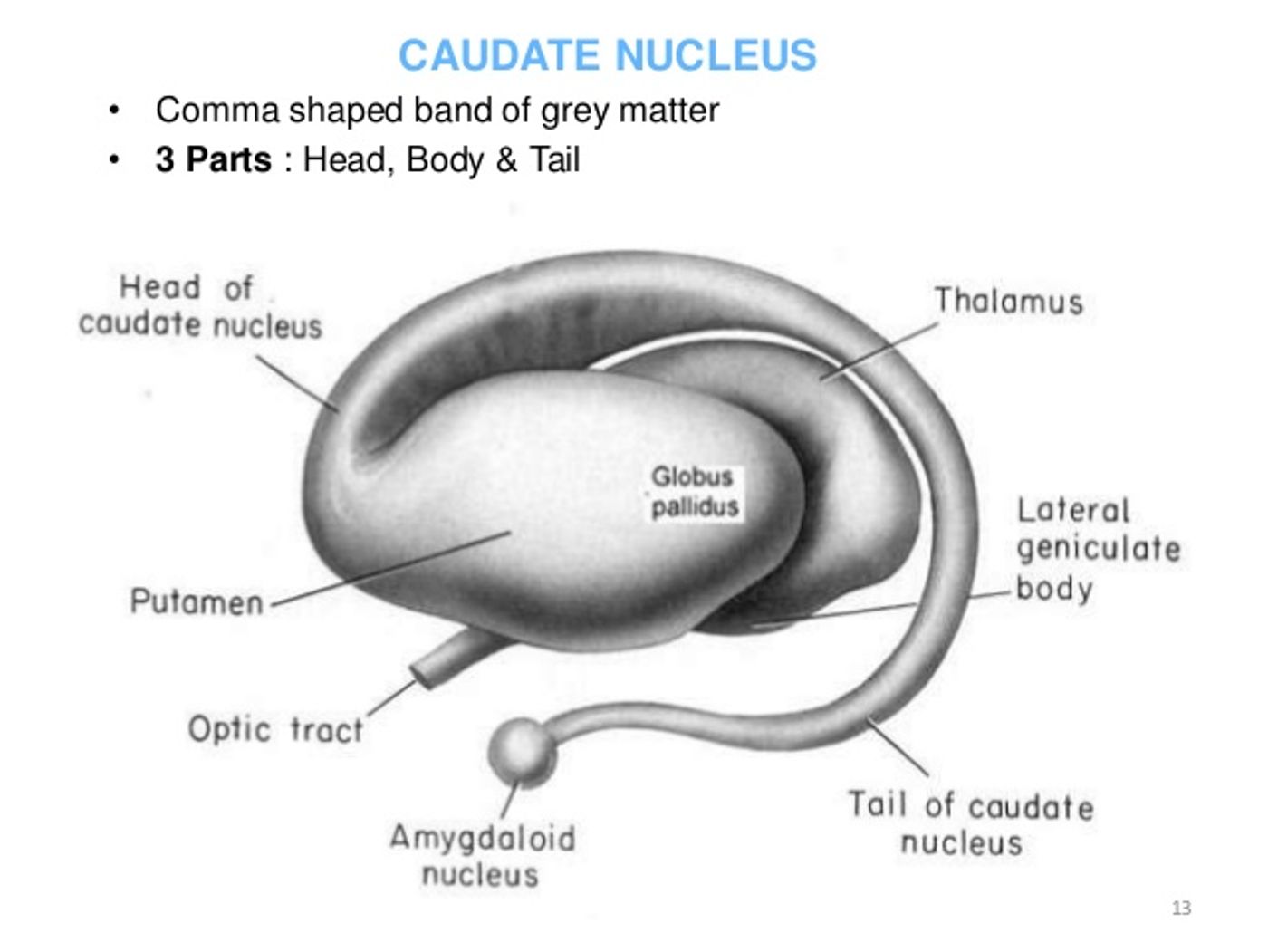
The caudate closely follows the contour of the lateral ventricle, giving it its characteristic curved configuration.
- Head 🧠:
- Bulbous anterior portion.
- Forms the lateral wall of the frontal horn of the lateral ventricle.
- Separated from the putamen by the anterior limb of the internal capsule.
- Body ➡️:
- Extends posteriorly along the body of the lateral ventricle.
- Forms part of the ventricular floor.
- Tail 🔄:
- Thin, elongated structure.
- Curves into the temporal lobe.
- Terminates near the amygdala in the temporal horn.
The caudate and putamen are collectively termed the striatum, connected by grey bridges crossing the internal capsule (giving the putamen its “striped” appearance).
🔬 Microanatomy & Neurochemistry
- ~95% are medium spiny neurons (MSNs) → GABAergic inhibitory neurons 🛑.
- Receive:
- Excitatory glutamatergic input from cortex & thalamus ⚡.
- Dopaminergic modulation from substantia nigra pars compacta (SNc) 🎯.
- Dopamine effects:
- D1 receptors → direct pathway (facilitates movement).
- D2 receptors → indirect pathway (inhibits competing movement).
⚙️ Functional Role
The caudate is especially involved in goal-directed behaviour and cognitive aspects of motor control.
- Motor Planning 🏃:
- Selects appropriate voluntary movement.
- Suppresses unwanted motor activity.
- Executive Function 🧩:
- Decision-making.
- Working memory.
- Behavioural flexibility.
- Reward & Learning 🎯:
- Involved in habit formation.
- Processes reinforcement signals.
- Emotion Regulation ❤️:
- Interacts with limbic circuits.
- Important in motivation and behavioural drive.
🩸 Blood Supply
- Anterior Cerebral Artery (ACA):
- Recurrent artery of Heubner → head of caudate.
- Middle Cerebral Artery (MCA):
- Lenticulostriate arteries → body.
- Anterior Choroidal Artery:
- Supplies tail and adjacent structures.
⚠️ These small penetrating arteries are vulnerable to hypertensive small-vessel disease → lacunar infarcts.
🏥 Clinical Correlations
🧬 Huntington’s Disease
- Autosomal dominant (CAG repeat expansion in HTT gene).
- Selective degeneration of caudate + putamen.
- Triad:
- Chorea 💃
- Cognitive decline 🧠
- Psychiatric disturbance 😔
- MRI: caudate atrophy → enlarged frontal horns (“boxcar ventricles”).
🩸 Stroke
- Lacunar infarct → abulia, apathy, subtle motor signs.
- Haemorrhage → contralateral motor deficit ± behavioural change.
🧍 Parkinson’s Disease
- Primary pathology in SNc → dopamine depletion.
- Reduced striatal dopaminergic input → bradykinesia, rigidity, tremor.
🧠 OCD
- Hyperactivity in cortico-striato-thalamo-cortical loops.
- SSRIs + CBT modulate this circuitry.
⚡ ADHD
- Reduced caudate volume reported in some studies.
- Stimulants (e.g. methylphenidate) modulate dopaminergic tone.
🔎 Investigations
- CT 🖥:
- Acute haemorrhage.
- Large infarcts.
- MRI 🧲:
- Best structural imaging.
- Detects atrophy (Huntington’s).
- Identifies demyelination, tumours, infarcts.
- Functional Imaging:
- PET → metabolic activity.
- fMRI → task-related activation.
- Genetic Testing 🧬:
- Huntington’s confirmation.
💊 Management Principles
- Stroke:
- Thrombolysis/thrombectomy if eligible.
- Secondary prevention (antiplatelets, statins, BP control).
- Huntington’s:
- Tetrabenazine for chorea.
- Psychiatric support.
- Parkinson’s:
- Levodopa or dopamine agonists.
- Deep brain stimulation (selected cases).
- OCD / Psychiatric:
- SSRIs.
- Cognitive behavioural therapy.
🧠 Clinical Insight
The caudate nucleus is not just a “motor structure” - it is deeply involved in cognition, motivation, and behavioural control. Lesions often produce subtle executive or behavioural changes before obvious motor deficits.
📚 References
- DeLong MR, Wichmann T. Circuits and circuit disorders of the basal ganglia. Arch Neurol.
- Alexander GE et al. Parallel organization of basal ganglia circuits. Annu Rev Neurosci.
- Walker FO. Huntington’s disease. Lancet.
| The content on this website is provided for educational and informational purposes only to support exam preparation (e.g., MLA, MRCP, USMLE) and learning. This is NOT medical advice, diagnosis, treatment, or professional guidance. It does not replace consultation with a qualified healthcare professional, official guidelines (e.g., NICE, GMC, BNF), or supervised clinical practice. Always verify information with current, authoritative sources. Makindo and its contributors accept no liability for any reliance on this content, including errors, omissions, or any resulting harm, loss, or consequences. By using this site, you agree to these terms. |
|
|
Categories
- About
- Acute Medicine
- Anaesthetics and Critical Care
- Anatomy
- Anatomy and Physiology
- Biochemistry
- Book
- Cardiology
- Collections
- CompSci
- Crib Sheets
- Critical care
- Dental
- Dermatology
- Differentials
- Drugs
- ENT
- Electrocardiogram
- Embryology
- Emergency Medicine
- Endocrinology
- Ethics
- Foundation Doctors
- GCSE
- Gastroenterology
- General Practice
- Genetics
- Geriatric Medicine
- Geriatrics
- Guidelines
- Haematology
- Hepatology
- Immunology
- Infectious Diseases
- Infographic
- Investigations
- Lists
- MRCP
- Mandatory Training
- Medical Students
- Microbiology
- Nephrology
- Neurology
- Neurosurgery
- Nutrition
- OSCE
- Obstetrics Gynaecology
- Oncology
- Ophthalmology
- Oral Medicine and Dentistry
- Orthopaedics
- Paediatrics
- Palliative
- Palliative Care
- Pathology
- Pharmacology
- Physiology
- Procedures
- Psychiatry
- Public Health
- Radiology
- Respiratory
- Resuscitation
- Revision Topics
- Rheumatology
- Statistics and Research
- Stroke
- Surgery
- Toxicology
- Trauma and Orthopaedics
- USMLE
- Urology
- Vascular Surgery