
| Download the amazing global Makindo app: ✅ Means NICE/National Guidelines 2026 compliant Android | Apple | |
|---|---|
| MEDICAL DISCLAIMER: Educational use only. Not for diagnosis or management. See below for full disclaimer. |
Musculocutaneous nerve
Related Subjects: |Radial Nerve |Median Nerve |Ulnar Nerve |Musculocutaneous nerve |Axillary nerve |Brachial plexus |Dermatomes |Femoral nerves |Sciatic nerve
Origin and Course
The musculocutaneous nerve is one of the major nerves of the upper limb, arising from the lateral cord of the brachial plexus. It provides motor innervation to the anterior muscles of the arm and sensory innervation to the lateral forearm. The musculocutaneous nerve originates from the lateral cord of the brachial plexus and includes fibers from the C5, C6, and C7 spinal nerves.
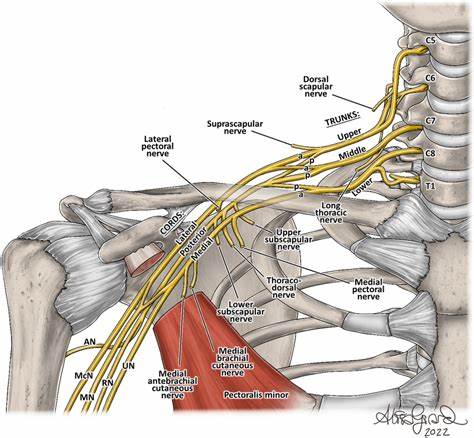
- Origin :
- Arises from the lateral cord of the brachial plexus, receiving fibers from the C5, C6, and C7 spinal nerves.
- Course :
- Descends between the biceps brachii and brachialis muscles.
- After innervating the muscles of the anterior arm, it continues as the lateral cutaneous nerve of the forearm.
Branches of the Musculocutaneous Nerve
- Muscular Branches :
- Innervate the coracobrachialis, biceps brachii, and brachialis muscles.
- Cutaneous Branch :
- Continues as the lateral cutaneous nerve of the forearm, providing sensory innervation to the skin on the lateral aspect of the forearm.
Functions of the Musculocutaneous Nerve
- Motor Functions :
- Coracobrachialis : Assists in flexion and adduction of the arm.
- Biceps Brachii : Flexes the elbow and supinates the forearm.
- Brachialis : Flexes the elbow.
- Sensory Functions :
- Provides sensation to the lateral aspect of the forearm through the lateral cutaneous nerve of the forearm.
Clinical Relevance
- Injury to the Musculocutaneous Nerve :
- Injuries can result from trauma, such as fractures or penetrating wounds, or iatrogenic causes like surgical procedures.
- Symptoms include weakness in elbow flexion and forearm supination, along with sensory loss on the lateral aspect of the forearm.
- Clinical Testing :
- Motor function can be assessed by testing the strength of elbow flexion and forearm supination.
- Sensory function can be evaluated by testing sensation on the lateral aspect of the forearm.
Diagnostic Evaluation
- Clinical Examination :
- Assessment of muscle strength and sensory function in the areas innervated by the musculocutaneous nerve.
- Electrophysiological Tests :
- Electromyography (EMG) and nerve conduction studies to evaluate nerve function and identify the site of injury.
- Imaging :
- MRI or ultrasound to visualize the nerve and surrounding structures, especially in cases of suspected nerve compression or injury.
Summary
The musculocutaneous nerve is a major nerve of the upper limb, responsible for motor innervation of the coracobrachialis, biceps brachii, and brachialis muscles, and sensory innervation to the lateral forearm. It originates from the lateral cord of the brachial plexus and descends through the anterior compartment of the arm. Injuries to the musculocutaneous nerve can result in weakness of elbow flexion and forearm supination, along with sensory loss on the lateral forearm. Diagnosis involves clinical examination, electrophysiological tests, and imaging studies.