
| Download the amazing global Makindo app: ✅ Means NICE/National Guidelines 2026 compliant Android | Apple | |
|---|---|
| MEDICAL DISCLAIMER: Educational use only. Not for diagnosis or management. See below for full disclaimer. |
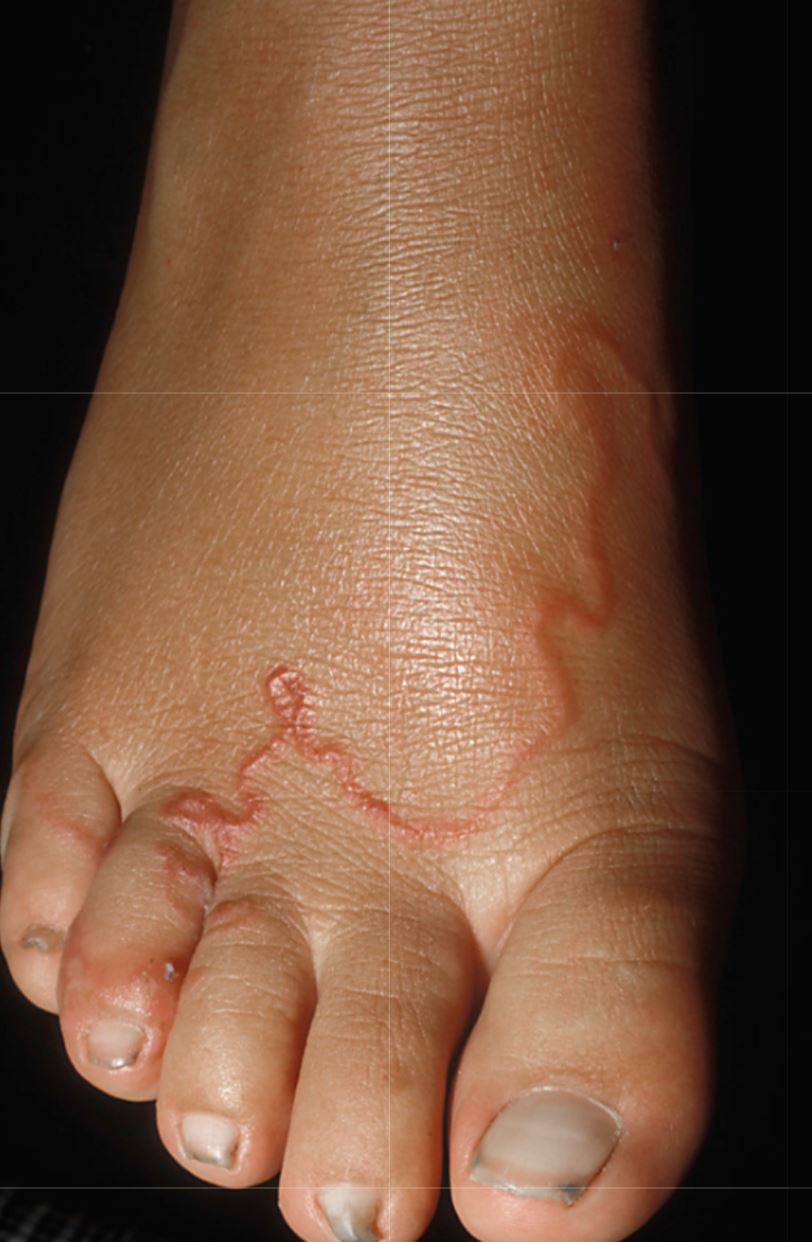
Cutaneous Larva Migrans
🐾🦶 Cutaneous larva migrans is a superficial parasitic skin infection caused by animal hookworm larvae, most commonly from dogs or cats. Humans are accidental dead-end hosts. Infection usually follows barefoot skin contact with contaminated sand or soil, especially after travel to tropical or subtropical areas.
⚠️ Risk Factors
- 🌍 Recent travel to tropical or subtropical regions.
- 🦶 Walking barefoot on beaches or contaminated soil.
- 🏖️ Sitting or lying directly on sand.
- 🐕 Exposure to dogs, cats or animal faeces.
- 🚽 Poor sanitation in endemic areas.
🔍 Clinical Features
- 🔥 Intensely itchy, serpiginous or “creeping” rash.
- 🐍 Raised erythematous track that slowly migrates.
- 🦶 Commonly affects feet, buttocks, thighs or hands.
- ⏳ Usually appears days to weeks after exposure.
- 🩹 Excoriation, impetiginisation or cellulitis may occur from scratching.
💡 The key clue is a very itchy, winding, migratory track after travel or soil/sand exposure. Larvae penetrate the epidermis but cannot complete their life cycle in humans, so infection is usually limited to the skin.
🤔 Differential Diagnosis
- 🕷️ Scabies.
- 🍄 Tinea corporis.
- 🌿 Contact dermatitis.
- 🔥 Urticaria.
- 🦟 Insect bites.
- ⚡ Larva currens from strongyloidiasis.
- 🦠 Impetigo or cellulitis if secondarily infected.
🧪 Investigations
- 👀 Usually a clinical diagnosis.
- 🌍 Ask about travel, beach exposure, barefoot walking and animal contact.
- 🔬 Skin biopsy is rarely helpful because the larva is usually ahead of the visible track.
- 🧫 Consider bacterial swab if crusting, discharge or cellulitis is present.
- 👩⚕️ Consider specialist advice if diagnosis is uncertain or strongyloidiasis is possible.
✅ Management
- ✅ Reassure that cutaneous larva migrans is usually self-limiting.
- 💊 Treat symptomatic, extensive, persistent or cosmetically troublesome disease.
- 🐛 Oral ivermectin or albendazole are commonly used anthelmintic options.
- 📚 Use BNF, local formulary and specialist guidance for dosing.
- 🦠 Treat secondary bacterial infection according to local antimicrobial guidance.
- 🔥 Offer antihistamines or topical corticosteroid for itch if needed.
Cutaneous larva migrans is often self-limiting because larvae usually die after several weeks, but anthelmintic treatment can shorten symptoms and reduce itch more quickly. Effective treatment often leads to rapid improvement in pruritus and gradual resolution of the track.
💊 Treatment Notes
- 💊 Albendazole may be used for several days depending on local guidance.
- 💊 Ivermectin is often used as single-dose or short-course therapy.
- 🤰 Avoid ivermectin in pregnancy unless specialist advice supports use.
- ⚖️ Check age, weight, pregnancy status, liver disease and drug interactions.
- 👶 Seek specialist advice for children, pregnancy, immunosuppression or treatment failure.
🚩 Refer or Seek Advice
- ❓ Diagnostic uncertainty.
- 🗺️ Extensive or recurrent lesions.
- ❌ Failure of initial treatment.
- 🤰 Pregnancy or breastfeeding.
- 👶 Young child or low body weight.
- ⚡ Possible strongyloidiasis or systemic parasitic infection.
- 🦠 Cellulitis, systemic symptoms or severe secondary infection.
🧠 Clinical Pearls
- 💡 Think: “itchy travelling line after travel”.
- 🦶 Feet and buttocks are classic sites.
- 🐛 The larva is usually ahead of the visible end of the track.
- 🧊 Cryotherapy is generally unreliable because the larva is hard to localise.
- ⚡ Larva currens moves much faster and suggests Strongyloides.
📚 References
- CDC - Cutaneous larva migrans.
- DermNet - Cutaneous larva migrans.
- BNF - Albendazole and ivermectin prescribing information.
⚕️ Disclaimer
This article is for clinician education and revision. Management should follow current BNF, local antimicrobial or parasitology guidance, patient-specific contraindications, and specialist infectious diseases or dermatology advice where needed.
| The content on this website is provided for educational and informational purposes only to support exam preparation (e.g., MLA, MRCP, USMLE) and learning. This is NOT medical advice, diagnosis, treatment, or professional guidance. It does not replace consultation with a qualified healthcare professional, official guidelines (e.g., NICE, GMC, BNF), or supervised clinical practice. Always verify information with current, authoritative sources. Makindo and its contributors accept no liability for any reliance on this content, including errors, omissions, or any resulting harm, loss, or consequences. By using this site, you agree to these terms. |
|
|
Categories
- About
- Acute Medicine
- Anaesthetics and Critical Care
- Anatomy
- Anatomy and Physiology
- Biochemistry
- Book
- Cardiology
- Collections
- CompSci
- Crib Sheets
- Critical care
- Dental
- Dermatology
- Differentials
- Drugs
- ENT
- Electrocardiogram
- Embryology
- Emergency Medicine
- Endocrinology
- Ethics
- Foundation Doctors
- GCSE
- Gastroenterology
- General Practice
- Genetics
- Geriatric Medicine
- Geriatrics
- Guidelines
- Haematology
- Hepatology
- Immunology
- Infectious Diseases
- Infographic
- Investigations
- Lists
- MRCP
- Mandatory Training
- Medical Students
- Microbiology
- Nephrology
- Neurology
- Neurosurgery
- Nutrition
- OSCE
- Obstetrics Gynaecology
- Oncology
- Ophthalmology
- Oral Medicine and Dentistry
- Orthopaedics
- Paediatrics
- Palliative
- Palliative Care
- Pathology
- Pharmacology
- Physiology
- Procedures
- Psychiatry
- Public Health
- Radiology
- Respiratory
- Resuscitation
- Revision Topics
- Rheumatology
- Statistics and Research
- Stroke
- Surgery
- Toxicology
- Trauma and Orthopaedics
- USMLE
- Urology
- Vascular Surgery