
| Download the amazing global Makindo app: ✅ Means NICE/National Guidelines 2026 compliant Android | Apple | |
|---|---|
| MEDICAL DISCLAIMER: Educational use only. Not for diagnosis or management. See below for full disclaimer. |
Table showing Visual Field Changes for Examination
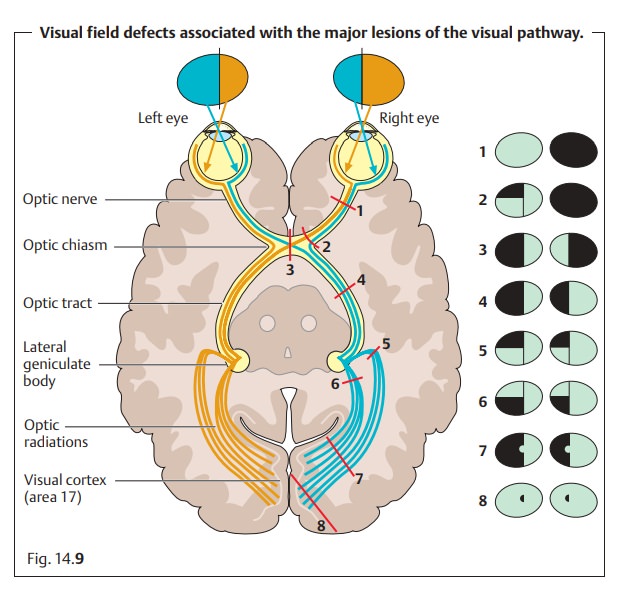
| Visual Field Change | Appearance | Associated Causes |
|---|---|---|
| Bitemporal Hemianopia | Loss of vision in the outer (temporal) half of both visual fields |
- Pituitary adenoma
- Craniopharyngioma - Suprasellar aneurysm |
| Homonymous Hemianopia | Loss of vision in the same half of the visual field in both eyes |
- Stroke affecting the occipital lobe
- Tumour in the optic tract or occipital lobe - Traumatic brain injury |
| Quadrantanopia | Loss of vision in one quarter of the visual field |
- Temporal lobe lesions (superior quadrantanopia)
- Parietal lobe lesions (inferior quadrantanopia) - Stroke |
| Central Scotoma | Loss of vision in the central visual field |
- Optic neuritis (often associated with multiple sclerosis)
- Macular degeneration - Toxic or nutritional optic neuropathy (e.g., due to alcohol, tobacco) |
| Arcuate Scotoma | Arc-shaped loss of vision, usually following the path of retinal nerve fibers |
- Glaucoma
- Optic nerve damage - Retinal disease |
| Altitudinal Hemianopia | Loss of vision in the upper or lower half of the visual field |
- Anterior ischaemic optic neuropathy (AION)
- Retinal artery occlusion - Optic neuritis |
| Tunnel Vision | Constricted visual fields, with loss of peripheral vision |
- Advanced glaucoma
- Retinitis pigmentosa - Hysteria or malingering (in some cases, true tunnel vision is rare) |
| Monocular Vision Loss | Complete loss of vision in one eye |
- Optic neuritis
- Retinal detachment - Central retinal artery occlusion - Severe glaucoma |