
| Download the amazing global Makindo app: ✅ Means NICE/National Guidelines 2026 compliant Android | Apple | |
|---|---|
| MEDICAL DISCLAIMER: Educational use only. Not for diagnosis or management. See below for full disclaimer. |
Narrow Complex Tachycardia ❤️
Related Subjects: |Wolff-Parkinson White syndrome (WPW) AVRT |Lown Ganong Levine Syndrome AVRT |Supraventricular Tachycardia (SVT) |Atrioventricular Nodal Reentrant Tachycardia AVNRT |Atrial Flutter |Atrial Fibrillation |Sinus Tachycardia |Sinus Arrhythmia |Multifocal Atrial Tachycardia |Resuscitation - Adult Tachycardia Algorithm
Overview
- Narrow Complex Tachycardia is characterized by a QRS complex duration of less than 120 milliseconds (or 3 small squares on an ECG).
- This type of tachycardia indicates that the source of the rapid heart rate is typically above the ventricles (supraventricular in origin), leading to efficient and synchronous ventricular contraction.
Key Characteristics
- QRS Duration: < 120 ms (3 small squares)
- Heart Rate: Generally > 100 bpm, often ranging from 150-250 bpm in conditions such as atrioventricular nodal reentrant tachycardia (AVNRT).
- Types: Common forms include:
- Atrioventricular Nodal Reentrant Tachycardia (AVNRT)
- Atrioventricular Reentrant Tachycardia (AVRT)
- Atrial Tachycardia
- Atrial Flutter with 2:1 Conduction (often presenting with a heart rate around 150 bpm)
Diagnostic Links and Causes
- Refer to links on common causes of supraventricular tachycardias (SVTs), such as AVNRT, AVRT, and atrial tachycardias for further details.
ECG Example
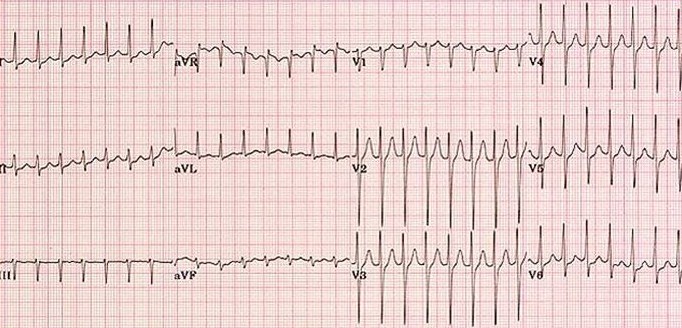
Example of Narrow Complex Tachycardia on ECG: Below is an image illustrating the ECG features of a typical narrow complex tachycardia, with rapid, regular rhythm and narrow QRS complexes.
| The content on this website is provided for educational and informational purposes only to support exam preparation (e.g., MLA, MRCP, USMLE) and learning. This is NOT medical advice, diagnosis, treatment, or professional guidance. It does not replace consultation with a qualified healthcare professional, official guidelines (e.g., NICE, GMC, BNF), or supervised clinical practice. Always verify information with current, authoritative sources. Makindo and its contributors accept no liability for any reliance on this content, including errors, omissions, or any resulting harm, loss, or consequences. By using this site, you agree to these terms. |
|
|
Categories
- About
- Acute Medicine
- Anaesthetics and Critical Care
- Anatomy
- Anatomy and Physiology
- Biochemistry
- Book
- Cardiology
- Collections
- CompSci
- Crib Sheets
- Critical care
- Dental
- Dermatology
- Differentials
- Drugs
- ENT
- Electrocardiogram
- Embryology
- Emergency Medicine
- Endocrinology
- Ethics
- Foundation Doctors
- GCSE
- Gastroenterology
- General Practice
- Genetics
- Geriatric Medicine
- Geriatrics
- Guidelines
- Haematology
- Hepatology
- Immunology
- Infectious Diseases
- Infographic
- Investigations
- Lists
- MRCP
- Mandatory Training
- Medical Students
- Microbiology
- Nephrology
- Neurology
- Neurosurgery
- Nutrition
- OSCE
- Obstetrics Gynaecology
- Oncology
- Ophthalmology
- Oral Medicine and Dentistry
- Orthopaedics
- Paediatrics
- Palliative
- Palliative Care
- Pathology
- Pharmacology
- Physiology
- Procedures
- Psychiatry
- Public Health
- Radiology
- Respiratory
- Resuscitation
- Revision Topics
- Rheumatology
- Statistics and Research
- Stroke
- Surgery
- Toxicology
- Trauma and Orthopaedics
- USMLE
- Urology
- Vascular Surgery