Related Subjects:
|Fever in a traveller
|Malaria Falciparum
|Malaria Non-Falciparum
|Viral Haemorrhagic Fevers (VHF)
|Lassa fever
|Dengue
|Marburg virus disease
|AIDS HIV
|Yellow fever
|Ebola Virus
|Leptospirosis
| Crimean-Congo haemorrhagic fever
|African Trypanosomiasis (Sleeping sickness)
|American Trypanosomiasis (Chagas Disease)
|Incubation Periods
|Notifiable Diseases UK
🩸 Ebola disease is a severe viral haemorrhagic fever caused by viruses in the orthoebolavirus group.
It was first identified in 1976 in outbreaks in what is now the Democratic Republic of the Congo and South Sudan.
⚠️ It spreads through direct contact with blood, body fluids, or contaminated materials, and can rapidly cause severe systemic illness and death.
ℹ️ About
- A severe viral haemorrhagic fever affecting humans and other primates.
- Fruit bats are thought to be the most likely natural reservoir.
- Transmission occurs through direct contact with blood or body fluids of an infected person, or contaminated objects.
- The virus enters through broken skin or mucous membranes of the eyes, nose, or mouth.
🌍 Geography
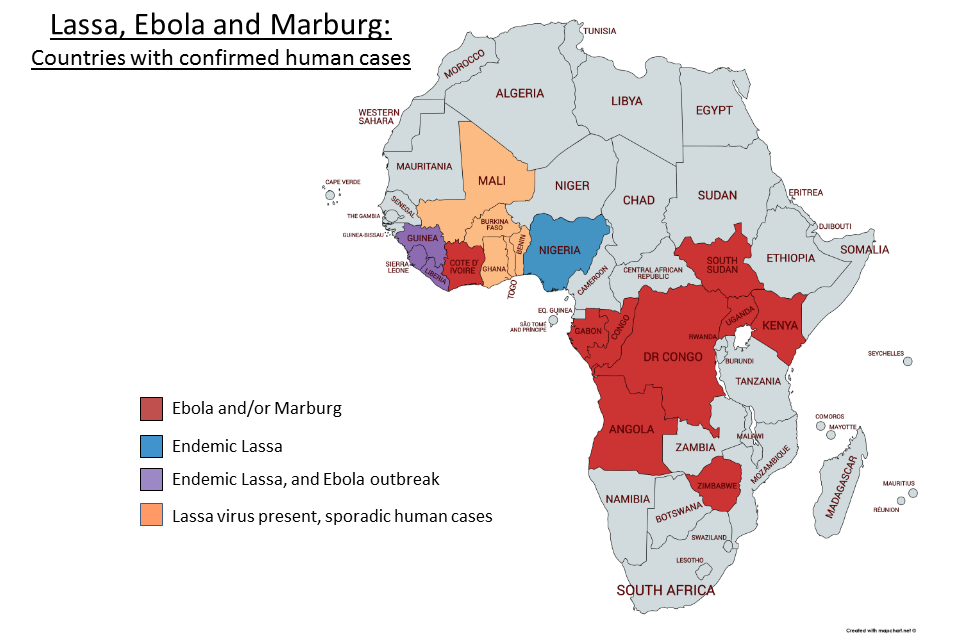
🧬 Aetiology
- Zaire orthoebolavirus
- Sudan orthoebolavirus
- Tai Forest orthoebolavirus
- Bundibugyo orthoebolavirus
- Reston orthoebolavirus – causes disease in nonhuman primates and pigs, but is not known to cause disease in people
🩺 Clinical Features
- Incubation period: 2–21 days, usually around 8–10 days.
- Sudden fever, fatigue, severe headache, myalgia, and sore throat.
- Vomiting, diarrhoea, abdominal pain, and weakness.
- Sometimes rash, impaired liver/kidney function, and less commonly internal or external bleeding.
🔎 Investigations
- PCR testing is central to diagnosis in acute infection.
- Antigen detection and ELISA-based methods may also be used.
- IgM and IgG antibody testing is more useful later in disease or after recovery.
- Testing should follow specialist public health / high-consequence infectious disease pathways.
💊 Management
- Supportive care: IV fluids, electrolyte correction, oxygen support, and blood pressure support.
- Treat co-infections and complications promptly.
- For disease caused by Zaire orthoebolavirus, monoclonal antibody treatments such as Inmazeb and Ebanga are available in specialist settings.
- Recovery depends on early supportive care, complication management, and immune response.
- Virus may persist in semen; in the absence of semen testing, safer sex precautions are advised for 12 months.
📚 References
