
| Download the amazing global Makindo app: ✅ Means NICE/National Guidelines 2026 compliant Android | Apple | |
|---|---|
| MEDICAL DISCLAIMER: Educational use only. Not for diagnosis or management. See below for full disclaimer. |
Gerstmann-Straussler-Scheinker Syndrome (GSS)
Related Subjects: |Dementias |Gerstmann-Straussler-Scheinker Syndrome (GSS) |Fatal Familial Insomnia (FFI) |Creutzfeldt Jakob disease (CJD) |Variant Creutzfeldt Jakob disease (vCJD) |Kuru
🧠 Gerstmann–Sträussler–Scheinker Syndrome (GSS) is a very rare inherited prion disease. It is classified as a transmissible spongiform encephalopathy (TSE), producing a sponge-like appearance of the brain due to neuronal loss and vacuolation. ⚠️ Do not confuse with Gerstmann syndrome (a different cortical syndrome).
📌 About
- Extremely rare prion disease (<1 in 10 million worldwide).
- Belongs to the family of transmissible spongiform encephalopathies (TSEs) alongside CJD and Fatal Familial Insomnia.
- Always inherited – reported in only a few families globally.
🧬 Aetiology
- Autosomal dominant inheritance.
- Caused by mutations in the PRNP gene encoding prion protein.
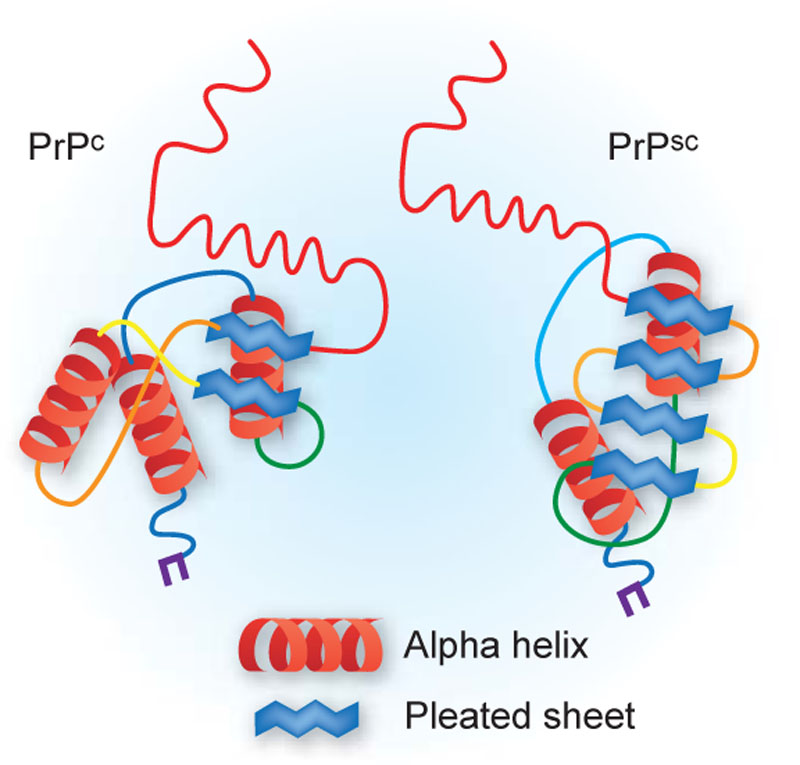
- Mutated prion protein misfolds into PrPSc, which accumulates in brain tissue causing neurodegeneration.
🩺 Clinical Features
- Onset: typically 35–55 years.
- 🎤 Dysarthria and cerebellar ataxia are often early features.
- Wide-based gait, truncal instability, recurrent falls.
- Nystagmus and spasticity.
- Gradual cognitive impairment → dementia.
- Late features: blindness, deafness, painful sensory phenomena (hyperpathia / burning pain).
🔎 Investigations
- EEG: Usually non-specific (unlike CJD which may show PSWCs).
- MRI/CT: Cerebellar atrophy most consistent finding.
- Genetic testing: Definitive – identifies PRNP mutation.
💊 Management
- No curative therapy – prognosis poor, survival 2–10 years after onset.
- Supportive management: physiotherapy, speech therapy, aids for mobility.
- Palliative care for progressive disability, aspiration pneumonia, coma.
📚 References
| The content on this website is provided for educational and informational purposes only to support exam preparation (e.g., MLA, MRCP, USMLE) and learning. This is NOT medical advice, diagnosis, treatment, or professional guidance. It does not replace consultation with a qualified healthcare professional, official guidelines (e.g., NICE, GMC, BNF), or supervised clinical practice. Always verify information with current, authoritative sources. Makindo and its contributors accept no liability for any reliance on this content, including errors, omissions, or any resulting harm, loss, or consequences. By using this site, you agree to these terms. |
|
|
Categories
- About
- Acute Medicine
- Anaesthetics and Critical Care
- Anatomy
- Anatomy and Physiology
- Biochemistry
- Book
- Cardiology
- Collections
- CompSci
- Crib Sheets
- Critical care
- Dental
- Dermatology
- Differentials
- Drugs
- ENT
- Electrocardiogram
- Embryology
- Emergency Medicine
- Endocrinology
- Ethics
- Foundation Doctors
- GCSE
- Gastroenterology
- General Practice
- Genetics
- Geriatric Medicine
- Geriatrics
- Guidelines
- Haematology
- Hepatology
- Immunology
- Infectious Diseases
- Infographic
- Investigations
- Lists
- MRCP
- Mandatory Training
- Medical Students
- Microbiology
- Nephrology
- Neurology
- Neurosurgery
- Nutrition
- OSCE
- Obstetrics Gynaecology
- Oncology
- Ophthalmology
- Oral Medicine and Dentistry
- Orthopaedics
- Paediatrics
- Palliative
- Palliative Care
- Pathology
- Pharmacology
- Physiology
- Procedures
- Psychiatry
- Public Health
- Radiology
- Respiratory
- Resuscitation
- Revision Topics
- Rheumatology
- Statistics and Research
- Stroke
- Surgery
- Toxicology
- Trauma and Orthopaedics
- USMLE
- Urology
- Vascular Surgery