
| Download the amazing global Makindo app: Android | Apple | |
|---|---|
| MEDICAL DISCLAIMER: Educational use only. Not for diagnosis or management. See below for full disclaimer. |
Anatomy of the Cervical Spine Vertebrae C1 (Atlas) and C2 (Axis)
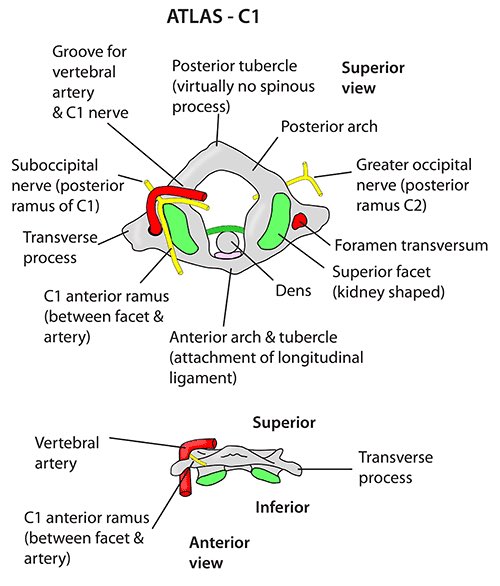
C1 - Atlas
- Structure : C1, known as the atlas, is the first cervical vertebra. It is ring-shaped and uniquely designed to support the skull.
- Key Features :
- Anterior Arch : Forms the front portion, about one-fifth of the ring. It has an articular facet for the dens of C2, creating a pivot joint.
- Posterior Arch : Covers the back portion, around two-fifths of the ring. It lacks a spinous process but has a small posterior tubercle.
- Lateral Masses : Positioned on each side, these structures bear the weight of the skull. Each lateral mass has a superior articular facet that articulates with the occipital condyles, enabling nodding and flexion-extension movements.
C2 - Axis
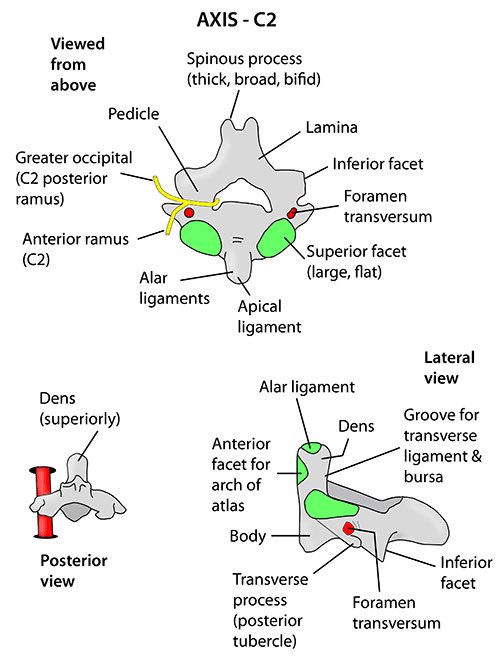
- Structure : C2, or the axis, is the second cervical vertebra. It serves as a pivot that allows the head and atlas to rotate.
- Key Features :
- Dens (Odontoid Process) : A peg-like projection that extends upward from the body of C2. It fits into the anterior arch of C1, creating the atlanto-axial joint, which allows for rotational movement.
- Superior Articular Facets : Located on either side of the dens, they articulate with the inferior articular facets of C1, supporting head rotation.
- Spinous Process : The first prominent spinous process in the cervical spine, often palpable at the base of the neck.
| The content on this website is provided for educational and informational purposes only to support exam preparation (e.g., MLA, MRCP, USMLE) and learning. This is NOT medical advice, diagnosis, treatment, or professional guidance. It does not replace consultation with a qualified healthcare professional, official guidelines (e.g., NICE, GMC, BNF), or supervised clinical practice. Always verify information with current, authoritative sources. Makindo and its contributors accept no liability for any reliance on this content, including errors, omissions, or any resulting harm, loss, or consequences. By using this site, you agree to these terms. |
|
|
Categories
- About
- Acute Medicine
- Anaesthetics and Critical Care
- Anatomy
- Anatomy and Physiology
- Biochemistry
- Book
- Cardiology
- Collections
- CompSci
- Crib Sheets
- Critical care
- Dental
- Dermatology
- Differentials
- Drugs
- ENT
- Electrocardiogram
- Embryology
- Emergency Medicine
- Endocrinology
- Ethics
- Foundation Doctors
- GCSE
- Gastroenterology
- General Practice
- Genetics
- Geriatric Medicine
- Geriatrics
- Guidelines
- Haematology
- Hepatology
- Immunology
- Infectious Diseases
- Infographic
- Investigations
- Lists
- MRCP
- Mandatory Training
- Medical Students
- Microbiology
- Nephrology
- Neurology
- Neurosurgery
- Nutrition
- OSCE
- Obstetrics Gynaecology
- Oncology
- Ophthalmology
- Oral Medicine and Dentistry
- Orthopaedics
- Paediatrics
- Palliative
- Palliative Care
- Pathology
- Pharmacology
- Physiology
- Procedures
- Psychiatry
- Public Health
- Radiology
- Respiratory
- Resuscitation
- Revision Topics
- Rheumatology
- Statistics and Research
- Stroke
- Surgery
- Toxicology
- Trauma and Orthopaedics
- USMLE
- Urology
- Vascular Surgery