Acute Medicine: Electrolytes, acid–base, AKI and metabolic emergencies
🩺 Electrolytes, acid–base, AKI and metabolic emergencies -page 6 of the Acute Medicine and Resuscitation chapter. Abnormal blood results are among the commonest reasons junior doctors are called. Most can wait for the morning -but severe hyperkalaemia, hyponatraemia with seizures, DKA and AKI need action now. Knowing which results are dangerous, how fast to correct them, and how to find the cause is core acute medicine. Detailed physiology is in the Renal and Endocrinology Anatomy, Physiology and Pharmacology chapters; this page covers the acute approach.
Your four questions for every abnormal result: Is it real (haemolysis, drip arm, wrong patient)? Is it dangerous right now -what does the ECG or the patient show? What is the cause (drugs are common)? How fast is it safe to correct?
Metabolic Acidosis and the Anion Gap
- Metabolic acidosis -low pH with low bicarbonate (and negative base excess); compensation by hyperventilation (low PaCO2 -Kussmaul breathing).
- Anion gap = Na+ − (Cl− + HCO3−) -normal about 8–16 mmol/L (some labs include potassium -about 10–20); low albumin lowers the gap (adjust).
- Raised anion gap (extra unmeasured acids):
- Lactic acidosis -shock, sepsis, hypoxia, ischaemic bowel, seizures, metformin, liver failure, cyanide, CO.
- Ketoacidosis -DKA, alcoholic ketoacidosis, starvation ketoacidosis, SGLT2 inhibitor-associated (euglycaemic) DKA.
- Kidney failure (uraemia).
- Toxins -methanol, ethylene glycol, salicylate, paracetamol (massive -pyroglutamic acid in malnourished), iron, isoniazid.
- Mnemonic -"MUDPILES" or "GOLDMARK" (Glycols, Oxoproline, L-lactate, D-lactate, Methanol, Aspirin, Renal failure, Ketoacidosis).
- Normal anion gap (hyperchloraemic) -loss of bicarbonate or gain of chloride:
- GI losses -diarrhoea, high-output ileostomy, pancreatic fistula, ureterosigmoidostomy.
- Renal tubular acidosis (types 1, 2, 4), acetazolamide.
- Excess 0.9% sodium chloride infusion.
- Addison's disease (type 4 RTA pattern -high potassium).
- Treatment -treat the cause (fluids, insulin, antibiotics, dialysis, antidotes); sodium bicarbonate only in specific situations (severe acidosis with AKI, certain poisonings, hyperkalaemia, normal anion gap acidosis with bicarbonate loss).
Metabolic Alkalosis
- Metabolic alkalosis -high pH with high bicarbonate; compensation by hypoventilation (raised PaCO2 -limited).
- Causes:
- Loss of acid -vomiting, nasogastric suction (hypochloraemic, hypokalaemic alkalosis -e.g. pyloric stenosis in infants).
- Diuretics (loop and thiazide) -"contraction alkalosis" with hypokalaemia.
- Mineralocorticoid excess -Conn's syndrome, Cushing's syndrome, liquorice (hypertension, hypokalaemia).
- Severe hypokalaemia.
- Bartter and Gitelman syndromes; milk-alkali syndrome (calcium and antacids); excess bicarbonate.
- Post-hypercapnic -after rapid correction of chronic CO2 retention (ventilation in COPD).
- Urine chloride helps -low (under 20 mmol/L) in vomiting and past diuretic use (chloride-responsive -give saline and potassium); high in mineralocorticoid excess and current diuretics.
- Features -often none; severe -confusion, arrhythmias, tetany (low ionised calcium), hypoventilation.
- Treatment -treat the cause; 0.9% sodium chloride with potassium for volume and chloride depletion; stop diuretics; potassium-sparing diuretics or treatment of the cause in mineralocorticoid excess.
Working Through Acid–base Problems
| Blood gas | Interpretation | Likely cause |
|---|---|---|
| pH 7.12, PaCO2 2.4, HCO3 6, glucose 28, ketones 6 | Metabolic acidosis (high anion gap) with respiratory compensation | DKA |
| pH 7.21, PaCO2 3.1, HCO3 11, lactate 8, BP 80/45 | Lactic acidosis | Septic shock |
| pH 7.30, PaCO2 3.8, HCO3 15, anion gap 12, diarrhoea | Normal anion gap metabolic acidosis | GI bicarbonate loss |
| pH 7.52, PaCO2 6.2, HCO3 38, K 2.8, vomiting | Metabolic alkalosis with partial compensation | Vomiting (pyloric obstruction) |
| pH 7.48, PaCO2 2.9, HCO3 16, tinnitus | Mixed respiratory alkalosis and metabolic acidosis | Salicylate poisoning |
| pH 7.26, PaCO2 9.2, HCO3 30, COPD | Acute-on-chronic respiratory acidosis | COPD exacerbation -NIV |
| pH 7.18, PaCO2 8.0, HCO3 22, RR 6, pinpoint pupils | Acute respiratory acidosis | Opioid toxicity |
| pH 7.55, PaCO2 3.0, HCO3 25, tingling fingers | Acute respiratory alkalosis | Hyperventilation -exclude PE, sepsis, pain first |
| Raised osmolar gap and anion gap, "drunk" without alcohol smell | High anion gap acidosis with osmolar gap | Ethylene glycol or methanol |
Hyperkalaemia
- Severity (UK Kidney Association) -mild 5.5–5.9, moderate 6.0–6.4, severe 6.5 mmol/L or more (or any level with ECG changes).
- Exclude pseudohyperkalaemia -haemolysed sample, delayed processing, very high platelets or white cells, drip arm, fist clenching -repeat urgently (but treat if ECG changes or high risk).
- Causes -AKI and CKD, drugs (ACE inhibitors, ARBs, spironolactone, amiloride, trimethoprim, NSAIDs, potassium supplements, heparin, ciclosporin, digoxin toxicity), acidosis (DKA), tissue breakdown (rhabdomyolysis, tumour lysis, haemolysis, burns, GI bleeding), Addison's disease, missed dialysis.
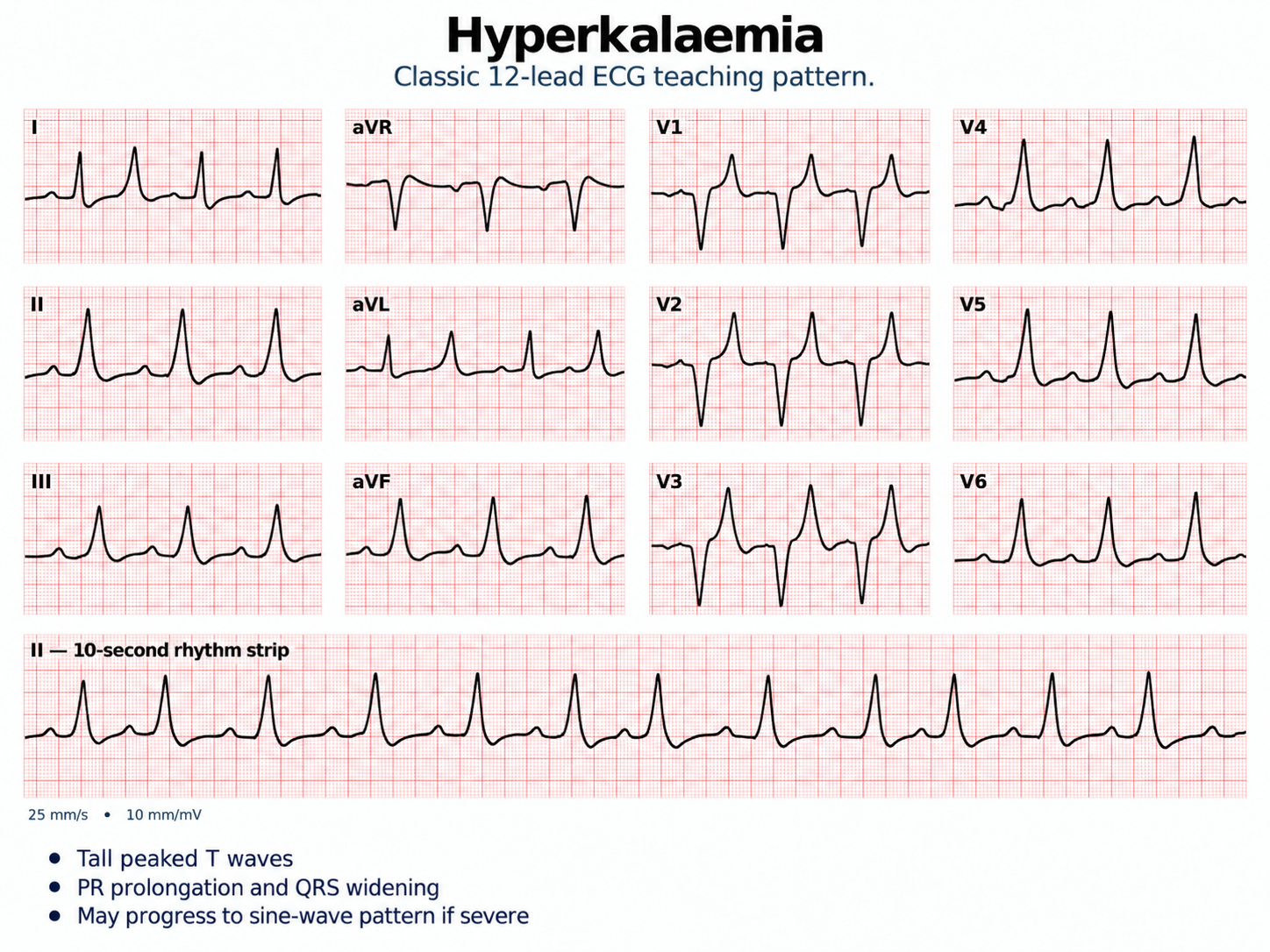
- ECG changes (may be absent even with severe hyperkalaemia) -tall tented T waves → flattened or absent P waves, prolonged PR → broad QRS → "sine wave" → VF or asystole; also bradycardia and heart block.
- Treatment (severe or ECG changes):
- Protect the heart -IV calcium -10% calcium gluconate 30 mL (or 10% calcium chloride 10 mL) over 5–10 minutes; repeat if ECG changes persist (works in minutes; lasts 30–60 minutes; doesn't lower potassium).
- Shift potassium into cells -10 units soluble insulin (Actrapid) with 25 g glucose (e.g. 50 mL of 50% or 250 mL of 10%) over 15 minutes -lowers potassium by about 1 mmol/L within 30–60 minutes; monitor glucose for 6 hours (hypoglycaemia is common -give a glucose infusion if pre-treatment glucose is low); nebulised salbutamol 10–20 mg as an adjunct.
- Remove potassium from the body -sodium zirconium cyclosilicate or patiromer (potassium binders); treat the cause; dialysis for refractory hyperkalaemia, especially with AKI or ESRD.
- Stop contributing drugs; continuous cardiac monitoring; recheck potassium at 1, 2, 4, 6 and 24 hours.
- Sodium bicarbonate -consider only with severe metabolic acidosis (specialist).
- Calcium in digoxin toxicity -traditionally avoided; use DigiFab for digoxin-induced hyperkalaemia.
Hypokalaemia
- Severity -mild 3.0–3.4, moderate 2.5–2.9, severe under 2.5 mmol/L (or symptomatic).
- Causes:
- GI losses -diarrhoea, vomiting (also via alkalosis), laxative abuse, high-output stoma, villous adenoma.
- Renal losses -loop and thiazide diuretics (commonest), mineralocorticoid excess (Conn's, Cushing's, liquorice, steroids), hypomagnesaemia, RTA (types 1 and 2), Bartter and Gitelman syndromes, DKA treatment.
- Shift into cells -insulin, salbutamol (high doses), theophylline, alkalosis, refeeding, thyrotoxic periodic paralysis.
- Poor intake (with other factors).
- Features -weakness, cramps, constipation and ileus, palpitations and arrhythmias (worse with digoxin and heart disease), rhabdomyolysis (severe).
- ECG -flattened T waves, ST depression, U waves, prolonged QT, arrhythmias (VT, torsades).
- Treatment:
- Mild -oral potassium (e.g. Sando-K 2 tablets 2–3 times daily) and treat the cause; consider potassium-sparing diuretics.
- Severe or symptomatic -IV potassium in pre-mixed bags (e.g. 40 mmol KCl in 1 L 0.9% sodium chloride), no faster than 10 mmol/hour peripherally (higher rates only with cardiac monitoring per local policy).
- Check and replace magnesium -hypokalaemia won't correct until magnesium is normal.
- Monitor potassium regularly (daily or more often).
- Hypokalaemia with hypertension -think primary hyperaldosteronism (Conn's) -aldosterone/renin ratio.
Hyponatraemia
- The commonest electrolyte disorder in hospital -sodium under 135 mmol/L; severe under 125, or with severe symptoms at any level.
- Symptoms depend on speed and level -nausea, headache, confusion, falls, gait problems (chronic mild); severe -vomiting, seizures, reduced consciousness, cardiorespiratory arrest (acute or very low).
- Assessment:
- Exclude pseudohyponatraemia (high lipids or protein) and hyperglycaemia (shifts water -corrected sodium).
- Serum osmolality -true hypotonic hyponatraemia under 275 mOsm/kg.
- Volume status -hypovolaemic, euvolaemic or hypervolaemic.
- Urine osmolality and urine sodium (paired, before treatment if possible).
- Causes:
Volume Causes Urine sodium Hypovolaemic Diuretics (thiazides), vomiting, diarrhoea, Addison's disease, cerebral salt wasting High (renal losses) or low under 20 (GI losses) Euvolaemic SIADH (pneumonia, lung cancer, CNS disease, pain, nausea, drugs -SSRIs, carbamazepine, PPIs, opioids, cyclophosphamide), hypothyroidism, glucocorticoid deficiency, low solute intake ("tea and toast"), primary polydipsia, beer potomania, MDMA Usually high (over 30) in SIADH; low in polydipsia and low solute Hypervolaemic Heart failure, cirrhosis, nephrotic syndrome, advanced CKD Low (unless on diuretics) - Severe symptoms (seizures, coma, vomiting) -hypertonic saline: 150 mL of 2.7% or 3% sodium chloride over 20 minutes, repeat up to 2–3 times (checking sodium) to raise sodium by about 5 mmol/L -in HDU or ICU with frequent monitoring (European guideline).
- Correction limits -no more than 10 mmol/L in the first 24 hours (and 8 mmol/L in each subsequent 24 hours); 8 mmol/L in 24 hours in high-risk patients (alcohol excess, malnutrition, hypokalaemia, liver disease, sodium under 120) -risk of osmotic demyelination syndrome (dysarthria, dysphagia, quadriparesis, locked-in -days later). If over-correction occurs -relower with 5% glucose and/or desmopressin (specialist).
- Treatment by cause -hypovolaemic: 0.9% sodium chloride (watch for rapid rise as ADH switches off); SIADH: fluid restriction (e.g. 0.5–1 L/day), stop drugs, treat cause, tolvaptan or urea (specialist); hypervolaemic: fluid restriction, treat heart or liver failure; adrenal or thyroid replacement where needed.
Hypernatraemia
- Sodium over 145 mmol/L -almost always a water deficit (losing water or not drinking enough), rarely sodium excess.
- Who -older, frail, confused or immobile people who can't access water; infants; ICU patients; people with diabetes insipidus.
- Causes:
- Inadequate intake -dementia, delirium, stroke, care home residents, nil by mouth.
- Water losses -fever, sweating, burns, diarrhoea, osmotic diuresis (hyperglycaemia -HHS), diabetes insipidus (cranial -head injury, pituitary surgery; nephrogenic -lithium, hypercalcaemia, hypokalaemia).
- Sodium gain (rare) -hypertonic saline or sodium bicarbonate, salt ingestion.
- Features -thirst (if able), confusion, drowsiness, irritability, seizures, coma; high mortality in older inpatients.
- Treatment -replace water -oral water if possible; otherwise IV 5% glucose (or 0.45% saline if also volume-depleted -0.9% saline first if shocked); correct slowly -no more than about 10 mmol/L in 24 hours in chronic hypernatraemia (risk of cerebral oedema); monitor sodium every 4–6 hours initially; treat the cause (desmopressin for cranial DI).
Hypercalcaemia
- Adjusted calcium over 2.6 mmol/L; severe over 3.0–3.5 or symptomatic.
- Causes -primary hyperparathyroidism (commonest in the community; PTH normal or raised) and malignancy (commonest in hospital; PTH suppressed) -together about 90%:
- Malignancy -PTHrP (squamous cell lung, breast, kidney), bone metastases, myeloma, lymphoma (vitamin D).
- Others -vitamin D excess, sarcoidosis and granulomatous disease, thiazides, lithium, milk-alkali syndrome, thyrotoxicosis, immobilisation, Addison's disease, familial hypocalciuric hypercalcaemia.
- Features -"bones, stones, groans, thrones and psychiatric overtones" -bone pain, kidney stones, abdominal pain, constipation, nausea, pancreatitis, polyuria and thirst (dehydration), confusion, low mood, drowsiness; short QT, arrhythmias.
- Investigations -PTH (key), U&E, phosphate, ALP, vitamin D, protein electrophoresis, chest X-ray, myeloma screen, PTHrP, imaging for malignancy.
- Acute treatment (severe or symptomatic):
- IV fluids -0.9% sodium chloride (e.g. 3–4 L over 24 hours, adjusted for heart and kidney function) -the most important step.
- IV bisphosphonate after rehydration -zoledronic acid 4 mg (or pamidronate) -works over 2–4 days; adjust in kidney impairment.
- Stop thiazides, calcium and vitamin D supplements, lithium.
- Others -denosumab (refractory or kidney failure), calcitonin (short-term), steroids (granulomatous disease, lymphoma, vitamin D toxicity), cinacalcet (parathyroid causes), dialysis (severe with kidney failure).
Hypocalcaemia
- Adjusted calcium under 2.2 mmol/L; severe under 1.9 or symptomatic. Check albumin (adjusted calcium) or ionised calcium on a blood gas.
- Causes -vitamin D deficiency, CKD, hypoparathyroidism (after thyroid or parathyroid surgery, autoimmune, hungry bone syndrome), hypomagnesaemia (PPIs, alcohol, diuretics), acute pancreatitis, rhabdomyolysis, tumour lysis, massive transfusion (citrate), drugs (bisphosphonates, denosumab, cinacalcet, foscarnet), sepsis, alkalosis (low ionised calcium).
- Features -perioral and peripheral tingling, muscle cramps, tetany, Trousseau's sign (carpal spasm with BP cuff), Chvostek's sign (facial twitch), laryngospasm, seizures, prolonged QT, arrhythmias, heart failure; chronic -cataracts, basal ganglia calcification.
- Treatment:
- Severe or symptomatic -IV calcium gluconate 10% -10–20 mL in 50–100 mL of 5% glucose over 10 minutes with ECG monitoring, then an infusion (e.g. 100 mL of 10% calcium gluconate in 1 L over 24 hours, adjusted to levels) (Society for Endocrinology).
- Correct magnesium first or at the same time (PTH needs magnesium).
- Mild -oral calcium and vitamin D (colecalciferol for deficiency; alfacalcidol or calcitriol in hypoparathyroidism and CKD).
- Avoid IV calcium extravasation (tissue necrosis) -use a large vein; don't mix with bicarbonate (precipitates).
Magnesium and Phosphate
- Hypomagnesaemia (under 0.7 mmol/L; severe under 0.4):
- Causes -PPIs (long-term), diuretics, alcohol, diarrhoea, high-output stoma, malnutrition, refeeding, aminoglycosides, ciclosporin and tacrolimus, cisplatin.
- Features -tremor, tetany, seizures, arrhythmias (torsades), refractory hypokalaemia and hypocalcaemia.
- Treatment -oral magnesium (diarrhoea) for mild; IV magnesium sulfate (e.g. 20 mmol over 4–12 hours; 8 mmol (2 g) over 10–15 minutes for torsades or seizures); stop or switch PPI.
- Hypermagnesaemia -usually kidney failure plus magnesium-containing laxatives or antacids, or magnesium treatment in pre-eclampsia -loss of reflexes, weakness, hypotension, respiratory depression, heart block -stop magnesium; IV calcium gluconate; dialysis.
- Hypophosphataemia (under 0.8; severe under 0.3):
- Causes -refeeding syndrome, alcohol, DKA treatment, malnutrition, vitamin D deficiency, hyperparathyroidism, IV iron (ferric carboxymaltose), respiratory alkalosis.
- Features -weakness (including respiratory muscles -failure to wean), confusion, haemolysis, heart failure, rhabdomyolysis.
- Treatment -oral (Phosphate Sandoz) or IV phosphate for severe or symptomatic (careful in kidney impairment); prevent refeeding syndrome (slow feeding, thiamine, monitor).
- Hyperphosphataemia -CKD, tumour lysis, rhabdomyolysis -phosphate binders; dialysis.
Acute Kidney Injury -Definition and Causes
- AKI -a rapid fall in kidney function (KDIGO):
Stage Serum creatinine Urine output 1 Rise of 26.5 µmol/L or more within 48 hours, or 1.5–1.9 times baseline (within 7 days) Under 0.5 mL/kg/hour for 6–12 hours 2 2.0–2.9 times baseline Under 0.5 mL/kg/hour for 12 hours or more 3 3 times baseline or more, or creatinine 354 µmol/L or more, or starting renal replacement therapy Under 0.3 mL/kg/hour for 24 hours or more, or anuria for 12 hours - Causes:
- Pre-renal (commonest) -hypovolaemia (dehydration, bleeding), sepsis, hypotension, heart failure, cirrhosis (hepatorenal), drugs (NSAIDs, ACE inhibitors, ARBs, diuretics).
- Intrinsic (renal) -acute tubular necrosis (prolonged hypoperfusion, sepsis, nephrotoxins -aminoglycosides, contrast, rhabdomyolysis), glomerulonephritis (vasculitis, anti-GBM, lupus -blood and protein on dipstick), acute interstitial nephritis (drugs -PPIs, NSAIDs, antibiotics), myeloma, thrombotic microangiopathy (HUS, TTP), malignant hypertension.
- Post-renal (obstruction) -prostatic enlargement, urinary retention (anticholinergics, constipation), stones, pelvic tumours, retroperitoneal fibrosis, blocked catheter.
- Risk factors -older age, CKD, diabetes, heart failure, liver disease, sepsis, nephrotoxic drugs, contrast, major surgery.
Managing AKI
- Assess (NICE NG148):
- Volume status (dehydrated, euvolaemic, overloaded), BP, urine output (catheter in severe AKI).
- Drug review -stop nephrotoxins and drugs that accumulate (see the Clinical Pharmacology chapter).
- Urine dipstick -blood and protein suggest glomerular disease (send urine PCR, consider ANCA, anti-GBM, ANA, complement, immunoglobulins -urgent nephrology).
- Bloods -U&E, potassium, bicarbonate (blood gas), calcium, phosphate, FBC, CK (rhabdomyolysis), LFTs.
- Renal tract ultrasound within 24 hours if obstruction is suspected, or the cause is unclear (within 6 hours if infected obstructed kidney suspected -pyonephrosis).
- Treat:
- Fluids if hypovolaemic (500 mL boluses with reassessment); avoid overload.
- Treat sepsis and the cause.
- Relieve obstruction -catheter (watch for post-obstructive diuresis), nephrostomy or stent.
- Manage complications -hyperkalaemia, acidosis, fluid overload.
- Monitor -daily U&E, fluid balance, weights.
- Indications for urgent renal replacement therapy (dialysis or haemofiltration) -"AEIOU":
- Acidosis -severe metabolic acidosis (pH under 7.15–7.2) not responding to treatment.
- Electrolytes -refractory hyperkalaemia.
- Intoxication -dialysable poisons (lithium, methanol, ethylene glycol, salicylate).
- Overload -fluid overload (pulmonary oedema) not responding to diuretics.
- Uraemia -encephalopathy, pericarditis, bleeding.
- Refer to nephrology -stage 3 AKI, suspected glomerular disease or intrinsic cause, AKI not responding to treatment, complications, kidney transplant or CKD stage 4–5.
- After AKI -follow up kidney function (risk of CKD), restart withheld drugs carefully, sick day rule advice.
Rhabdomyolysis
- Muscle breakdown releasing myoglobin, potassium, phosphate and CK.
- Causes -long lie after falls, crush injury, prolonged seizures, extreme exercise, hyperthermia (heat stroke, NMS, serotonin syndrome, MDMA), drugs and toxins (statins -especially with fibrates or clarithromycin, cocaine, amphetamines, alcohol, antipsychotics), infections (influenza), hypokalaemia and hypophosphataemia, compartment syndrome, inherited myopathies.
- Features -muscle pain, weakness, swelling, dark ("cola") urine; may be asymptomatic.
- Tests -CK (over 5 times normal; often over 10,000 in significant cases), urine dipstick positive for blood without red cells on microscopy (myoglobin), U&E (AKI), potassium (high), phosphate (high), calcium (low early, high in recovery), LFTs.
- Complications -AKI, hyperkalaemia (arrhythmias), compartment syndrome, DIC.
- Treatment -aggressive IV fluids (crystalloid) aiming for a high urine output (e.g. 200–300 mL/hour -over 1–2 mL/kg/hour) while avoiding overload; treat hyperkalaemia; avoid nephrotoxins; stop causative drugs; check compartments (fasciotomy); dialysis if severe AKI. Bicarbonate and mannitol are not routinely recommended.
Diabetic Ketoacidosis
- Diagnosis (JBDS):
- Ketonaemia -blood ketones 3.0 mmol/L or more (or urine ketones 2+ or more).
- Blood glucose over 11 mmol/L or known diabetes (euglycaemic DKA occurs with SGLT2 inhibitors, pregnancy, starvation).
- Acidosis -venous pH under 7.3 and/or bicarbonate under 15 mmol/L.
- Triggers -new type 1 diabetes, missed insulin, infection, MI, surgery, pancreatitis, SGLT2 inhibitors, steroids, alcohol, pregnancy.
- Features -polyuria, thirst, vomiting, abdominal pain, Kussmaul breathing, ketotic breath, dehydration, drowsiness.
- Treatment (follow local DKA protocol):
- Fluids -0.9% sodium chloride (e.g. 1 L in the first hour, then reducing rates; 500 mL bolus if systolic under 90); care in young adults, older people, pregnancy, heart or kidney failure.
- Fixed-rate IV insulin infusion -0.1 units/kg/hour (soluble insulin); continue long-acting basal insulin.
- Potassium -add to fluids according to levels (none if over 5.5; 40 mmol/L if 3.5–5.5; senior review if under 3.5 -insulin will lower potassium).
- Add 10% glucose (e.g. at 125 mL/hour) when glucose falls below 14 mmol/L, continuing insulin until ketones clear.
- Monitor -hourly glucose and ketones; venous gas (pH, bicarbonate, potassium) at 1, 2 and 4 hours, then every 4 hours; aim for ketones to fall by at least 0.5 mmol/L/hour.
- Resolution -ketones under 0.6 and pH over 7.3 -switch to subcutaneous insulin with a meal (stop IV 30–60 minutes after).
- Complications -hypokalaemia, hypoglycaemia, cerebral oedema (children and young adults -headache, falling GCS), aspiration, VTE, ARDS.
- Severe DKA (ketones over 6, pH under 7.0, bicarbonate under 5, potassium abnormal, GCS under 12, hypotension) -HDU or ICU.
- Involve the diabetes team; education before discharge (sick day rules, ketone testing).
Hyperosmolar Hyperglycaemic State
- HHS -severe hyperglycaemia and dehydration without significant ketoacidosis, usually in older people with type 2 diabetes (may be the first presentation); develops over days; higher mortality than DKA.
- Features (JBDS) -marked hyperglycaemia (30 mmol/L or more), hypovolaemia, high osmolality (320 mOsm/kg or more -calculated as 2Na + glucose + urea), ketones under 3, pH over 7.3; confusion, drowsiness, seizures, focal signs.
- Triggers -infection, MI, stroke, drugs (steroids, thiazides), poor fluid intake.
- Treatment:
- IV 0.9% sodium chloride -the main treatment -replace fluid gradually over 24–48 hours (fluid deficits are large -100–200 mL/kg).
- Insulin only if ketones are raised (over 1) or glucose stops falling with fluids -low-dose fixed-rate insulin 0.05 units/kg/hour.
- Aim for slow falls -glucose by up to 5 mmol/L/hour; sodium by no more than 10 mmol/L in 24 hours; osmolality by 3–8 mOsm/kg/hour.
- VTE prophylaxis (high thrombosis risk), foot care, monitor potassium and kidney function, treat the cause.
- Sodium may rise initially as glucose falls -acceptable if osmolality is falling.
Adrenal and Thyroid Emergencies
- Adrenal crisis:
- In people with Addison's disease, hypopituitarism, or long-term steroid use (stopped suddenly, missed doses, or intercurrent illness without dose increase).
- Features -vomiting, abdominal pain, weakness, confusion, hypotension and shock, hyponatraemia, hyperkalaemia (primary), hypoglycaemia.
- Treatment -IV or IM hydrocortisone 100 mg immediately, then 200 mg over 24 hours (continuous infusion or 50 mg 6-hourly); IV 0.9% sodium chloride (1 L over the first hour); glucose; treat the trigger; don't delay treatment for tests (take a cortisol sample first if possible).
- Thyroid storm (thyrotoxic crisis):
- Triggered by infection, surgery, iodine, stopping antithyroid drugs, childbirth.
- Fever, tachycardia (AF), heart failure, agitation, delirium, vomiting and diarrhoea, jaundice.
- Treatment -propranolol (or esmolol), propylthiouracil or carbimazole, Lugol's iodine (at least 1 hour after the antithyroid drug), hydrocortisone, supportive care (cooling, fluids), treat the trigger; critical care.
- Myxoedema coma (severe hypothyroidism):
- Older people, often triggered by infection, cold, sedatives -hypothermia, bradycardia, hypotension, hypoventilation, hyponatraemia, hypoglycaemia, reduced consciousness.
- Treatment -IV hydrocortisone first (possible coexisting adrenal insufficiency), then thyroid hormone (IV liothyronine or levothyroxine, cautiously), passive rewarming, ventilatory support, treat infection.
- Pituitary apoplexy -sudden headache, visual loss, ophthalmoplegia -hydrocortisone, neurosurgery (see page 5).
- See the Endocrinology Emergencies chapter for detail.
Metabolic Emergencies at a Glance
| Problem | Danger signs | Immediate treatment |
|---|---|---|
| Hyperkalaemia | K 6.5 or more, or ECG changes | IV calcium; insulin–glucose; salbutamol; binders; dialysis |
| Hypokalaemia | K under 2.5, arrhythmias, weakness | IV KCl max 10 mmol/hour peripherally; correct magnesium |
| Hyponatraemia | Seizures, coma, vomiting | 150 mL hypertonic saline over 20 min (repeat); max 10 mmol/L in 24 h |
| Hypernatraemia | Confusion, coma in frail people | Water (oral or 5% glucose); slow correction |
| Hypercalcaemia | Over 3.0–3.5, confusion, dehydration | IV saline, then zoledronic acid; find cause (PTH) |
| Hypocalcaemia | Tetany, seizures, long QT | IV calcium gluconate; correct magnesium |
| Hypomagnesaemia | Torsades, refractory low K and Ca | IV magnesium sulfate |
| AKI stage 3 | Creatinine 3 times baseline, anuria | Fluids if dry, stop nephrotoxins, relieve obstruction, AEIOU dialysis |
| Rhabdomyolysis | CK over 10,000, dark urine, high K | Aggressive IV fluids; treat K |
| DKA | Ketones 3+, pH under 7.3, glucose over 11 | Fluids, insulin 0.1 units/kg/h, potassium, continue basal |
| HHS | Glucose 30+, osmolality 320+, no ketoacidosis | Slow IV saline; low-dose insulin only if needed; VTE prophylaxis |
| Adrenal crisis | Shock, low Na, high K, steroid user | Hydrocortisone 100 mg IV/IM; saline |
Spot the Diagnosis
| Clue | Diagnosis |
|---|---|
| K 7.1 with a normal ECG and a haemolysed sample | Possible pseudohyperkalaemia -repeat urgently |
| Tall tented T waves and broad QRS in a man on spironolactone with AKI | Severe hyperkalaemia -IV calcium now |
| Glucose 2.4 two hours after insulin–dextrose for hyperkalaemia | Treatment-induced hypoglycaemia |
| U waves and flat T waves after high-dose furosemide | Hypokalaemia |
| Potassium won't rise despite IV replacement | Low magnesium |
| Hypertension and hypokalaemia in a 45-year-old | Primary hyperaldosteronism |
| Sodium 118 with seizures | Severe symptomatic hyponatraemia -hypertonic saline |
| Euvolaemic hyponatraemia, high urine sodium and osmolality, lung mass | SIADH (small cell lung cancer) |
| Low sodium, high potassium and hypotension in a steroid user who stopped prednisolone | Adrenal crisis |
| Quadriparesis and dysarthria 3 days after sodium rose from 110 to 128 | Osmotic demyelination syndrome |
| Sodium 162 in a care home resident with dementia | Water deficit -hypernatraemia |
| Polyuria and high sodium on long-term lithium | Nephrogenic diabetes insipidus |
| Calcium 3.4, suppressed PTH, back pain and anaemia | Myeloma |
| Calcium 2.8 with high PTH and kidney stones | Primary hyperparathyroidism |
| Perioral tingling and Chvostek's sign the day after thyroidectomy | Post-surgical hypoparathyroidism |
| Low phosphate and heart failure after starting NG feeds in anorexia | Refeeding syndrome |
| Creatinine 3 times baseline with blood and protein on dipstick | Glomerulonephritis -urgent nephrology |
| AKI with rash, fever and eosinophilia on omeprazole | Acute interstitial nephritis |
| AKI with bilateral hydronephrosis and a large prostate | Post-renal obstruction |
| Dark urine, dipstick blood but no red cells, CK 40,000 | Rhabdomyolysis |
| Ketones 4.2 and pH 7.15 with glucose 9 on dapagliflozin | Euglycaemic DKA |
| Glucose 48, osmolality 360, no ketones, drowsy 80-year-old | HHS |
| Fever 40°C, AF 160 and delirium in a woman with Graves' disease after surgery | Thyroid storm |
| Hypothermia, bradycardia and coma with a very high TSH | Myxoedema coma |
Exam-style Scenarios
1. A 76-year-old man with CKD on ramipril and spironolactone feels weak. Potassium 7.2. ECG shows tall tented T waves and a broad QRS.
Answer: Severe hyperkalaemia with ECG changes.
- IV calcium gluconate 10% 30 mL over 5–10 minutes with cardiac monitoring (repeat if ECG changes persist).
- Insulin 10 units with 25 g glucose IV; salbutamol nebuliser; monitor glucose hourly for 6 hours; recheck potassium.
- Stop ramipril and spironolactone; potassium binder; treat AKI; nephrology for dialysis if refractory.
2. A 70-year-old woman with lung cancer is confused and has a seizure. Sodium 114 mmol/L; clinically euvolaemic.
Answer: Severe symptomatic hyponatraemia (probable SIADH).
- 150 mL of 3% (or 2.7%) sodium chloride over 20 minutes, recheck sodium, repeat up to 2–3 times aiming for a 5 mmol/L rise; HDU or ICU.
- Limit the rise to no more than 10 mmol/L in 24 hours (8 if high risk) -osmotic demyelination risk; check sodium every 2–4 hours.
- Paired urine osmolality and sodium, TFTs, cortisol; then fluid restriction and cause-specific treatment; review drugs.
3. A 68-year-old woman with breast cancer has confusion, constipation and thirst. Adjusted calcium 3.6 mmol/L, creatinine 160 (baseline 80).
Answer: Severe hypercalcaemia of malignancy with AKI.
- IV 0.9% sodium chloride (e.g. 3–4 L over 24 hours with monitoring for overload).
- After rehydration -IV zoledronic acid (dose adjusted for kidney function) or denosumab; stop thiazides and calcium.
- Check PTH (suppressed), PTHrP, bone imaging; oncology input; recheck calcium daily.
4. An 18-year-old with type 1 diabetes has vomiting and abdominal pain. Glucose 26, blood ketones 5.8, venous pH 7.08, bicarbonate 6, potassium 5.1.
Answer: Severe DKA.
- IV 0.9% sodium chloride (rapid initial litre if shocked); fixed-rate insulin 0.1 units/kg/hour; continue basal insulin.
- Add potassium 40 mmol/L to fluids (potassium 3.5–5.5); 10% glucose when glucose under 14; hourly glucose and ketones; gas at 1, 2, 4 hours.
- Severe features -HDU; find trigger (infection, missed insulin); diabetes team; watch for cerebral oedema in young people.
5. An 84-year-old man was found on the floor after 2 days. He is confused. Creatinine 340 (baseline 90), potassium 6.4, CK 52,000. Urine is dark brown.
Answer: Rhabdomyolysis with stage 3 AKI and hyperkalaemia.
- ECG; treat hyperkalaemia (calcium if ECG changes, insulin–glucose).
- Aggressive IV fluids aiming for a high urine output (catheter, hourly monitoring), balancing overload risk in an older patient; stop statins and nephrotoxins.
- Look for the cause of the fall and compartment syndrome; renal referral for dialysis if refractory (AEIOU); pressure care, delirium care.
Key Points
- Anion gap = Na − (Cl + HCO3); raised in lactic acidosis, ketoacidosis, kidney failure, toxic alcohols and salicylate.
- Normal anion gap acidosis -diarrhoea, RTA, excess saline.
- Metabolic alkalosis -vomiting, diuretics, mineralocorticoid excess.
- Hyperkalaemia -IV calcium protects the heart; insulin–glucose and salbutamol shift potassium; binders or dialysis remove it; watch glucose.
- Hypokalaemia -IV KCl no faster than 10 mmol/hour peripherally; correct magnesium.
- Hyponatraemia -assess osmolality, volume and urine sodium; hypertonic saline for severe symptoms; maximum 10 mmol/L rise in 24 hours (8 if high risk).
- Hypernatraemia means water deficit -replace slowly.
- Hypercalcaemia -PTH separates hyperparathyroidism from malignancy; fluids first, then bisphosphonate.
- Hypocalcaemia -IV calcium gluconate if severe; correct magnesium.
- AKI -KDIGO stages; pre-renal, intrinsic, post-renal; stop nephrotoxins, dipstick urine, ultrasound if obstruction.
- Urgent dialysis -AEIOU (acidosis, electrolytes, intoxication, overload, uraemia).
- Rhabdomyolysis -dark urine, dipstick blood without red cells, high CK -aggressive fluids.
- DKA -fluids, fixed-rate insulin 0.1 units/kg/hour, potassium, continue basal, add glucose under 14.
- HHS -slow fluid replacement; insulin only if ketones or glucose not falling; VTE prophylaxis.
- Adrenal crisis -hydrocortisone 100 mg IV/IM immediately.
Guidelines and Further Reading
- UK Kidney Association: Clinical practice guideline -treatment of acute hyperkalaemia in adults (2023)
- European Society of Endocrinology / ERA-EDTA: Clinical practice guideline on diagnosis and treatment of hyponatraemia
- Society for Endocrinology: Emergency guidance -acute hypercalcaemia, acute hypocalcaemia, acute hyponatraemia, adrenal crisis
- NICE NG148: Acute kidney injury -prevention, detection and management; KDIGO AKI guideline
- Joint British Diabetes Societies for Inpatient Care: Management of DKA in adults; Management of HHS in adults
- NICE CG32: Nutrition support for adults (refeeding syndrome)
- BNF: Fluids and electrolytes
- BNF -for current doses